In oilfield drilling and geological exploration, heavy-duty stabilizers are critical components of downhole drill strings. Their structural design directly affects drill string stability, wellbore trajectory control, and tool life. Heavy-duty operations place higher demands on stabilizers for load-bearing capacity and wear resistance, so design must balance mechanical performance, material strength, and the complexity of downhole conditions. Proper structural design allows heavy-duty stabilizers to maintain drill string posture under high pressure, intense vibration, and complex formations, optimizing the drilling process.
Blade Design and Support Characteristics
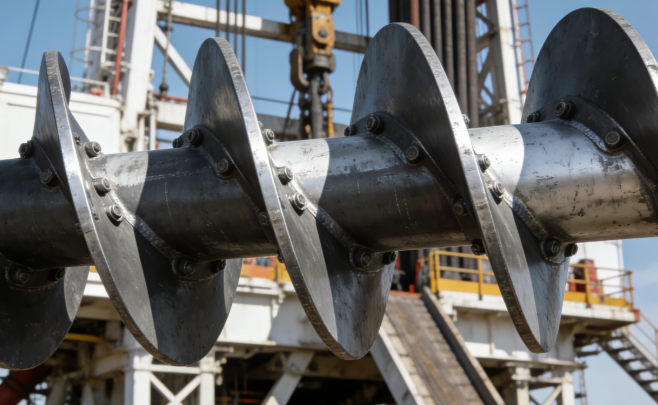
The blades of heavy-duty stabilizers are often thickened or designed with multiple blades to increase contact area with the wellbore and distribute drill string load. Blade structures must balance wear resistance and guiding ability, providing sufficient radial support during drilling. Proper blade arrangement reduces drill string wobble, lowers vibration amplitude, and improves bit penetration efficiency. Blade design features include:
- Thickened or multi-blade structure: Enhances contact area with the wellbore, increasing support and stability
- Optimized guiding shape: Controls drill string rotation and reduces bit deviation
By scientifically designing blade shape and quantity, heavy-duty stabilizers maintain the drill string along the central axis, minimize wellbore deviation, and reduce tool wear in complex formations and high-load conditions.
Stabilizer Body Structure and Material Selection
The stabilizer body is typically made of high-strength steel or alloy materials to withstand bending, torque, and impact loads during drilling. The design emphasizes a balance between rigidity and toughness, ensuring that blades provide adequate support while absorbing rotational and vibrational impacts. Key characteristics of the body structure include:
- Use of high-strength materials and heat treatment to improve load capacity and wear resistance
- Combining rigidity and toughness to resist vibration impacts and extend service life
Optimized material and structural design not only enhance durability but also ensure drill string posture stability in high-pressure, high-vibration environments, providing reliable support for downhole operations.
Internal Force Distribution and Load Optimization
Heavy-duty stabilizers must withstand complex radial, axial, and torsional forces during drilling. To ensure even load distribution, symmetrical blade layouts and multi-point contact designs are often used, dispersing forces across blades and the body to reduce local overload. Optimizing internal force distribution can slow wear on blades and the stabilizer body while improving trajectory control accuracy. Optimization measures include:
- Symmetrical blade placement to distribute load and enhance stability
- Optimized blade-to-body contact area to reduce local stress concentration
This design approach ensures balanced forces in heavy-duty stabilizers under complex formation conditions, improving drill string stability and downhole operational efficiency.
Modular Design and Maintainability
Modern heavy-duty stabilizers increasingly adopt modular designs, allowing blades and the body to be independently replaced or serviced, reducing maintenance costs and downtime. Modular designs also make it easier to adjust blade quantity and arrangement for different wellbore diameters and inclinations, enhancing operational flexibility. Key features of modular design include:
- Removable or replaceable blades to extend equipment life
- Customizable body design for wellbore diameter and formation type, improving adaptability
Through modular structure, operators can quickly adjust or maintain stabilizers, increasing drilling efficiency and improving equipment management.