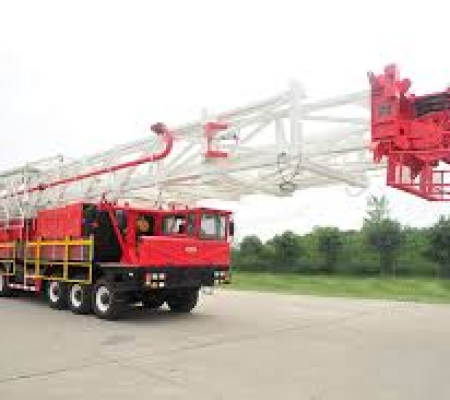
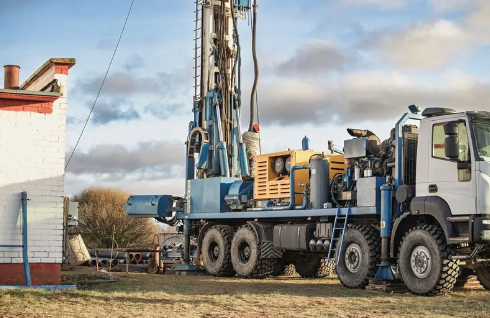
In modern drilling engineering, the mobility and environmental adaptability of equipment are becoming increasingly important, especially in projects with complex terrain and dispersed construction sites where traditional large fixed drilling rigs often struggle to meet rapid relocation requirements. Trailer-mounted drilling rigs, with their compact structure, convenient transportation, and flexible deployment, are now widely used in geological exploration, water well drilling, and foundation engineering. Different geological conditions require different drilling performance, and trailer-mounted drilling rigs demonstrate strong adaptability across a wide range of formations due to their flexible configuration capabilities.
Soft Soil and Loose Formations
In soft ground conditions, trailer-mounted drilling rigs emphasize drilling efficiency and rapid mobility.
- In clay, sand, and other soft formations, drilling resistance is relatively low, allowing trailer-mounted rigs to maintain high drilling speed
- The equipment weight is moderate, reducing the risk of ground collapse or vehicle sinking
- Suitable for farmland, water well, and shallow foundation construction projects
- Offers higher relocation efficiency in short-cycle and multi-site operations
Therefore, soft formations are among the most common application environments for trailer-mounted drilling rigs.
Gravel Layers and Medium-Hard Formations
In gravel or medium-hard formations, trailer-mounted drilling rigs must balance power output and operational stability.
- Different drill bits can be used to adapt to gravel, cobblestone, and other complex particle structures
- Medium-hard formations require higher torque, which trailer-mounted drilling rigs can generally provide
- Commonly used in highway foundation projects and geological exploration work
- Capable of continuous operation and suitable for medium-depth drilling projects
These geological conditions require strong overall equipment performance, and trailer-mounted drilling rigs offer good adaptability.
Rock Formations and Complex Geological Conditions
In hard rock or complex formations, trailer-mounted drilling rigs place greater demands on power systems and stability.
- High-strength drill bits can be equipped for hard rock crushing and improved drilling capability
- Drilling parameters can be adjusted flexibly in fault zones or alternating soft-hard formations
- Suitable for mountain geological surveys and mineral exploration projects
- Easier to relocate compared with large fixed drilling rigs, making them ideal for multi-area continuous construction
- Requires relatively lower road conditions for transportation in remote areas
Although drilling in complex formations is more difficult, trailer-mounted drilling rigs still maintain strong engineering adaptability.
Hydrogeological and Groundwater Projects
Trailer-mounted drilling rigs also have high practical value in water resource development projects.
- Flexible deployment in rural or remote area well-drilling projects allows rapid construction
- Used for groundwater exploration and aquifer analysis to improve water resource development efficiency
- Can quickly arrive at emergency water supply project sites
- Suitable for shallow and medium-depth groundwater development projects
Their mobility advantage makes them widely used in public utility engineering.
Complex Terrain and Special Construction Areas
The advantages of trailer-mounted drilling rigs in special terrain mainly lie in transportation and deployment flexibility.
- Easier to transport in mountainous or hilly areas with limited road access
- Can quickly relocate equipment in deserts, plateaus, and other challenging environments
- Requires less construction site space, making it suitable for narrow working areas
- Can be rapidly deployed and put into operation in temporary engineering projects
This high mobility gives trailer-mounted drilling rigs clear advantages in field operations.
With convenient transportation, flexible relocation capability, and strong geological adaptability, trailer-mounted drilling rigs have become an important part of modern drilling engineering equipment. From soft formations to complex rock layers, from groundwater projects to field exploration, they can provide stable performance according to different construction requirements. As the engineering industry continues to move toward higher efficiency and multi-scenario construction, trailer-mounted drilling rigs are also evolving toward greater intelligence, higher stability, and lower energy consumption, providing more flexible and efficient drilling solutions while improving overall construction efficiency and project economics.