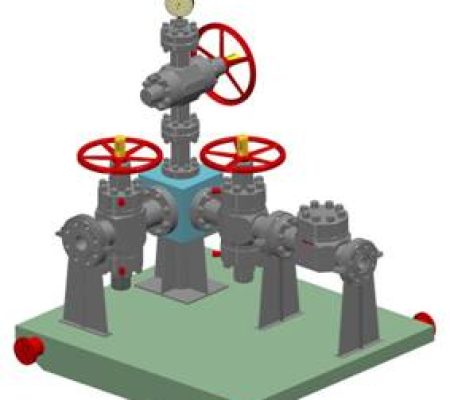
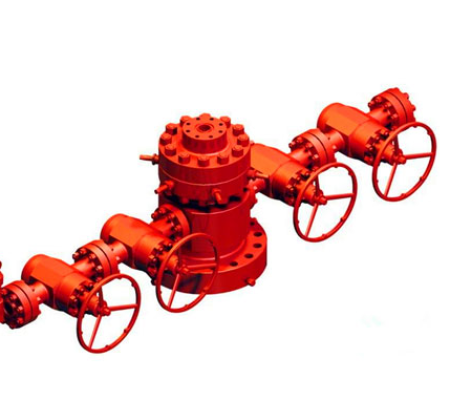
Christmas tree oilfield equipment at the wellhead is a key device in the well control system, used to control oil and gas flow, isolate pressure, and ensure production safety. Depending on the application environment, it is mainly divided into two types: dry Christmas trees and wet Christmas trees. The two differ significantly in installation location, maintenance methods, and applicable operating conditions.
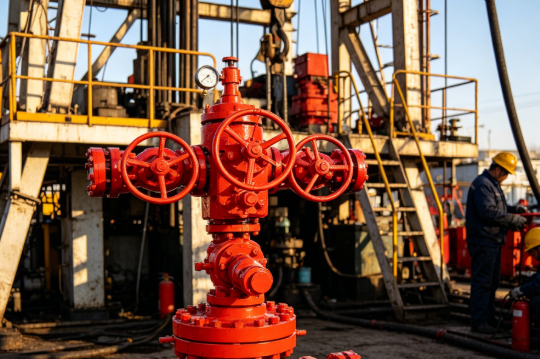
Key differences between dry and wet Christmas trees
What is a dry Christmas tree?
A dry Christmas tree is typically installed above the water surface (on a platform or inland wellhead), with the wellhead equipment always exposed to the air. After connecting to the wellbore, it directly controls oil and gas production through the wellhead equipment.
Its characteristics are:
· The equipment is located on the ground or platform.
· Easy for manual maintenance and inspection.
· Relatively low risk of environmental corrosion.
· More suitable for onshore oilfields or fixed platforms.
Because the equipment is visible and accessible, maintenance is more convenient, making it the most common type in traditional oil and gas development.
What is a wet Christmas tree?
Wet Christmas trees are installed on the seabed or in subsea environments, where the equipment is permanently submerged in seawater or well fluid and operated via a remote control system.
Characteristics include:
Installed on the seabed or at deep-water wellheads
Cannot be directly accessed by personnel
Reliant on underwater robots or remote systems for maintenance
Extremely high environmental pressure and corrosion. Wet systems are typically used in deep-sea oil and gas development and are a highly complex and technologically advanced wellhead control solution.
Operation and Maintenance Methods for the Two Types of Equipment
- Operation Procedure for Dry Christmas Trees
Operation of dry systems is relatively intuitive, allowing maintenance personnel direct contact with the equipment.
Typical procedures include:
· On-site closure of the main valve for wellhead isolation
· Releasing internal system pressure
· Manual valve operation and inspection
· Observing for leaks and pressure stability
· Replacing or maintaining necessary components.
Because the equipment is on the ground or platform, the maintenance process is relatively direct, allowing for quick problem identification.
- Operation Procedure for Wet Christmas Trees
Because wet systems are located on the seabed, all operations rely on remote systems.
A typical process includes:
· Sending commands via the surface control center
· Operating the wellhead valves using a hydraulic/electric control system
· Visual inspection using an ROV (Remotely Operated Vehicle)
· Monitoring pressure and flow using sensors
· Remote isolation or shutdown as needed.
The entire process cannot be directly intervened manually; therefore, the equipment must possess extremely high reliability.
Design and Operation Considerations
Technical Focus of Dry Systems
The core of a dry Christmas tree system lies in “easy maintenance + reliable sealing.”
Technical points include:
· Valve sealing structure design (preventing surface leakage)
· Pressure bearing capacity design (suitable for medium and high pressure)
· Manual/hydraulic hybrid control system
· Anti-corrosion coating and external protective structure
Due to the relatively controllable environment, the design focus leans towards ease of operation and maintenance efficiency.
Technical Focus of Wet Systems
Wet Christmas tree technology is more complex, with its core being “remote reliability + adaptability to extreme environments.” Technologies include:
· Deep-sea high-pressure sealing system design
· Remote hydraulic or electro-hydraulic control modules
· Standardized ROV interface design
· Multiple redundant safety shutdown systems
· Seawater corrosion and microbial corrosion resistant structures
Especially in deep-sea environments, equipment failure leads to extremely high repair costs, thus redundancy design is essential.
Differences in Reliability Design
Dry systems prioritize “maintainability”Wet systems prioritize “long-term stable operation under non-maintainable conditions”Wet systems typically have a longer design life, but longer maintenance cycles and higher complexity.
Materials Adapted to Different Environments
- Material Selection for Dry Christmas Trees
Dry systems operate in relatively mild environments but still need to withstand oil and gas corrosion.
Common materials include:
· Carbon steel or low-alloy steel (main structure)
· Stainless steel (valves and critical sealing components)
· Elastomeric sealing materials (NBR, FKM)
· Anti-corrosion coatings (epoxy coatings, etc.)
- Material Selection for Wet Christmas Trees
Wet systems have higher material requirements because they operate in seawater, high-pressure, and low-temperature environments for extended periods.
Common materials include:
· High-strength corrosion-resistant alloy steel (main structure)
· Super duplex stainless steel (resistant to pitting and stress corrosion)
· Inconel-like nickel-based alloys (high-pressure critical components)
· PTFE/metal composite sealing system
· Deep-sea anti-corrosion coating and cathodic protection system
Frequently Asked Questions
- “Is a wet system always more advanced than a dry system?”
Many people believe that “subsea equipment = more advanced,” but this is not entirely true. Wet and dry systems are not related by technological superiority, but rather by different application scenarios. Dry systems are suitable for land, shallow water platforms, and easily maintained environments; wet systems are suitable for deep sea environments where human contact is impossible.
- “What if a wet system breaks down?”
Wet systems are designed with non-maintainability in mind, relying on high redundancy and remote control systems to ensure stable operation even without long-term maintenance.
- “Is a dry system safer?”
Dry systems are easier to maintain, but wet systems are designed with a higher safety level; the only difference is the maintenance method.
The biggest difference between a dry and wet Christmas tree is that one is on land, and the other is on the seabed. Dry-type pumps are like “control valves at your fingertips,” allowing for direct inspection and repair when problems arise. Wet-type pumps, on the other hand, are more like “remote equipment placed in the deep sea,” inaccessible to humans and operated only by systems and robots. Dry-type equipment is more intuitive and easier to maintain, making it suitable for onshore or platform environments. Wet-type systems are more complex but can operate stably in the extreme environments of the deep sea, making them crucial equipment for modern deep-sea oil and gas development. Furthermore, dry-type pumps prioritize economy and maintainability, while wet-type pumps emphasize pressure resistance, corrosion resistance, and long-term reliability. Neither is inherently better; rather, each is suited to different oil and gas development scenarios.