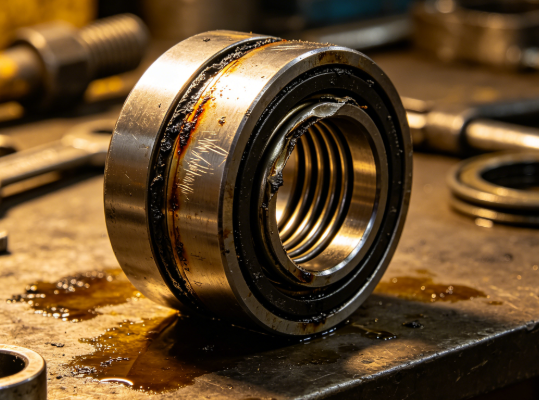
The normal operation of a mechanical seal depends on the formation of an extremely thin liquid lubricating film between the rotating ring and the stationary ring. This film is typically only micrometer-level in thickness, yet it performs three key functions: “isolating the medium + reducing friction + removing heat.” When the liquid film exists stably, the friction state is in “fluid lubrication,” and the seal runs smoothly with low temperature rise.“Dry running damage” refers to a condition in which the mechanical seal operates without an effective liquid film, causing direct solid-to-solid contact friction between the rotating and stationary faces. In this state, the friction coefficient increases sharply, a large amount of heat is generated instantly, and the face temperature rises rapidly, leading to carbonization, cracking, deformation, or even complete burning. Dry running is not an instantaneous event but a gradual instability process: from thinning liquid film → local rupture → boundary lubrication → complete dry friction. Especially in chemical pump systems, once dry running occurs, it often causes irreversible damage in a short time, and it is considered one of the most severe failure modes of mechanical seals.
How Does Equipment Operation Lead to Dry Running?
The occurrence of mechanical seal dry running is usually not accidental, but the result of gradual accumulation during installation, start-up, and operation. The typical failure trigger process is as follows:
Insufficient preparation before start-up
If the seal chamber is not fully filled with liquid or the flushing system is not started in advance before equipment start-up, the seal faces will be in an almost unlubricated condition. Even when the pump starts rotating, a stable liquid film cannot be formed immediately, and short-term direct contact occurs between the rotating and stationary rings. Although this stage is brief, it is enough to cause initial wear, and this initial damage will further weaken the ability to establish a stable liquid film later.
Unstable conditions at start-up moment
During start-up, if cavitation, pressure fluctuations, or incomplete medium filling occur in the pump, the pressure inside the seal chamber becomes unstable. These fluctuations cause the liquid film to repeatedly break and reform, creating “intermittent dry friction.” This condition is more dangerous than continuous dry friction because heat accumulates in a pulsed manner, making thermal cracking more likely.
Deterioration of lubrication during operation
During normal operation, if the flushing flow decreases, filters become clogged, or the medium becomes more viscous, the thickness of the liquid film gradually decreases. When the lubricating film can no longer maintain a stable thickness, the seal faces enter boundary lubrication, and local areas begin to experience direct metal or carbon contact, initiating localized dry running.
Long-term deviation from design conditions
When equipment operates for a long time under low flow, high temperature, or gas-containing conditions, the mechanical seal may completely lose liquid film support and enter full dry friction. At this point, the temperature rises sharply, the sealing faces are rapidly damaged, and failure shutdown usually occurs within a short time.
Core Causes of Dry Running
Failure of lubricating film formation
Mechanical seals rely on the medium to form a hydrodynamic film under high-speed rotation. If the medium is insufficient, pressure is inadequate, or the start-up sequence is incorrect, the film cannot form, leading directly to dry friction. In chemical pumps, if gas is mixed in or the medium flow is discontinuous, the film is easily disrupted. Solutions include fully filling and venting the pump before start-up, ensuring the seal chamber is filled with liquid, and keeping the flushing system running in advance.
High-frequency hidden issues
The flushing system is responsible for cooling and supplementing lubrication. Once it is blocked or has insufficient flow, the seal face temperature rises rapidly, causing the liquid film to evaporate or vaporize, thereby triggering dry running. For example, blockage in API Plan 11 piping is a common issue. Solutions include regular filter cleaning, optimizing flushing paths, and selecting appropriate flushing schemes based on medium characteristics.
Equipment-related issues
If the pump shaft has vibration or misalignment, the seal faces will experience periodic separation and impact, preventing continuous film formation. This “intermittent contact” expands localized dry friction areas and eventually leads to complete failure. Therefore, precise alignment and vibration control are required to keep shaft system stability within allowable limits.
Failure acceleration factors
Once dry friction occurs, material heat resistance determines the rate of damage. For example, ordinary carbon graphite easily carbonizes at high temperatures, while cemented carbide may develop micro-crack propagation under thermal shock. If material selection is improper, even short-term dry running can cause severe damage. Therefore, in high-temperature or high-speed conditions, silicon carbide and other high thermal stability materials should be preferred.
Common Questions
Q: Why does a mechanical seal suddenly burn out? Is it a quality issue?
Most “sudden burnouts” are not quality problems, but the result of flushing interruption, incorrect start-up sequence, or short-term dry running.
Q: Can dry running be recovered by adding water or cooling?
No. Once the sealing faces have experienced dry friction and high-temperature damage, the surfaces are irreversibly damaged and must be replaced.
Q: Why does the same equipment not dry run in some cases but does in others?
The differences mainly come from operating habits, flushing system maintenance conditions, and process stability, rather than differences in the seal itself.
Mechanical seal dry running damage mainly occurs when the necessary “water film” disappears, causing two high-speed rotating hard surfaces to come into direct contact. Under normal conditions, this extremely thin liquid film acts like a “lubricating protective layer,” reducing friction and removing heat. However, once this layer disappears due to improper start-up, insufficient flushing, medium interruption, or equipment vibration, the metal or carbon materials come into direct contact. Initially, it may only cause slight heating, but due to rapidly increasing friction, the temperature rises quickly, and the material soon suffers burn marks, cracks, or even complete failure. This type of damage often happens quickly and appears to be a “sudden failure,” but it is actually the result of gradually accumulated preconditions. Therefore, the key to dry running is not “why it fails quickly,” but “why lubrication is lost.” As long as the start-up procedure is correct, the flushing system is stable, and operating conditions do not fluctuate excessively, most dry running problems can be prevented in advance. For field maintenance, more important than repair is ensuring it “does not happen.”