
In industrial fields such as oil drilling, aerospace, and pressure vessel manufacturing, pneumatic pressure testing devices serve as core testing equipment, undertaking the crucial task of verifying the safety of pressure-bearing components. By simulating pressure environments under extreme working conditions, they accurately test the pressure resistance and sealing performance of equipment such as blowout preventer assemblies, throttling manifolds, and valves, thus constructing the first line of defense for industrial safety. This article will systematically explain the working logic of pneumatic pressure testing devices from three dimensions: power conversion mechanism, pressure regulation principle, and intelligent control system.
Power Conversion Mechanism: The Physical Process of Compressed Air Driving Hydraulic Boosting
The core power source of the pneumatic pressure testing device is compressed air, which is converted into energy form through a pneumatic booster pump. Taking the Simingte SUPC_JKQDB_140 device as an example, this device adopts a two-stage booster structure: the primary pump has a liquid-to-air ratio of 1:60, and the secondary pump increases the liquid-to-air ratio to 1:200. When compressed air at 0.3-0.8 MPa enters the primary pump, it drives the piston to generate initial hydraulic pressure. Hydraulic oil then enters the secondary pump chamber through a check valve. Under a higher compression ratio, the hydraulic pressure increases exponentially, ultimately reaching an output pressure of 140 MPa.
This process follows Pascal’s Law: pressure changes at any point in a closed fluid are transmitted equally in all directions. The pneumatic pump changes the volume of the hydraulic chamber through the reciprocating motion of the piston. Combined with a precision sealing structure, this ensures that hydraulic oil can only flow out through the output end, thus efficiently converting pneumatic energy into hydraulic energy. For example, in a blowout preventer (BOP) pressure test scenario, this device can raise 100L of hydraulic oil from atmospheric pressure to 70 MPa within 15 minutes, meeting the type test conditions required by the MT/T98-2006 standard.
Pressure Control Principle: Multi-stage Precise Control and Dynamic Balance Technology
To achieve precise pressure control, the device employs “pneumatic-hydraulic” proportional control technology. Operators set the target air pressure (e.g., 0.5 MPa) by adjusting the pressure reducing valve at the air inlet. When the hydraulic circuit pressure reaches the set value, the forces on both sides of the pneumatic pump piston are balanced, and pressurization automatically stops. If a pressure drop occurs due to leakage, the balance is broken, and the pump restarts to replenish pressure. This dynamic balancing mechanism keeps pressure fluctuations within ±0.5%FS, ensuring the reliability of test data.
In high-pressure testing scenarios, the device is equipped with dual protection: a mechanical safety valve and an electrical safety system. When the pressure exceeds 110% of the rated value, the safety valve spring compresses, and hydraulic oil flows back to the tank through the pressure relief channel. Simultaneously, the pressure sensor triggers the PLC control system, the audible and visual alarm is activated, and the emergency stop button cuts off the air supply. For example, in a test of an offshore drilling platform, this device successfully intercepted an overpressure event caused by a valve defect, preventing equipment damage worth 2 million yuan.
Intelligent Control System: Integration of Data Acquisition and Process Automation Technologies
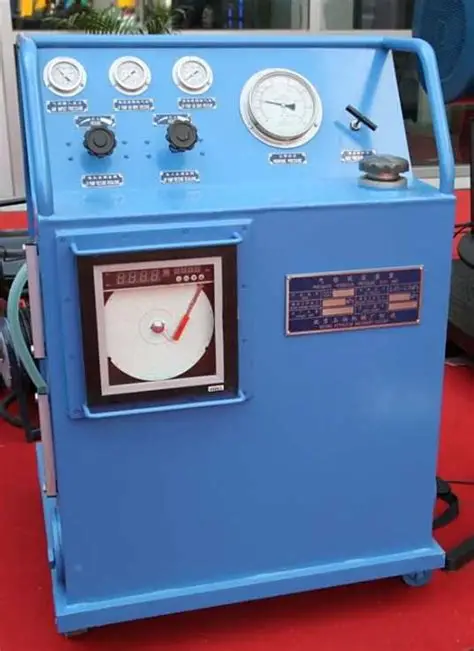
Modern pneumatic pressure testing devices integrate industrial Internet of Things (IoT) technology to achieve intelligent management of the testing process. Taking the Siminte sealed chassis pressure test bench as an example, its electrical control system comprises three core modules:
Data Acquisition Module: Employs a 0.4-grade precision pressure sensor to monitor hydraulic circuit pressure values in real time, with a sampling frequency of 100Hz;
Process Control Module: The PLC controller supports 10 preset test programs and can automatically execute actions such as pressure increase, pressure holding, and pressure release, with a pressure holding timing accuracy of 0.1 seconds;
Data Analysis Module: The disc recorder and electronic storage system synchronously record pressure-time curves, supporting USB export of test reports, conforming to the requirements of GB/T 2351-1993 standard.
In a certain aero-engine pipeline test, this device, through its dual-circuit synchronous testing function, simultaneously conducted 140MPa pressure tests on 8 sets of pipe fittings, improving testing efficiency by 400% compared to traditional manual pumps. Its intelligent diagnostic system can also automatically identify minute leak points in pipe fittings based on the pressure decay curve, with a positioning accuracy of 0.1mm.
Application Scenarios Expansion: From Extreme Condition Simulation to Full Life Cycle Management
The application of pneumatic pressure testing devices has broken through the boundaries of traditional industrial fields. In new energy vehicle battery pack testing, it verifies the shell’s sealing performance through hydrostatic testing at pressures up to 3 MPa. In hydrogen energy storage tank inspection, pneumatic pressurization technology can simulate a 35 MPa high-pressure environment to detect weld defects. In the medical device manufacturing field, this device is used for artificial heart valve pressure resistance testing, with pressure control accuracy reaching ±0.01 MPa.
With the advancement of Industry 4.0, pneumatic pressure testing devices are evolving towards intelligence and modularity. Siminte’s latest SUPC_5G series equipment integrates a 5G communication module, enabling remote monitoring and fault pre-diagnosis. Its modular design supports rapid tooling changes, adapting to the testing needs of different pressure-bearing components. These technological innovations not only improve testing efficiency but also drive industrial testing towards the goal of “zero accidents.”
From the physical principles of power conversion to the digital revolution of intelligent control, the technological evolution of pneumatic pressure testing devices reflects the transformative trajectory of the industrial testing field. Through precise mechanical design, intelligent control systems, and stringent safety standards, it constructs a core barrier to ensure industrial safety. Driven by both energy transition and intelligent manufacturing, this “guardian of industrial pressure” will continue to evolve, injecting safe momentum into high-quality development.