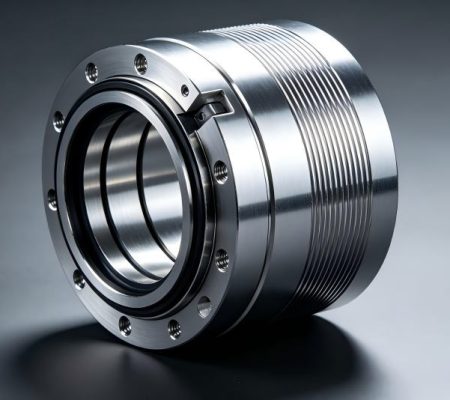
In the operation of industrial equipment, mechanical seals play a crucial role in preventing media leakage and ensuring equipment safety. They are typically installed at the shaft end of pumps, compressors, or agitators, and operate under high-speed rotation and complex conditions for extended periods. Many people believe that mechanical seal failure is mainly caused by wear, aging, or improper installation, neglecting the hidden factor of “impact.” In fact, whether it’s mechanical impact, liquid impact, or instantaneous impact from pressure fluctuations, all can cause varying degrees of damage to mechanical seals. Impacts are characterized by their “suddenness” and “high instantaneous energy,” meaning that even short-lived impacts can severely affect precision structures. Especially the internal dynamic ring, stationary ring, and elastic elements of the mechanical seal, which rely on stable contact and uniform force distribution, can experience displacement, cracking, or even direct damage once subjected to impact.
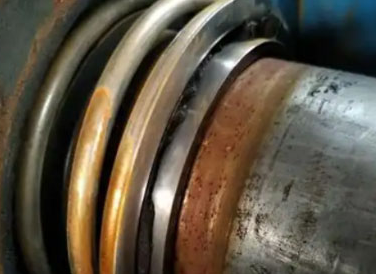
Does Impact Cause Failure?
Impact can cause failure, and its impact cannot be ignored.
• Impact can disrupt the seal’s fit.
• It can alter the internal stress structure.
• In severe cases, it can directly damage the seal.
For example, a water pump suddenly starting up generates water hammer, causing a rapid pressure surge that leads to the instantaneous separation of the mechanical seal surface, followed by leakage. This is a typical example of impact-induced failure.
Effects of Mechanical Impact
Mechanical impacts typically originate from external sources:
① Collisions during equipment handling or installation
② Sudden shaft jamming followed by restarting
③ Coupling impact or misalignment
These impacts easily cause hard damage, such as seal surface cracking or component deformation. For example, accidentally striking the shaft end during equipment installation can cause misalignment of internal mechanical seal components, resulting in abnormal vibration and leakage after operation.
Liquid Impact
Liquid impact is the most common but easily overlooked cause:
• Rapid valve closure
• Sudden pump shutdown or startup
• Sudden gas release in pipelines
These situations create a “water hammer effect,” forming a momentary high-pressure impact on the seal surface. For example, in long pipeline systems, rapid valve closure can cause pressure wave rebound, resulting in a strong impact on the mechanical seal and even cracking of the seal surface. IV. Pressure
Fluctuation Impact (Continuous Damage)
Besides instantaneous impacts, frequent pressure fluctuations can also cause problems:
✔ Fluctuating pressure
✔ Unstable system operation
✔ Frequent valve actuation
While this impact is not as severe as water hammer, it is a form of “chronic damage.” Over time, it leads to accelerated wear on the sealing surface, spring fatigue, and ultimately, failure.
Impact on the Sealing Surface
The most critical part of a mechanical seal is the sealing surface:
· Impact can cause instantaneous separation
· Creates micro-cracks
· Accelerates surface wear
For example, a strong impact may not immediately cause leakage, but it will leave tiny damage to the sealing surface. Over time, this damage gradually expands, eventually leading to a noticeable leak.
Impact on Elastic Elements
The springs or bellows inside a mechanical seal are also sensitive:
—— Impact causes spring deformation
—— Uneven elastic force
—— Jamming
For example, after being impacted, the spring may lose its original elasticity, preventing the sealing surface from maintaining stable contact, thus causing leakage or abnormal noise.
Superimposed Equipment Vibration
Impact is often accompanied by vibration:
• Increased equipment vibration after impact
• Vibration transmitted to sealing components
• Secondary damage
For example, an impact causing slight shaft bending results in continuous vibration after operation. This vibration continuously acts on the mechanical seal, accelerating its damage.
Typical Case Analysis
In actual production, there is a case where a factory failed to follow proper procedures when stopping a pump, directly closing the outlet valve, causing strong water hammer in the pipeline. The mechanical seal did not immediately leak, but after several hours of operation, dripping began. Disassembly revealed fine cracks on the sealing surface. This illustrates that impact causes “delayed damage,” not immediate damage. Another example is equipment dropped during transport. Although there was no obvious external damage, a slight leak persisted after installation, ultimately confirmed to be due to misalignment of internal sealing components.
How to Reduce the Impact of Impacts
To avoid problems caused by impacts, the following measures can be taken:
✔ Start and stop equipment slowly to avoid instantaneous impacts
✔ Install buffer devices or check valves
✔ Design pipelines rationally to reduce water hammer
✔ Avoid impacts during handling and installation
For example, installing a slow-closing valve in a long-distance conveying system can effectively reduce the impact of water hammer on the mechanical seal.
Impact is indeed one of the important factors leading to mechanical seal failure, and it is often insidious and delayed. Unlike wear or aging, damage caused by impact may not be obvious in the short term, but will gradually manifest itself during subsequent operation. Therefore, during equipment maintenance, we should not only focus on surface problems, but also pay attention to whether there is an impact risk in the operating conditions. Analysis shows that whether it is mechanical impact, liquid impact, or pressure fluctuation, it will essentially disrupt the stable state inside the mechanical seal. Since the mechanical seal itself is a component that relies on precise fit, once this balance is broken, it is difficult to restore. Therefore, in daily operation, we should try to avoid drastic changes in operating conditions and reduce the possibility of impacts through reasonable design and standardized operation. At the same time, when sealing problems occur, “whether there is impact” should be one of the important directions for investigation, rather than simply replacing the seal. Only by fundamentally controlling the impact source can the service life of the mechanical seal be truly extended and the long-term stable operation of the equipment be guaranteed.