In the operation of industrial equipment, mechanical seals, as crucial components preventing media leakage, directly impact the safety and stability of the equipment. Abnormal noises from mechanical seals, especially sharp, piercing noises, often indicate internal problems. Such noises not only affect the working environment but may also be a precursor to equipment failure. If not investigated promptly, they can lead to shortened seal life, leaks, equipment downtime, or even safety accidents.
Many operators, when faced with sharp noises, often immediately assume “equipment aging” or “normal phenomena,” neglecting further inspection. However, under normal operating conditions, mechanical seals should run smoothly with minimal noise. Abnormal screeching noises are usually closely related to abnormal friction, installation problems, or changes in operating conditions. Therefore, systematically analyzing the causes of these noises is crucial for timely problem-solving and extending equipment lifespan. The following sections will explain several common causes in detail, with examples from real-world scenarios.
Common Noise Sources
When a mechanical seal is in a “dry running” state, it is prone to producing sharp noise:
· Lack of lubricant on the sealing surface
· Failure to prime the pump before startup
· Insufficient medium in the sealing cavity
For example, if a centrifugal pump is started directly without priming after maintenance, the mechanical seal will rub at high speed without liquid lubrication, producing a piercing scream within a short time, accompanied by a rapid increase in temperature.
Installation Misalignment (An Easily Overlooked Issue)
If there are misalignments during installation, it can also cause noise:
① The rotating and stationary rings are not perfectly aligned
② Uneven force on the sealing surface
③ Inconsistent spring compression
In actual cases, some maintenance personnel have not tightened the seal evenly during installation, causing one side of the sealing surface to contact first, resulting in uneven wear during operation and producing a periodic sharp sound.
Damage to the Sealing Surface
The condition of the sealing surface directly determines operational stability:
✔ Scratches on the surface
✔ Cracks or chipping
✔ Foreign objects trapped
For example, during the overhaul of a chemical pump, tiny particles of impurities entered the sealing surface, causing intermittent friction during operation and producing a sharp, metallic scraping sound.
Spring Failure
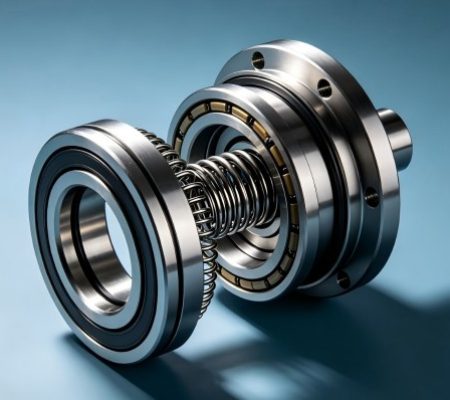
The springs inside the mechanical seal play a crucial role:
• Spring fatigue and loss of elasticity
• Spring jamming or rusting
• Uneven spring force distribution
When the spring cannot provide stable pressure, the sealing surface will vibrate, leading to a sharp friction sound. This sound is usually accompanied by irregular vibrations.
Effects of Equipment Vibration
Pump or motor vibration can also be transmitted to the sealing components:
• Bearing damage
• Coupling misalignment
• Unstable foundation
For example, in one pump unit, loose foundation bolts caused increased overall vibration, leading to resonance in the mechanical seal and producing a continuous, sharp noise.
Cooling or Flushing System Abnormalities (Hidden Causes)
Mechanical seals typically rely on cooling or flushing systems:
· Interruption of cooling water
· Insufficient flushing fluid pressure
· Pipeline blockage
Insufficient cooling leads to increased sealing surface temperature and deteriorated lubrication, easily generating sharp friction noises. For example, the seal may “scream” shortly after the cooling water valve is closed.
Changes in Operating Environment
Changes in the transported medium can also affect the seal:
—— Contains particulate impurities
—— Viscosity too high or too low
—— Corrosive
For example, when transporting liquids containing sand, particles entering between the sealing surfaces can produce a sharp sound similar to “sandpaper rubbing.”
Abnormal Speed
Abnormal operating speed can also cause problems: overspeeding, frequent starts and stops, and unstable speed.When the speed is too high, the friction frequency increases, making the sound sharper and more piercing, and may even be accompanied by increased vibration.
Assembly Environment Issues
Many problems stem from the assembly environment:
✔ Excessive dust
✔ Inappropriate humidity
✔ Improper operation
For example, replacing seals in an open-air environment allows dust to enter the sealing surface, resulting in abnormal friction noises after operation.
From dry friction to installation deviations, from equipment vibration to the influence of the medium, every link can be a contributing factor. Therefore, in operation, judgment cannot rely solely on experience but should be analyzed in conjunction with the equipment’s condition. The above analysis reveals that most noise problems are closely related to “abnormal friction,” which usually stems from insufficient lubrication, improper installation, or changes in external conditions. For example, ensuring pre-start priming, standardizing installation procedures, and regularly inspecting the cooling system can effectively prevent most problems. Furthermore, during routine inspections, if any abnormal sound is detected, the machine should be stopped immediately for inspection, rather than continuing operation.