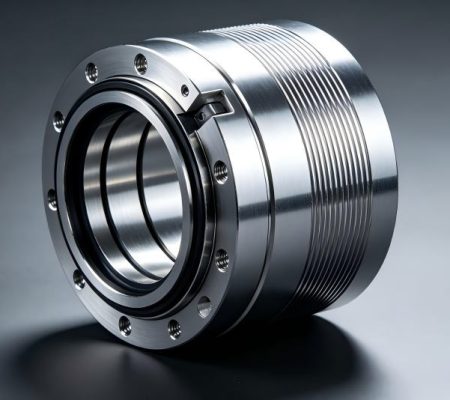

In various industrial equipment, the sealing system is a crucial component ensuring safe operation and stable production. With increasingly complex operating conditions, single-stage seals are no longer sufficient to meet the demands for high reliability and long-term operation; multi-stage sealing structures are gradually becoming the mainstream design. The secondary seal, as a vital supplement to the primary seal, directly impacts the stability and safety of the entire sealing system due to its adaptability to various operating conditions. The secondary seal is not simply a ‘backup seal,’ but plays a vital role in protection, buffering, and isolation under specific operating conditions. Unlike the primary seal, which directly withstands media pressure and workload, the secondary seal deals more with complex and variable boundary environments, resulting in significantly comprehensive and specific operating requirements.
Secondary Seal Pressure
The secondary seal typically does not directly withstand the main operating pressure of the equipment, but it still needs to possess a certain pressure resistance. Its operating requirements emphasize the ability to absorb residual pressure and form a buffer barrier in the event of a minor leak or momentary failure of the primary seal. The secondary seal should maintain a stable sealing state within a low to medium pressure range, while avoiding structural deformation or material fatigue due to excessive pressure. The design typically requires secondary seals to possess pressure adaptability, meaning they must maintain continuous protection under pressure fluctuations or pulsations without instantaneous failure.
Temperature of Secondary Seals
Temperature is a crucial factor affecting the performance of secondary seals. Secondary seals are often located outside or in the transition zone of primary seals, and are susceptible to both the conduction of medium temperature and changes in ambient temperature. Therefore, their operating requirements emphasize a wide temperature adaptability range. Under high-temperature conditions, secondary seals should maintain material stability to prevent hardening, cracking, or loss of elasticity; under low-temperature conditions, they must maintain sufficient flexibility to prevent seal failure due to embrittlement. Frequent temperature changes also require secondary seals to possess good thermal cycling resistance.
Media of Secondary Seals
Although secondary seals do not directly and continuously contact the main process medium, they may still be exposed to medium vapors, condensates, or trace leaks. Therefore, their operating requirements include basic requirements for media compatibility. Secondary seal materials must possess certain corrosion resistance, swelling resistance, and chemical stability to prevent performance degradation during long-term operation. In addition, the secondary seal must adapt to external environmental factors such as dust, water vapor, oil, and corrosive components in the air, serving to isolate external pollution and protect the primary seal.
Secondary Seal Operating Conditions
During equipment operation, vibration, axial movement, radial offset, and frequent start-stop cycles all affect the sealing system. The operating conditions of the secondary seal emphasize its adaptability to dynamic changes. The secondary seal should maintain sealing continuity when equipment operation is unstable or the load changes, absorbing minor displacements through its own elasticity and structural compensation to prevent sealing surface failure due to mechanical impact or vibration. Simultaneously, during start-stop phases, the secondary seal should have rapid response capabilities to promptly establish an effective sealing state.
Secondary Seal Lifespan
One of the design goals of the secondary seal is to extend the service life of the overall sealing system; therefore, its operating conditions impose clear requirements on lifespan and reliability. The secondary seal should possess long-term operational stability, maintaining sealing performance without significant degradation within the specified operating range. Its material aging rate, wear characteristics, and elasticity retention capacity must meet the dual requirements of continuous operation and long-term standby. Simultaneously, secondary seals should possess a certain degree of failure tolerance, providing basic protection even during gradual performance degradation, rather than preventing sudden failure.
The operating conditions required for secondary seals exhibit distinctly comprehensive and auxiliary characteristics. Their primary goal is not to withstand extreme conditions, but rather to provide reliable support and protection for primary seals under complex, variable, and boundary conditions. From pressure adaptation, temperature variations, media compatibility, operating status to lifespan reliability, the operating conditions of secondary seals span the entire equipment operation process. Properly meeting these requirements can not only effectively reduce the overall risk of the sealing system but also significantly improve the stability and safety of equipment operation.