
Carbon ring seals rely on a ‘micro-gap + gas film’ to achieve a sealing effect, which is completely different from the end-face contact sealing of mechanical seals. Therefore, the ‘gap’ becomes a core parameter in the design, processing, installation, and operation of carbon rings. If the gap is too small, it will lead to the ring biting the shaft, jamming, localized contact, and rapid wear; if the gap is too large, the gas film will be difficult to establish, resulting in increased leakage and decreased sealing efficiency. Especially in high-speed, high-temperature equipment with drastic pressure differential changes, such as aero-engines, gas turbines, railway brake compressors, industrial turbines, and high-speed compressors in the petrochemical industry, carbon rings are extremely sensitive to gaps.
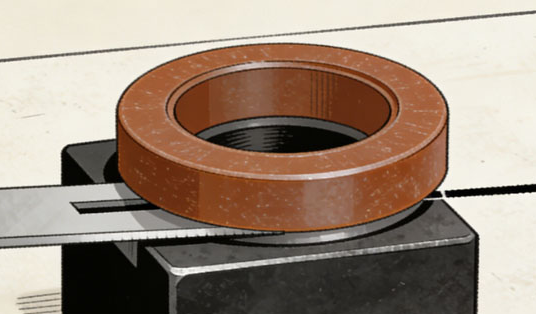
Because carbon graphite materials have characteristics such as high thermal expansion, high brittleness, and susceptibility to installation stress, determining the gap is not merely a ‘numerical judgment’ of a single dimension, but involves comprehensive engineering calculations considering design conditions, shaft diameter thermal expansion, speed changes, sealing cavity structure, gas film characteristics, manufacturing tolerances, and assembly deviations.
Basic Functional Positioning
The carbon ring is not tightly attached to the shaft surface, but relies on a gas film in the micro-gap to isolate the leaking medium.The main functions of clearance include:Preventing solid contact: Ensuring no direct friction between the carbon ring and the shaft.Forming a stable gas film: Allowing the medium to form controllable resistance within the micro-gap, achieving a sealing effect.
Absorbing micro-vibrations in the shaft system: Providing necessary degrees of freedom to prevent the ring from breaking due to vibration.Allowing for thermal expansion compensation: The shaft undergoes thermal expansion at high speeds and temperatures, which the clearance must accommodate.Therefore, a smaller clearance is not always better; a balance must be struck between leakage and reliability.
Shaft Diameter Thermal Expansion Changes
Carbon ring clearance design must be based on hot conditions, not cold dimensions at installation.
Engineers need to consider:
The linear expansion coefficient of the shaft material
The equipment’s maximum temperature and rate of temperature rise
The maximum outer diameter change caused by thermal expansion
Whether thermal expansion is uniform and whether there are areas of excessive heat.
If thermal expansion is ignored, the installed clearance may become zero after the equipment heats up, leading to the carbon ring biting the shaft or instantaneous breakage.
How to Evaluate Clearance
In high-speed equipment, the gas film carrying capacity varies with rotational speed.Higher rotational speed: Gas film formation is easier; efficiency is higher; allow for a slightly larger clearance; operation is smoother.Medium- and low-speed equipment: Gas film formation is difficult; more sensitive to clearance; excessive clearance directly leads to increased leakage.Therefore, clearance design is usually evaluated in conjunction with parameters such as ‘critical rotational speed’ and ‘stable gas film range.’
How to Adjust the Clearance
The effect of the clearance is completely different under different pressure differential conditions.High pressure differential: The clearance cannot be too large, otherwise leakage will be obvious; but it also cannot be too small, otherwise pressure shocks will pose a risk of damage.Low pressure differential: The clearance can be appropriately increased to make the annulus more stable and prevent intermittent contact.Gas media: More dependent on the gas film, the clearance needs to be more stable.Oil-containing or humid media: Will change the properties of the film layer, and the clearance design needs to consider viscosity changes.
The properties of the medium directly affect the gas film thickness and resistance, and are important variables in determining the final clearance.
Consider Manufacturing and Assembly Tolerances
Actual installation will introduce certain errors, therefore sufficient margin must be allowed for the clearance, including: carbon ring inner diameter tolerance; shaft diameter tolerance; coaxiality deviation between the seal seat and the housing; assembly eccentricity and tilt; and micro-interference caused by cleanliness. If the designed clearance is too idealistic and assembly deviations are not considered, there may be a risk of localized insufficient clearance during actual operation.
Determine the Final Clearance
The final clearance is often determined by the design department through the following methods: shaft diameter thermal expansion calculation; carbon ring material expansion; gas film bearing model; leakage simulation; differential pressure stability analysis; and verification under actual operating conditions. Engineers usually do not provide a single dimension directly, but rather a clearance range. For example, ‘0.05–0.12 mm’ or ‘clearance calculated proportionally to shaft diameter,’ which is then fine-tuned based on actual measurements during installation.
The installation clearance of the carbon ring seal is not a fixed value, but an engineering parameter determined based on material properties, thermal expansion, rotational speed, differential pressure, gas film behavior, manufacturing errors, and actual operating conditions. The more precise the clearance, the more stable the gas film, and the easier it is to achieve the design goals for equipment leakage, lifespan, and reliability. For maintenance or procurement personnel, understanding the essence of clearance is more important than memorizing any ‘experienced values.’
In practical applications, the most common problems with carbon ring seals are often related to improper clearance: clearance that is too small leads to shaft wear and burnout; clearance that is too large leads to increased leakage; uneven clearance leads to gas film instability; and neglecting thermal expansion during clearance can cause instantaneous rupture at startup. A standardized clearance setting process ensures that the equipment remains within a controllable sealing range from startup to steady-state operation.