
In oil drilling operations, the drilling rig winch, as the core power transmission equipment of the drilling system, directly affects drilling safety and operational efficiency due to the reliability of its braking system. In deep wells, ultra-deep wells, and complex geological conditions, the winch needs to frequently start and stop and bear the weight of several to tens of tons of drill string. As a key friction component of the braking system, monitoring the wear condition of brake pads is crucial for ensuring the continuity of drilling operations. Traditional manual inspection methods are limited by harsh well site environments and insufficient monitoring frequency, making it difficult to detect abnormal brake pad wear in real time. Modern intelligent monitoring technology, through multi-dimensional data fusion and real-time analysis, achieves accurate early warning of brake pad wear, providing reliable assurance for safe drilling operations.
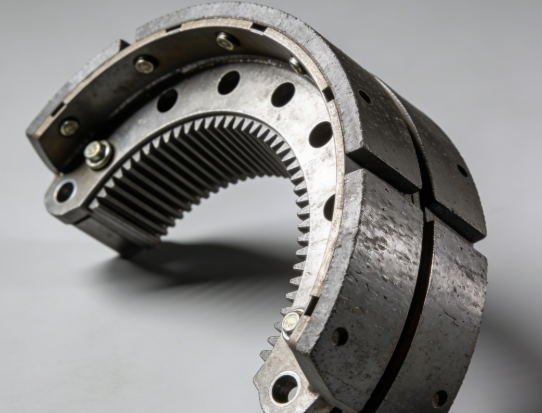
The working environment of oil drilling winch brake pads is extremely harsh. High temperature, high pressure, strong vibration, and drilling fluid corrosion significantly accelerate their wear process. Under high-temperature conditions, the brake pad friction material is prone to thermal degradation, leading to a decrease in the coefficient of friction; chemicals in the drilling fluid may corrode the brake pad metal backing plate, causing a reduction in structural strength; frequent emergency stops can lead to uneven local wear, forming “grooves” or “uneven wear.” Actual data from an offshore drilling platform shows that after drilling 3000 meters continuously, the wear of brake pads in certain areas can reach more than twice the normal value. If not replaced in time, this could lead to brake failure, causing serious accidents such as drill string falls or equipment damage. Therefore, real-time monitoring of brake pad wear is a crucial step in preventing drilling accidents.
Mechanical monitoring technology triggers early warning signals through physical structures and is suitable for basic drilling rig winches. Some brake pads have a metal sensing element embedded during manufacturing. When the friction material wears to its limit thickness (usually 3-5 mm), the metal element contacts the brake disc, triggering a microswitch in the control cabinet, illuminating the instrument panel alarm light, and cutting off the winch power. This design is inexpensive and highly reliable, but it has limitations—the metal element is usually only located at the edge of the brake pad. If the central area wears faster or there is uneven wear such as “conical wear,” the metal element may not trigger the early warning in time. Furthermore, well site vibrations can cause microswitch malfunctions, requiring regular calibration to reduce the false alarm rate.
Electronic monitoring technology collects data in real time through sensors, significantly improving monitoring accuracy and response speed. Mainstream solutions include two types: resistive and eddy current. Resistive sensors embed sensing wires in the friction material. When wear reaches its limit, the sensing wires contact the brake disc, causing a change in resistance and triggering the control unit to send an alarm signal to the drilling monitoring system via a wireless module. Eddy current sensors, on the other hand, continuously monitor changes in the gap between the brake disc and the sensor through non-contact measurement. When the gap exceeds a set threshold (typically 0.5-1 mm), it is considered excessive wear. Actual application data from a land drilling team shows that after adopting electronic monitoring, the number of unplanned brake pad replacements decreased by 35%, and the downtime caused by brake failure was reduced to less than 2 minutes per hour, significantly improving operational efficiency.
Multi-parameter fusion monitoring technology achieves a three-dimensional assessment of brake pad wear conditions by comprehensively analyzing data such as vibration, temperature, and pressure. In deep-well drilling winches, the braking system monitoring module integrates vibration, temperature, and pressure sensors: the vibration sensor captures high-frequency vibration signals during braking and identifies abnormal vibrations caused by uneven brake pad wear through spectrum analysis; the temperature sensor monitors the surface temperature of the brake disc to prevent brake pad material performance degradation due to overheating from friction; and the pressure sensor records changes in brake cylinder pressure and, combined with idle stroke time parameters, determines braking response sensitivity. After applying multi-parameter fusion monitoring to an offshore drilling platform, the system can predict the remaining lifespan of brake pads 48 hours in advance, transforming maintenance planning from “passive response” to “proactive prevention,” reducing annual maintenance costs by more than 20%.
From land to sea, from shallow wells to ultra-deep wells, brake pad wear monitoring technology for oil drilling winches is undergoing a transformation from single-parameter to multi-dimensional fusion, and from localized to remote monitoring. The reliability of mechanical monitoring, the accuracy of electronic monitoring, and the comprehensiveness of multi-parameter fusion monitoring together construct a brake pad health management system covering the entire drilling lifecycle. With the popularization of 5G communication and edge computing technologies, future monitoring systems will have the ability to transmit data in real time and perform cloud analysis. Through big data mining, they will predict brake pad wear trends, achieving a leap from “experience-based maintenance” to “intelligent operation and maintenance,” and building a more robust technical defense for the safe and efficient operation of oil drilling.