In oil drilling operations, the drilling pump, as the core equipment of the drilling fluid circulation system, directly affects drilling efficiency and downhole safety. From the power end to the hydraulic end, from mechanical wear to hydraulic anomalies, drilling pump failures are diverse and complex in cause. Quickly locating the root cause of the failure and implementing targeted treatment can not only reduce non-productive time but also avoid well control risks caused by equipment failure. Therefore, mastering the diagnostic methods and handling procedures for common drilling pump failures is an essential core skill for drilling technicians.
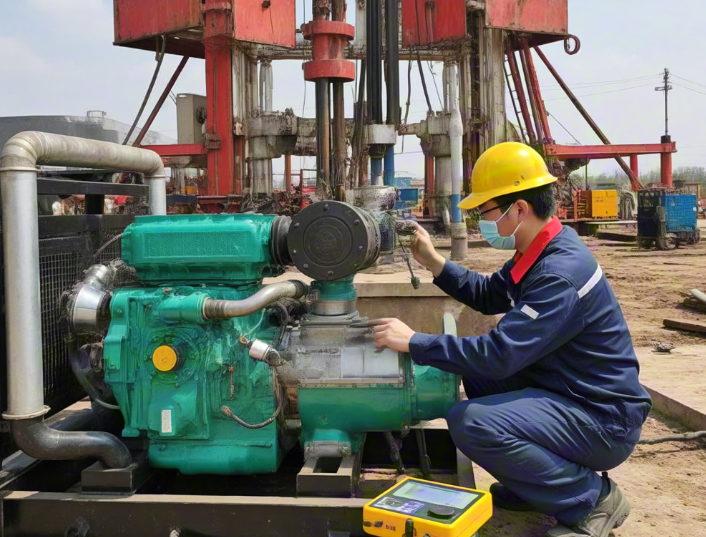
Abnormal noises and vibrations on the power end are among the most common manifestations of drilling pump failures, often related to wear or loosening of transmission components. For example, when the crankshaft bearing clearance is too large, periodic metallic impact sounds will be generated during rotation, accompanied by increased pump body vibration; when the clearance between the crosshead slider and guide plate exceeds the standard, uneven friction during piston reciprocating motion will cause a harsh friction sound. In one drilling team, the failure to replace worn crankshaft bearings in a timely manner led to a broken bearing cage, and flying metal fragments punctured the hydraulic end cylinder liner, causing a drilling fluid leak. When handling such faults, the pump must first be stopped and the pressure released. The power unit should be disassembled to inspect the wear of components such as the crankshaft, connecting rod, and crosshead. Replace any parts that exceed the specifications and readjust the clearances to the standard range (e.g., the clearance between the crosshead and guide plate should be controlled at 0.25-0.40mm). Finally, a no-load test run should be conducted to verify the repair effect.
Faults involving hydraulic pressure fluctuations and insufficient displacement are often directly related to valve seal failure or cylinder liner wear. The drilling pump’s suction and discharge valves achieve one-way sealing through springs and valve seats. If the valve disc is deformed, the spring is fatigued, or the valve seat is worn, it can cause drilling fluid backflow, leading to pressure fluctuations. For example, when a drilling team reached 3000 meters, the pump pressure suddenly dropped by 15%. Inspection revealed that the discharge valve disc had developed honeycomb corrosion due to long-term erosion, preventing the sealing surface from fully adhering. Furthermore, scoring or uneven wear on the cylinder liner inner wall increases piston movement resistance, resulting in insufficient displacement. When handling such malfunctions, the pump must first be stopped and the drilling fluid drained. The hydraulic end should be disassembled to check the valve seals. Damaged valve discs, springs, and valve seats should be replaced. Simultaneously, the cylinder liner inner diameter and piston outer diameter should be measured to ensure the clearance is within the range of 0.05-0.15mm to prevent accelerated wear due to excessive clearance.
Lubrication system malfunctions are a hidden killer causing mechanical damage to drilling pumps. Gears, bearings, and other components on the power end rely on lubricating oil to reduce friction and temperature. Insufficient lubricating oil level, deteriorated oil quality, or blocked oil passages can lead to localized overheating and even bearing failure. For example, in one drilling pump, a clogged lubricating oil pump filter caused interruption of crankshaft bearing lubrication. After two hours of operation, the bearing temperature soared to 120°C, causing the bearing to seize. Routine maintenance requires regular checks of the lubricating oil level (maintained above the oil level mark), oil quality (no emulsification, no impurities), and oil passage unobstructed flow. The lubricating oil should be changed every 500 hours, and the oil pump filter and oil passages should be cleaned to ensure continuous and effective lubrication system operation.
Seal leakage is another high-frequency failure type of drilling pump, manifesting as leaks in cylinder liner seals, piston rod seals, and valve cover seals. Leaks can be caused by seal aging, installation misalignment, or pressure surges. For example, during high-pressure drilling, a drilling team experienced a piston rod seal where the rubber hardened due to aging, losing its elastic sealing ability, causing drilling fluid to spray out along the piston rod and contaminate the drilling platform. When handling such failures, the pump must first be stopped and the pressure released. The sealing components at the leaking location must be disassembled, and the wear and aging of the seals inspected. Seals of the same model must be replaced (e.g., V-ring seals should be replaced in groups), ensuring correct installation orientation and uniform preload. Finally, a low-pressure test run should be conducted to verify the sealing effect.
Troubleshooting drilling pumps requires a combination of technical experience and systems thinking. From mechanical vibrations at the power end to abnormal pressure at the hydraulic end, from latent faults in the lubrication system to overt leaks in the seals, each type of failure must be handled through a process of “observing the phenomenon – analyzing the cause – locating the fault – implementing repair – verifying the effect.” For drilling teams, establishing an equipment failure database, conducting regular failure simulation drills, and strengthening daily maintenance are key to reducing failure rates and improving operational efficiency. Only by transforming failure handling capabilities into preventative maintenance awareness can the continuous and stable operation of drilling pumps be guaranteed under complex geological conditions, providing solid equipment support for the safety and efficiency of drilling operations.