In the development of energy resources such as oil and natural gas, the construction of drilling equipment foundations is a core element in ensuring the safe and efficient operation of drilling. The quality of foundation construction directly affects not only the stability of equipment operation but also the success or failure of the entire drilling project. From foundation type selection to construction process control, each step must strictly adhere to technical specifications to create a solid and reliable support platform for the drilling equipment.
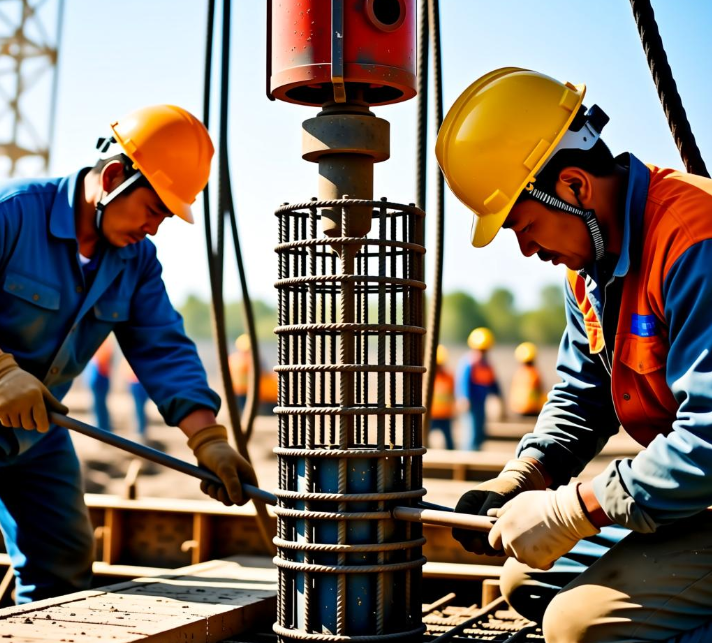
The selection of foundation type requires comprehensive consideration of geological conditions, drilling depth, and equipment characteristics. In soft strata or during rainy season operations, grouting foundations with rock filling are the preferred choice due to their high load-bearing capacity. During construction, it is essential to ensure the injectability of the grout, injecting it under pressure into rock fissures, which hardens to form a highly impermeable and cohesive rock mass. For shallow wells or areas with hard strata, precast reinforced concrete foundations are more advantageous, as their reusability effectively reduces construction costs. If the construction area is located in a mountainous region with abundant stone resources, paved stone foundations are an economical choice due to the convenience of locally sourced materials. Meanwhile, metal casing foundations, with their high load-bearing capacity and convenient transportation, are widely used in special geological environments such as beaches.
The core of foundation construction lies in the precise control of dimensions and strength. During the design phase, geological surveys are needed to obtain foundation bearing capacity data, and the foundation area is calculated based on the drilling rig load. Taking the ZJ45 drilling rig as an example, the front edge line of its foundation must be extended towards the wellhead according to the design dimensions on the drawings, using the wellhead center as a reference. The foundation width must be determined by connecting parallel lines with a measuring tape, and mouse holes must be reserved. During construction, the foundation pit excavation must follow the principle of “smaller at the top, larger at the bottom,” and the flatness error of the pit bottom must be controlled within ±20mm. Loose soil must be thoroughly removed. During the concrete pouring stage, C25-C30 strength grade concrete must be vibrated and compacted in layers, and the deviation of the anchor bolt hole position must not exceed ±5mm to prevent positioning deviations during equipment installation.
The equipment installation phase has extremely stringent precision requirements. Taking the AD130/1000 drilling rig as an example, the upper surface of the ground beam must be leveled before installation, and the error must be controlled within ±3mm. During platform installation, a level must be used for repeated calibration to ensure that the tightening torque of the bolts connecting the main beam and the traveling beam reaches the design value. During the derrick installation phase, crane operators must work closely with the command personnel, using flag signals to precisely control the lifting angle and prevent stress concentration at the connection between the columns and crossbeams. After equipment alignment, the secondary grouting layer thickness must be maintained at 50-100mm to provide buffer space for equipment operation.
A quality control system is implemented throughout the entire construction process. During material arrival, steel must be accompanied by a quality certificate, and welding materials must undergo diffusible hydrogen content testing of the deposited metal. A three-level quality inspection system is implemented during construction; foundation level errors are monitored in real time using a laser rangefinder, and planar displacement deviation must not exceed ±20mm. During the acceptance phase, ultrasonic testing technology is used to inspect internal concrete defects, and pressure grouting is used to reinforce areas with insufficient load-bearing capacity. A case study from an oilfield shows that by introducing BIM technology for 3D modeling, the foundation construction rework rate was reduced by 42%, and the construction period was shortened by 15 working days.
From foundation type selection to precise equipment installation, drilling equipment foundation construction is akin to building a sophisticated mechanical castle. Every tightening of a bolt and every pour of concrete embodies the engineers’ unwavering pursuit of safety and efficiency. With the widespread adoption of digital construction technologies, intelligent monitoring systems are gradually replacing traditional manual inspections, injecting technological momentum into well foundation construction. Against the backdrop of energy development venturing into deep earth and deep sea areas, only by adhering to standardized construction and meticulous management can we build a solid safety barrier for drilling equipment and provide a robust guarantee for energy security.