In the daily operation of the pump industry, the component most frequently causing shutdowns, leaks, and even equipment accidents is often not the pump body or the motor, but the seemingly small seal. Especially in pumps operating under high-pressure conditions, such as boiler feed pumps, reverse osmosis high-pressure pumps, water injection pumps, and ultra-high-pressure cleaning pumps, the frequency of seal failure is significantly higher than in ordinary centrifugal pumps, and the damage is sudden, severe, and difficult to predict in advance. Many engineers wonder: why can the same materials and the same structure run for one or two years in ordinary pumps, but burn out in high-pressure pumps in just days or weeks?
The reason why high-pressure pump seals are more “fragile” is not fundamentally due to the seals themselves being less durable, but rather because high-pressure systems place extremely stringent demands on the seals in terms of fluid dynamics, heat, structural deformation, and lubrication conditions. Pressure is not simply “a little higher,” but rather it amplifies frictional heat, compressive force, end-face displacement, permeation tendency, and material fatigue many times over, causing any tiny deviation to be magnified into catastrophic failure. Understanding these failure logics helps purchasers make more accurate selections, helps users reduce damage, and allows maintenance teams to more effectively extend seal life.
Higher pressure, greater frictional heat
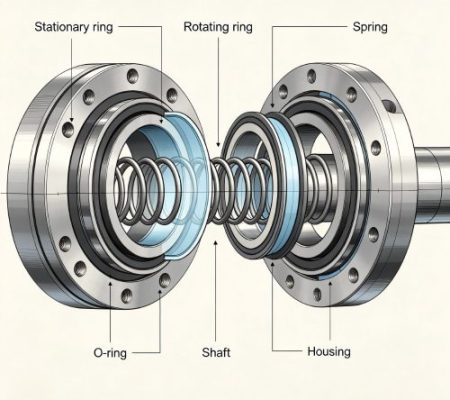
Sealing faces rely on a liquid film for lubrication, but high pressure thins and ruptures this film, multiplying the coefficient of friction.Increased frictional heat creates localized high-temperature “hot spots” between the sealing faces, manifesting as: ablation and bluing of silicon carbide sealing faces; direct charring of the resin-bonded carbon ring; loss of spring elasticity; hardening or carbonization of rubber O-rings.On high-pressure pumps, even with stable flow, the sealing face temperature can instantly rise from tens of degrees Celsius to two or three hundred degrees Celsius. Many seal failures are not actually caused by pressure but by heat.
High pressure causes sealing face compression
The closing force on the sealing face is directly related to the pressure. The higher the pressure, the more forcefully the end face is compressed, resulting in: accelerated wear; further drying of the lubricating film; short-term dry friction during operation; and end face adhesion during shutdown, leading to instantaneous tearing upon restart.This is why high-pressure pump seals generally use harder material mating, such as silicon carbide to silicon carbide, rather than carbon to hard rings as in ordinary pumps.
Amplified shaft deflection and runout
High-pressure pumps are mostly multi-stage structures with long shafts, high speeds, and complex inter-stage forces. Even slight misalignment leads to uneven stress on the end face, potentially resulting in: wear through one side first; the sealing ring “biting” the end face; and high pressure penetrating through weak points, causing instantaneous leakage.Therefore, high-pressure pump seals typically require stricter shaft diameter coaxiality limits and higher levels of dynamic balancing.
Media Issues Amplify Damage
Under high pressure, the destructiveness of the medium is amplified. For example:
Small solid particles → are accelerated by pressure to become “sandpaper” abrasives
Weakly corrosive media → corrosion rates multiply under high temperature and pressure
Residual gases → expand upon compression, causing cavitation and impacting the end face.
Therefore, high-pressure pump seals are often paired with flushing water, filtration systems, or double-end-face mechanical seals to mitigate risks.
Inadequate Auxiliary Systems
High-pressure seals require stable auxiliary systems, such as:
Flushing pressure must always be higher than the pump chamber pressure
Cooling water cannot be interrupted
Sufficient venting is required during initial startup
Bearing temperature rise must be controlled, otherwise thermal expansion will alter the seal clamping force.
Many high-pressure seal accidents occur within 10–60 seconds of a brief interruption of flushing water or failure to vent before startup, resulting in irreversible damage.
High-pressure pump seals are prone to burnout not due to a single cause, but rather because pressure triggers a chain reaction, exponentially increasing the requirements for seal structure, materials, lubrication, cooling, and assembly precision. In high-pressure environments, even the smallest particles, slight shaft misalignment, brief periods of dry friction, or fluctuations during a single flush can become “fatal factors” for the seal. Therefore, making high-pressure pump seals more durable does not hinge on reinforcing a single component, but rather on addressing the “system as a whole”: selecting the right materials and structure, ensuring proper flushing, controlling temperature rise, reducing shaft misalignment, minimizing solid and corrosion sources, while simultaneously ensuring stable actual pump pressure and operating conditions.