In downhole drilling operations, stabilizers are key components of the drill string, mainly used to control wellbore trajectory, enhance drilling stability, reduce drill string vibration, and improve wellbore quality. Proper installation of stabilizers directly affects drilling efficiency, tool lifespan, and downhole safety. Clarifying installation standards and industry-recommended practices for downhole conditions provides important guidance for field operations.
Role of Stabilizers in Downhole Drilling
Downhole stabilizers are typically installed near the drill bit or along the drill string, providing controlled contact with the wellbore to limit lateral movement. Proper placement and number of stabilizers help maintain the drill bit’s orientation, reduce wellbore deviation, and improve trajectory control. Complex formations or directional and horizontal wells impose higher technical requirements for stabilizer installation.
Stabilizer Selection and Well Conditions Matching
Before installation, stabilizer types must be selected according to well depth, wellbore diameter, formation characteristics, and drilling method. Common downhole stabilizers include integral stabilizers, replaceable sleeve stabilizers, and spiral stabilizers.
- Wellbore diameter should maintain a proper clearance with stabilizer outer diameter
- Formation hardness determines material selection and surface treatment
- Spiral stabilizers are usually used in directional sections to reduce wellbore friction
- Hard-wearing alloys or coated structures are preferred in highly abrasive formations
Improper selection can cause wellbore damage or accelerated stabilizer wear.
Industry Standards for Stabilizer Placement
In downhole operations, stabilizer placement generally follows drill string design specifications. Near-bit stabilizers are commonly installed a certain distance above the drill bit to improve bit guidance. Additional mid-string or upper stabilizers may be installed to control overall drill string stiffness.
- Distance from near-bit stabilizer to drill bit must meet design requirements
- Multiple stabilizers should maintain proper spacing to avoid sudden stiffness changes
- Placement in directional wells should align with trajectory design
Proper placement reduces bending stress and abnormal vibration in the drill string.
Pre-Installation Inspection and Preparation
Before running stabilizers, a comprehensive inspection ensures structural integrity and dimensional compliance. Key checks include the stabilizer body, connection threads, and blade surfaces. Cracks, deformation, or severe wear can increase downhole risks.
- Inspect threads for completeness and damage
- Confirm blade outer diameter matches wellbore design
- Ensure wear-resistant surfaces are intact
- Measure critical dimensions and record data
Thorough preparation is essential for smooth downhole operations.
Key Points During Installation
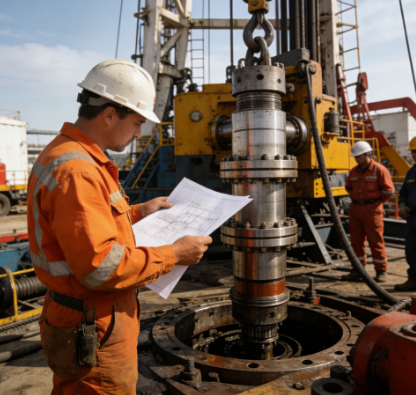
On-site installation should strictly follow drill string assembly procedures. Connections between stabilizers and drill collars or other downhole tools must be clean, centered, and tightened to the specified torque. Avoid striking or dragging blades to prevent surface damage.
For replaceable sleeve stabilizers, ensure sleeves are properly seated and secured to prevent loosening downhole. After installation, recheck the drill string to confirm stabilizer placement matches the design.
Monitoring and Management During Downhole Operations
Once installed, stabilizer performance can be indirectly assessed through drilling parameters. Torque, pump pressure, and rate of penetration fluctuations often relate to stabilizer placement or wear. Real-time data monitoring allows timely detection of potential issues.
Experience in the industry shows that for long sections or complex wells, managing stabilizer service intervals based on cumulative footage or time reduces the risk of downhole incidents.
Standards for Removal and Reuse
After tripping out, stabilizers should be removed and inspected according to standard procedures. Use dedicated tools during disassembly to avoid damaging threads or blades. Assess used stabilizers for wear to determine whether they can be run again.
- Blades exceeding wear limits should be repaired or discarded
- Damaged threads require reworking
- Severely worn coatings should be recoated
Standardized reuse management ensures safety while lowering drilling costs.
Industry Recommended Standardized Management
Many drilling teams now adopt standardized management for stabilizers. Unified selection rules, installation procedures, and inspection standards make stabilizer use more consistent and traceable. This approach improves overall downhole operation quality and reduces non-productive time caused by improper installation.