
An internal mechanical seal is a very common installation structure among mechanical seals, widely used in rotating machinery such as centrifugal pumps, chemical pumps, reactors, and mixing equipment. The term “internal” means the mechanical seal is installed inside the equipment’s sealing cavity, with the sealing end face facing the medium. Its biggest difference from an external mechanical seal lies not only in the installation location but also in the stress distribution, medium contact state, and applicable operating conditions. Many mechanical seals seen in industrial equipment are actually internal structures.
What is an internal mechanical seal?
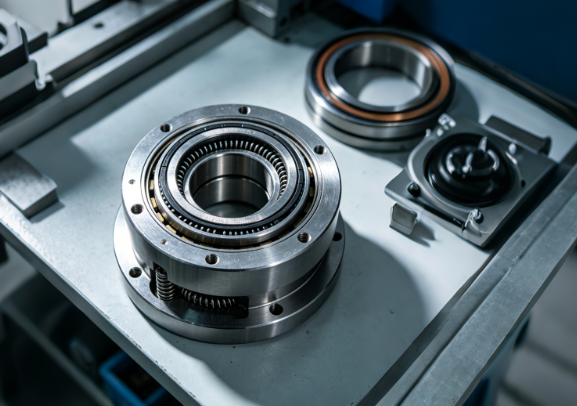
An internal mechanical seal refers to a structure where the dynamic ring, stationary ring, and compensation mechanism of the mechanical seal are installed inside the equipment’s sealing cavity, with the sealing end face facing the medium. It is typically installed where the pump shaft passes through the pump body, preventing medium leakage through the precise fit of the dynamic and stationary ring end faces. An internal mechanical seal is essentially a seal that “works inside the equipment.” The medium pressure mainly acts on the inside of the sealing end face, thus utilizing the pressure of the medium itself to help form a seal. This structure is very common in industry because it occupies little space, is highly adaptable, and is suitable for most common operating conditions.
Internal mechanical seals typically include
a rotating ring, a stationary ring, a spring or bellows compensation mechanism, an auxiliary sealing ring, a gland, and a shaft sleeve. These components together form a dynamic sealing system. During equipment operation, the rotating ring rotates with the shaft, while the stationary ring remains stationary, forming an extremely thin liquid film between them, achieving low-leakage operation. The biggest characteristic of internal mechanical seals is that the medium pressure usually contributes to the contact of the sealing face, thus its sealing stability is good under many medium and low pressure conditions.
How do internal mechanical seals work?
Internal mechanical seals are not simply “installed and finished”; they have a complete workflow from installation to operation.
Pre-installation Inspection and Preparation
Before installation, it is necessary to check whether the shaft sleeve, sealing cavity, shaft diameter, and positioning dimensions meet the requirements, and to confirm that the surfaces of the rotating and stationary rings are free of scratches or dents. Because internal mechanical seals operate inside the equipment, the installation space is often tight, and any small deviation may affect subsequent operation. In addition, it is necessary to confirm the medium parameters, such as temperature, pressure, corrosiveness, and particle content, to ensure that the sealing structure matches the operating conditions.
Mechanical Seal Installation Process
During installation, the stationary ring is usually fixed first, followed by the rotating ring and spring assembly. Because it is an internal structure, the sealing assembly needs to be gradually installed into the sealing cavity from the shaft end. Therefore, the compression and coaxiality must be controlled during installation. If the installation is too tight, the end face pressure will be too high; if the installation is too loose, leakage is likely. Many field problems are not due to a faulty seal itself, but rather to inaccurate installation dimensions.
Start-up and Operation Phase
After the equipment starts, the rotating ring rotates at high speed with the shaft, while the stationary ring remains stationary, forming a micron-level liquid film between them. The medium pressure will push the sealing end face to maintain a stable fit, while the liquid film also provides lubrication and cooling. Internal mechanical seals are not completely “dry contact” during normal operation; they rely on the liquid film to balance friction and sealing effect.
Shutdown and Maintenance
After shutdown, it is necessary to check the sealing end face for wear, crystallization, corrosion, or signs of leakage. If the equipment is shut down for an extended period, it’s also necessary to prevent the medium from crystallizing and jamming the sealing face. Regular maintenance includes checking spring elasticity, the aging of auxiliary sealing rings, and the flatness of the sealing face.
Why are internal mechanical seals widely used?
The core reason why internal mechanical seals have become the mainstream structure in industry is their significant advantages in sealing stability, compact structure, and wide applicability.
l Medium pressure facilitates seal formation
The biggest technical feature of internal mechanical seals is that the direction of medium pressure favors the contact of the dynamic and static rings. The more stable the pressure, the easier it is for a liquid film to form on the sealing face, thus providing good sealing performance under many medium and low pressure conditions. This is why most common centrifugal pumps prefer an internal structure.
l Compact structure and small footprint
Because the sealing components are installed inside the sealing cavity, they do not require much external space. For applications with compact equipment layouts and limited installation space, internal mechanical seals are easier to implement. Compared to external structures, they have less impact on the overall appearance of the equipment.
- Suitable for most standard operating conditions
Internal mechanical seals can be used in conventional operating conditions such as clean water, oil, and general chemical media. They meet basic sealing requirements while offering good cost control, thus having a wide range of applications.
- High requirements for installation accuracy
Although the internal structure is widely used, it has high requirements for shaft runout, coaxiality, and installation dimensions. Because its end face works inside the equipment, shaft eccentricity or excessive vibration can easily cause uneven wear, overheating, or leakage.
- Not suitable for all extreme operating conditions
Internal mechanical seals may have limitations under ultra-high pressure, high vacuum, or strong crystallization conditions. For example, under certain high-pressure conditions, the medium pressure can cause excessive end face specific pressure, thus accelerating wear. Therefore, balanced or external structures may be more suitable for these scenarios.
What materials are used for internal mechanical seals?
The durability of an internal mechanical seal largely depends on the appropriate matching of materials.
- Selection of Materials for Dynamic and Static Rings
Common materials include silicon carbide, tungsten carbide, graphite, and ceramics.
Silicon carbide: Wear-resistant and corrosion-resistant, suitable for most chemical applications.
Tungsten carbide: Stronger impact resistance, suitable for applications with high vibration.
Graphite: Good self-lubricating properties, suitable for applications with poor lubrication.
Ceramics: Lower cost, but weaker impact resistance. Different media and pump types require different material combinations.
- Auxiliary Seal Ring Materials
Auxiliary seal rings typically use:
· Nitrile rubber (NBR)
· Fluororubber (FKM)
· Perfluororubber (FFKM)
· PTFE
Ordinary water pumps can use nitrile rubber, while higher-grade materials must be used for high-temperature or highly corrosive applications.
- Spring and Metal Component Materials
Springs and glands are often made of 304 or 316 stainless steel or Hastelloy. Stainless steel is sufficient for ordinary applications; however, in acidic, alkaline, or chlorine-containing media, stronger corrosion-resistant materials are required.
- Material Selection Should Not Be Based on Single Performance Items
Many people only focus on “which material is harder,” but mechanical seal materials are actually about “pairing relationships.” For example, a hard-on-hard combination, while wear-resistant, has poor impact resistance; a hard-on-soft combination is more suitable for some insufficient lubrication conditions. Truly reasonable material selection aims to achieve a balance in the entire sealing system under actual operating conditions.
Frequently Asked Questions
Which is better, an internal or external mechanical seal?
Internal mechanical seals are advantageous due to their compact structure, wide application, suitability for most common operating conditions, and the fact that medium pressure helps form a seal. Therefore, they are very common in centrifugal pumps and conventional chemical equipment. External mechanical seals, on the other hand, are more suitable for certain highly corrosive, high-viscosity, or easily crystallizing media because their springs and some key structures do not directly contact the medium, reducing the risk of clogging and corrosion.
Common Operating Conditions: Internal Seals are More Common
Highly Corrosive or Special Media: External Seals May Be More Suitable
Therefore, selection should not be based solely on the structural name, but rather on the actual operating conditions.
An internal mechanical seal is essentially a “mechanical seal structure installed inside the equipment.” Its most significant feature is that it utilizes the pressure of the medium itself to help the sealing end face fit, resulting in a compact structure and wide application; many common centrifugal pumps and chemical pumps use this method. Although it may seem like a small component, it actually requires high precision in installation, shaft stability, and material matching. Incorrect installation, excessive shaft vibration, or incorrect material selection can easily lead to problems such as leakage, overheating, and uneven wear. Often, the durability of a mechanical seal depends not only on the product itself, but also on the compatibility of the “equipment, operating conditions, and materials.” The reason why internal mechanical seals have become the mainstream in industry is not because they are “omnipotent,” but because they can balance sealing performance, installation space, and cost control under most standard operating conditions.