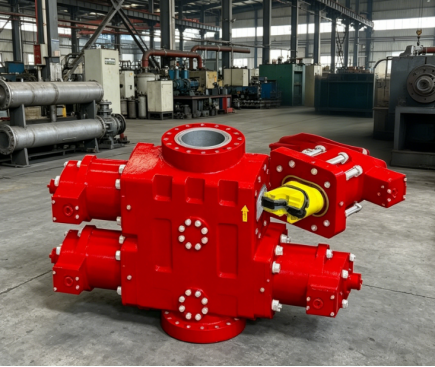
In oil and gas drilling, the downhole environment is often characterized by high-pressure fluids and complex formation variations. Improper control can lead to serious safety accidents. The well control system, as the core system for ensuring drilling safety, includes the blowout preventer (BOP), which plays a crucial role in sealing and controlling the well. Primarily installed at the wellhead, it is used to quickly cut off the fluid flow path in abnormal situations, preventing blowouts. Its structure emphasizes high reliability and rapid response capabilities, ensuring stable operation even under high-pressure conditions. Therefore, it holds an irreplaceable core position in the entire well control system, playing a fundamental role in ensuring personnel safety and stable equipment operation.
Rapidly sealing the wellhead to prevent blowouts
The most critical function of the BOP is to control the wellhead in emergencies.
- When the well pressure rises abnormally, the BOP can quickly close the wellhead passage, preventing high-pressure fluid from escaping.
- Multi-stage sealing is achieved through different gates or annular structures, improving emergency response capabilities.
This rapid sealing capability is the primary reason why the BOP is the core of well control.
Adapting to High-Pressure Environments and Ensuring System Stability
Drilling operations often involve extremely high bottom-hole pressures.
- Blowout preventers (BOPs) are made of high-strength alloy materials, capable of withstanding extreme pressures and impact loads.
- They maintain structural stability even under prolonged high-pressure conditions, avoiding the risk of failure.
This pressure-bearing capacity ensures the continuous and reliable operation of the well control system.
Working in tandem with the well control system for comprehensive control
The well control system consists of multiple devices working together.
- Blowout preventers work in conjunction with choke manifolds and kill systems to achieve comprehensive regulation of well pressure.
- Control modes can be flexibly switched under different operating conditions, improving overall well control efficiency.
This system synergy enhances the overall stability of the well control system.
Enhancing Safety and Reducing Accident Risks
Well control safety is a core objective of drilling operations.
- Blowout preventers effectively isolate high-pressure fluids within the well, reducing the threat of blowouts to personnel and equipment.
- They provide a reliable safety barrier in emergency situations, improving on-site emergency response capabilities.
This safety protection capability makes it an irreplaceable core piece of equipment.
In actual drilling operations, blowout preventers (BOPs) are not merely standalone devices, but rather the most critical safety barrier in the well control system. From rapid sealing and high-pressure withstand capabilities to system coordination and risk protection, each function directly relates to the safety and stability of downhole operations. As oil and gas development continues to advance into deeper and higher-pressure areas, the importance of BOPs continues to increase, and their core role in the well control system becomes increasingly prominent, making them an indispensable key piece of equipment in modern drilling engineering.