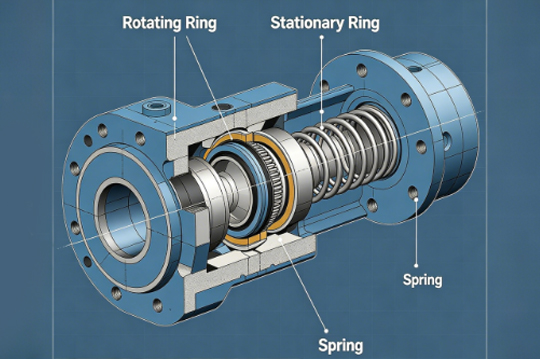
Whether pump equipment must use mechanical seals is not a simple “yes or no” question. In essence, it is a systematic engineering decision based on operating conditions, safety requirements, and maintenance strategy. In industrial applications, there are mainly two types of shaft sealing methods for pumps: mechanical seals and packing seals, while in some special conditions, magnetic seals or diaphragm structures may also be used.A mechanical seal is a high-precision sealing structure that relies on the contact between a rotating ring (dynamic ring) and a stationary ring (static ring), forming an extremely thin liquid film to achieve sealing. It is characterized by very low leakage, stable operation, and suitability for high-pressure, high-speed, and complex media conditions. In contrast, a packing seal achieves sealing through frictional compression between flexible packing material and the shaft. This design inherently allows a small amount of leakage to provide cooling and lubrication.
Therefore, there is no universal rule that pumps must use mechanical seals. The selection depends entirely on application scenarios. For example, chemical pumps, petroleum transfer pumps, and pharmaceutical pumps typically prioritize mechanical seals, while low-pressure clean water pumps or temporary equipment may still use packing seals.
Selection and Application Decision Process for Pump Sealing Methods
· Operating Condition Analysis Stage
The first step is to clearly define the operating conditions of the pump, including fluid properties (corrosiveness, presence of particles), temperature, pressure, and rotational speed. If the medium is toxic, volatile, or high-value—such as chemical solvents or petroleum products—mechanical seals are almost mandatory, because packing seals cannot meet zero-leakage or ultra-low leakage requirements. However, in simple conditions such as room-temperature clean water transport, packing seals may still be sufficient, meaning mechanical seals are not strictly required.
· Safety and Environmental Requirement Evaluation Stage
Modern industries place increasing emphasis on environmental protection and safety standards. If the pump handles toxic, hazardous, or flammable media, even if a packing seal can technically operate, it is often not allowed due to continuous micro-leakage risks. Mechanical seals offer a significant advantage in such cases, enabling near-zero or controlled leakage, which complies with strict safety regulations. Therefore, in high-safety industries, mechanical seals are often not just an option but a standard configuration.
· Economic and Maintenance Cycle Evaluation Stage
In some non-critical applications, companies may choose packing seals to reduce initial costs. However, long-term maintenance frequency must be considered. Packing seals require periodic adjustment or replacement, while mechanical seals can operate for long periods under normal conditions with significantly lower maintenance requirements. Therefore, in lifecycle cost (LCC) analysis, mechanical seals are often more economical over time.
· Final Selection and Operational Validation Stage
After selection, trial operation is necessary to verify sealing performance, including leakage rate, temperature rise, and vibration levels. If the mechanical seal operates stably after startup, the selection is considered appropriate. If abnormal heating or leakage occurs, the flushing system or structural compatibility must be re-evaluated.
Differences Between Mechanical Seals and Packing Seals
Whether pumps must use mechanical seals ultimately depends on several technical factors that define their application boundaries.
Leakage Control Capability:
The biggest advantage of mechanical seals is their superior leakage control. By relying on a fluid film between sealing faces, they can achieve near-zero leakage operation. Packing seals, however, must allow controlled leakage to ensure lubrication and cooling. In toxic, flammable, or high-value media applications, this difference directly determines whether mechanical seals are required, as packing seals cannot meet strict sealing standards.
Differences in Friction Mechanism and Efficiency:
Packing seals involve direct contact friction between the shaft and packing material, resulting in higher energy loss and continuous heat generation. Mechanical seals operate mainly under fluid-film lubrication conditions, significantly reducing friction losses. This gives mechanical seals a clear efficiency advantage, especially in high-speed pump systems.
Impact on Shaft Wear:
Long-term operation of packing seals causes continuous shaft wear, potentially forming grooves or dimensional changes. Mechanical seals, however, cause minimal shaft wear because friction occurs between seal faces rather than directly on the shaft. This is particularly important for high-value pump systems, as shaft repair costs are much higher than seal replacement.
System Dependency Differences:
Although mechanical seals offer superior performance, they are more dependent on system conditions, such as flushing systems, alignment accuracy, and stable operating environments. Poor system design may lead to seal failure. Packing seals, on the other hand, are simpler and more tolerant of harsh conditions, making them still useful in low-demand applications.
Frequently Asked Customer Questions
Q: Should all pumps be upgraded to mechanical seals?
Not necessarily. For low-pressure, low-speed, and non-critical applications, packing seals remain economically reasonable.
Q: Are mechanical seals always safer?
They are safer in high-risk media conditions, but only when correctly selected and properly installed.
Q: Why do some older equipment still use packing seals?
Because they are low-cost, easy to maintain, and sufficient for non-critical applications.
There is no absolute rule that pumps must use mechanical seals. The choice depends on operating conditions.If the application involves clean water, low pressure, and non-critical operation, packing seals are still a practical and cost-effective option. They are simple in structure and easy to maintain.However, in cases involving chemical media, high temperature, high pressure, flammable or explosive fluids, or strict leakage control requirements, mechanical seals are usually the standard solution. This is because they can reduce leakage to extremely low levels while offering more stable operation and longer service life.In short, packing seals prioritize simplicity and cost, while mechanical seals prioritize performance and safety. The right choice is always determined by the working environment rather than a universal rule.