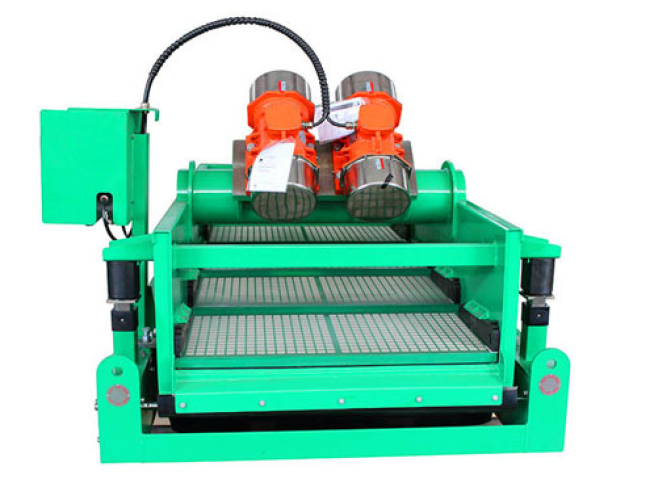
Vibrating screens, also known as vibrating screens, are core solids control equipment in oil drilling mud systems and play a crucial role in mud purification systems. They primarily utilize the excitation force generated by a vibrating motor to induce compound vibrations in the screen box, thereby achieving material movement and stratification on the screen surface, achieving separation and filtration. Depending on the number of vibrations, vibrating screens are typically classified into single-vibrating screens, double-vibrating screens, and triple-vibrating screens to meet different processing capacities and precision requirements. Furthermore, to better adapt to diverse market demands, customized products are offered to meet specific customer needs, ensuring the vibrating screen can precisely match various complex working conditions.
Equipment Features
- High-Efficiency Drive Motor Configuration
Equipped with a high-power magnetic drive motor, this motor offers the significant advantage of zero maintenance, greatly reducing the cost of equipment use and maintenance. Simultaneously, the dual-motor magnetic drive force is between 7.5G and 8G, ensuring stable and powerful vibration during operation, effectively improving material processing efficiency and separation effect.
- Flexible Screen Box Angle Adjustment
The screen box angle of the vibrating screen can be adjusted within the range of 3° to 10°. This design allows operators to flexibly adjust the screen’s tilt angle according to different material characteristics, processing requirements, and on-site conditions, thereby optimizing the material’s movement trajectory and residence time, further improving separation accuracy and processing capacity.
- Robust and Durable Structure
The vibrating screen’s overall structure is made of high-strength steel, possessing excellent resistance to pressure, vibration, and corrosion. It can operate stably for extended periods in harsh working environments, reducing downtime due to equipment failure and improving production efficiency.
- Convenient Screen Replacement
The screen features a quick-disassembly design, making screen replacement simple and convenient, significantly shortening equipment maintenance and screen replacement time. Furthermore, different screen specifications can be easily and quickly replaced according to different separation requirements, improving the equipment’s versatility and adaptability.
Applications
Oil Drilling Industry: In oil drilling mud solids control systems, vibrating screens are mainly used for primary treatment of drilling fluids, removing larger drill cuttings and solid impurities, purifying the drilling fluid, ensuring stable drilling fluid performance, improving drilling efficiency, and reducing drilling costs.
Applications: In the mining and metallurgical industry, vibrating screens are used for screening and classifying ores, separating ores of different particle sizes to provide suitable material particle sizes for subsequent mineral processing, thereby improving beneficiation efficiency and metal recovery rates.
In the coal industry, vibrating screens are used to screen raw coal during coal washing, removing gangue and impurities to improve coal quality. They can also be used to classify washed clean coal to meet the particle size requirements of different users.In the chemical industry, vibrating screens are used to screen and filter chemical raw materials and products, removing impurities and agglomerates to ensure product purity and quality.With its unique design features, wide range of applications, and reliable performance, the vibrating screen has become an indispensable piece of equipment in many industries. As industries continue to demand higher production efficiency and product quality, vibrating screens will continue to play a vital role, constantly innovating and developing to adapt to the diversified needs of the market.
Technical parameters:
| Model | ZS112-QDZ | ZS113-AHB | ZS114-AHB | ZS114-ALD |
| Vibration Trajectory | Linear Motion | Linear Motion | Linear Motion | Linear Motion |
| Processing Capacity (m³/h) | 70 | 120 | 150 | 150 |
| Vibration Motor Power (kW) | 2×0.75 | 2×1.5 | 2×1.72 | 2×1.94 |
| Number of Screens | 2 | 3 | 4 | 4 |
| Screen Size (mm) | 750×900 | 585×1165 | 585×1165 | 585×1165 |
| Screen Area (m²) | 1.35 | 2.04 | 2.73 | 2.73 |
| Excitation Intensity (g) | ≤7.1G | ≤7.5G | ≤7.5G | ≤8.0G |
| Double Amplitude (mm) | 3.92 ~ 5.62 | 4.14 ~ 5.96 | 4.4 ~ 6.34 | 4.4 ~ 6.34 |