A mechanical seal is a critical component used in pumps, compressors, and other rotating equipment to prevent fluid leakage. Its core function is to form an extremely thin liquid film between the rotating ring (dynamic ring) and stationary ring (static ring), achieving a balanced state of “controlled micro-leakage + stable lubrication.” Once the selection is incorrect, it essentially means a failure in matching the seal structure, materials, or operating conditions, which can directly lead to leakage, wear, or even equipment shutdown.
Where Does Incorrect Selection Go Wrong?
· Material Mismatch
When the sealing face materials or elastomer (O-ring) materials are not suitable for the process fluid, issues such as corrosion, swelling, or hardening may occur. For example, using standard carbon steel or non-resistant rubber in highly corrosive media can lead to rapid seal failure. Industry studies show that material incompatibility is one of the major causes of mechanical seal failure.
· Incorrect Operating Condition Matching
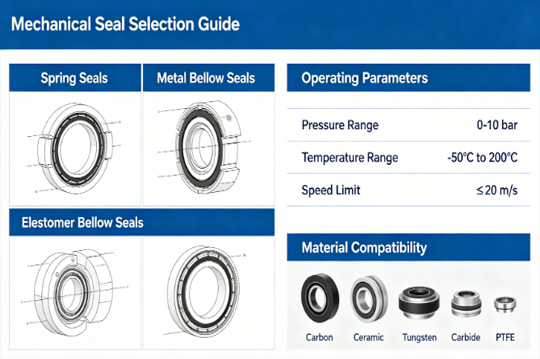
If pressure, temperature, and rotational speed limits are not properly considered during selection, the seal may operate beyond its design range. For instance, excessive temperature can cause sealing face distortion or premature aging and failure of elastomer components such as O-rings.
· Wrong Seal Structure Selection
Different seal structures (single mechanical seal, double mechanical seal, cartridge type, etc.) are designed for different operating conditions. If a standard single seal is used in hazardous or toxic media applications, the risk of leakage increases significantly.
· Misjudged Lubrication and Media Conditions
Mechanical seals rely on the process fluid to form a lubricating film. If the selection does not account for whether the medium contains solid particles or is prone to vaporization, it may lead to dry running, severe friction, and even burning damage of the seal faces.
How Selection Errors Gradually “Amplify” into Failure
Mechanical seal failure is usually not instantaneous but a progressive deterioration process:
Insufficient Information at the Selection Stage:
Many issues originate from incomplete early-stage data collection, such as only providing flow rate without fluid composition, ignoring temperature fluctuations, or not considering start-stop frequency. As a result, suppliers cannot accurately match real operating conditions.
Design and Selection Deviation:
Based on incomplete parameters, seals are often selected “by experience,” leading to:
Lower-than-required material grade
Insufficient structural pressure resistance
Lack of proper cooling or flushing design
Amplification During Installation and Operation:
Even if the system initially runs, incorrect selection will be amplified during operation:
Unstable fluid film → increased friction
Temperature rise → seal face deformation
Vibration increase → uneven wear between rotating and stationary rings
Studies show that dry running and insufficient lubrication can quickly cause sealing face burning and cracking.
Entry into a Failure Cycle:
Eventually, a vicious cycle forms:Leakage → Temperature rise → Accelerated wear → Increased leakage → Shutdown
Specific Failures Caused by Incorrect Selection
Thermal Runaway of Seal Faces
When materials or lubrication conditions are mismatched, a stable fluid film cannot form between the sealing faces, leading to dry friction. This results in:
· Sharp increase in friction coefficient
· Rapid local temperature rise
· Thermal cracking or burning of sealing faces
In severe cases, carbon rings may fracture, carbide faces may crack, and complete sealing failure may occur.
Elastomer (O-Ring) Failure
Incorrect selection often causes premature failure of elastomer components:
Chemical incompatibility → swelling or dissolution
Temperature mismatch → hardening and loss of elasticity
Pressure mismatch → extrusion deformation
Once the O-ring fails, leakage will occur even if the sealing faces are still in good condition.
Structural Load Capacity Insufficiency
If an improper seal structure is selected (e.g., using a low-pressure design in high-pressure service):
· Spring force is insufficient to maintain face contact
· Rotating ring may separate
· Sealing faces cannot maintain proper contact
Typical results include steady dripping leakage or sudden leakage during startup/shutdown.
Vibration-Induced Uneven Wear
If shaft vibration or misalignment is not considered during selection:
· Uneven contact between sealing faces
· Localized severe wear
· Conical wear patterns
This significantly shortens seal life and may cause premature failure several times faster than normal.
Abrasive Wear in Particulate Media
When standard seals are used in fluids containing solids:
· Particles enter the sealing interface
· Scratching channels form on sealing faces
· Leakage gradually increases
This type of damage is usually irreversible and requires full seal replacement.
Frequently Asked Questions (FAQ)
Q: Will a wrongly selected mechanical seal leak immediately?
Not necessarily. Many incorrectly selected seals may still operate initially, but they often experience “delayed failure.” For example, temperature-resistant issues may take days or weeks before cracks appear.
Q: Which is more serious—installation error or selection error?
Selection error is more critical. Installation issues can often be corrected, but selection errors are system-level mismatches that cannot be fundamentally resolved without changing the seal type.
Q: How can I tell if the issue is due to incorrect selection?
Common signs include repeated early leakage in new seals, abnormal darkening or cracking of seal faces, rapid O-ring degradation, or frequent failures despite normal operating conditions.
At its core, incorrect mechanical seal selection means the seal does not match the operating conditions. It is like installing a passenger car braking system on a heavy-duty truck—it may work at first, but problems will appear quickly.In real operation, such issues do not show up immediately. Instead, they develop step by step: first unstable lubrication film, then rising temperature, followed by accelerated wear of sealing faces, and finally continuous leakage or even equipment shutdown.In many field cases, the problem is not poor seal quality, but incorrect initial selection—failure to properly consider the medium, temperature, pressure, and presence of solids. More importantly, once the selection is wrong, later adjustments or maintenance can only provide very limited improvement, because the core sealing components are fundamentally mismatched to the operating conditions.