
To understand the principle of mechanical seals, we can start with something common in our homes. For example, the rubber gasket under a kitchen faucet keeps water inside the pipe and prevents leakage. The ‘original intention’ of a mechanical seal is similar, only it faces more complex scenarios and has stricter requirements.
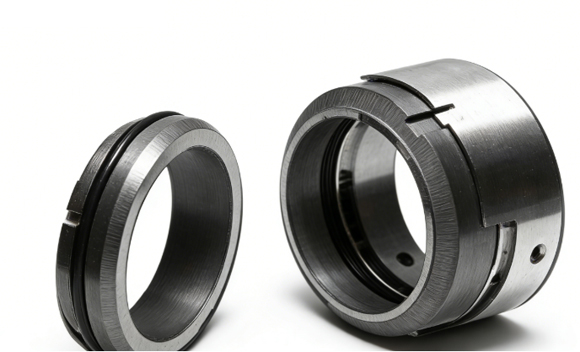
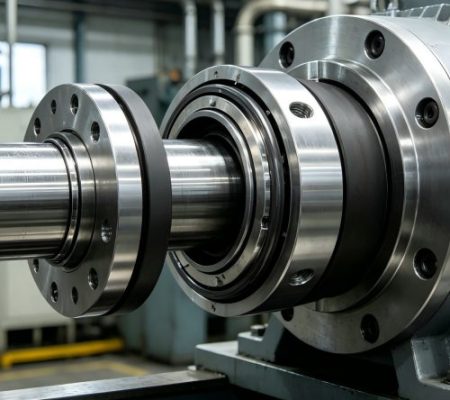
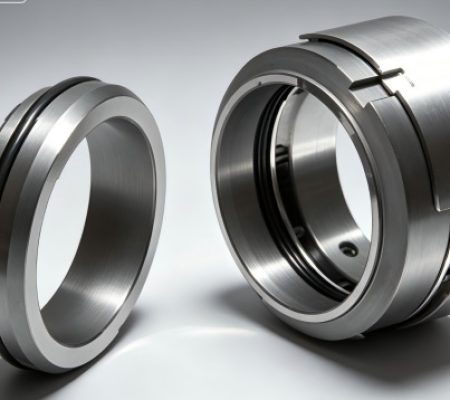
The core of a mechanical seal is the ingenuity of ‘two surfaces tightly pressed together.’ It mainly consists of two parts: a fixed ‘stationary ring,’ tightly adhered to the equipment casing; and a rotating ‘moving ring,’ rotating with the shaft. The contact surfaces of these two rings are polished extremely smooth, like two pieces of freshly wiped glass. When they are tightly pressed together, they form an almost invisible ‘wall,’ blocking the liquid or gas inside and preventing it from ‘slipping away.’
Simply having two surfaces tightly pressed together is not enough. Because the shaft vibrates and the temperature changes during machine operation, the contact surfaces may heat up due to friction or gaps may appear due to pressure changes. Therefore, mechanical seals also contain several ‘helpers.’ For example, the spring acts like an invisible hand, gently pushing the rotating and stationary rings to maintain the appropriate pressure—neither too loose to cause leakage nor too tight to cause excessive wear. The sealing rings, like a group of small guardians, plug other potential leak points, such as the gap between the shaft and the housing, ensuring the entire sealing system is leak-free.
The advantage of this design lies in the ‘dynamic-static combination.’ The rotating ring rotates with the shaft, while the stationary ring remains stationary, but their contact surfaces always remain tightly fitted. When the machine starts, the shaft begins to rotate, the rotating ring rotates accordingly, and the stationary ring, like a steadfast goalkeeper, firmly blocks the internal fluid. Even when the machine operates at high speed and generates vibration, the spring and sealing rings can automatically adjust to keep the contact surfaces in optimal condition.
The principle of mechanical seals is also reflected in their ‘self-repairing’ intelligence. For example, when the contact surfaces experience slight wear due to prolonged friction, the spring pressure automatically causes the rotating and stationary rings to shift slightly, allowing the new smooth surfaces to continue to adhere. This ability to ‘dynamically adjust’ allows mechanical seals to operate for extended periods in harsh environments such as high temperature, high pressure, and strong corrosion, without easily failing. More importantly, the principle of mechanical seals makes them more efficient and environmentally friendly than traditional packing seals. Packing seals are like plugging a crack with a rope; over time, the rope hardens and cracks, leading to increasingly severe leaks. Mechanical seals, through the contact of two smooth surfaces, can reduce leakage by more than 90%, saving resources and avoiding environmental pollution. At the same time, because they reduce internal pressure loss, machines operate more energy-efficiently and effectively.
The principle of mechanical seals is ‘solving complex problems with simple structures.’ They don’t require complex electronic components or frequent manual maintenance; they rely on precise design and a clever combination of materials. Like a lock, where the key and lock cylinder must perfectly match to open, the dynamic and static rings of a mechanical seal must perfectly fit to block the fluid’s ‘escape route.’
Next time you see those rumbling machines in a factory, consider this: it is these small mechanical seals, with their simple principle of ‘two surfaces touching,’ that silently protect the safety, efficiency, and environmental protection of industrial production. They may be inconspicuous, but they are indispensable ‘invisible guardians’ in the modern industrial system.