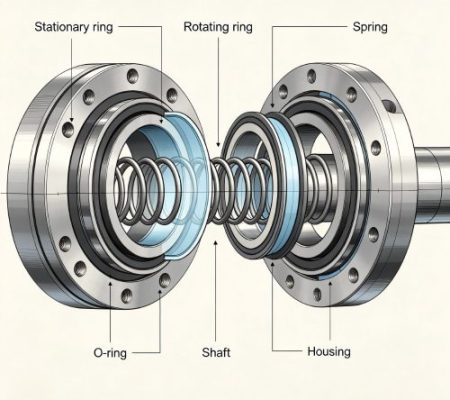
Many buyers encounter the same dilemma when purchasing mechanical seals: why do suppliers quote prices ranging from hundreds to thousands of dollars for the same model, the same size, and even similar appearance? Mechanical seals are not standard parts; they are ‘system components’ that rely on material quality, processing precision, and compatibility with operating conditions. Similar appearances do not guarantee consistent performance, let alone the same lifespan. Especially when conveying corrosive media, materials containing solid particles, or operating under high temperature and pressure, the quality of a seal directly determines the frequency of equipment downtime, safety risks, and annual maintenance costs.

For buyers, the large price difference in mechanical seals is not due to industry chaos, but rather a genuine difference arising from variations in technology, material grade, adaptability to operating conditions, manufacturing precision, and after-sales service. Simply put: cheaper seals ‘look the same,’ but cannot guarantee long-term stable operation under demanding conditions; expensive seals ‘don’t look different,’ but the consistency of key materials, structure, and processing determines whether they can prevent leakage and burnout under complex operating conditions.
Different Material Values
The core value of a mechanical seal lies in its materials; different material grades directly determine its lifespan.
Completely Different End-Face Materials
Silicon Carbide (SSiC): Most expensive, most wear-resistant, and most corrosion-resistant.
Sintered Silicon Carbide vs. Reaction-Sintered Silicon Carbide: Lifespan can differ by 2–3 times.
Carbon Graphite: Cheap but susceptible to dry wear.
Tungsten Carbide (WC): Impact-resistant in metallic applications, but susceptible to corrosion.
Some inexpensive seals use ‘cold-pressed silicon carbide’ or ‘graphite with insufficient carbon content,’ resulting in a lifespan only 1/4–1/3 that of high-quality materials.
Significant Differences in O-ring Materials
FKM (Fluororubber): Temperature resistant up to 200℃
FFKM (Perfluororubber): Temperature resistant up to 300℃, resistant to strong corrosion, price x10
NBR masquerading as FKM: Low cost, easily mistaken for a ‘cheap seal’ – a common way to cut corners.
Differences in Spring and Metal Component Materials
304 Stainless Steel → Lowest cost, but prone to corrosion
316 Stainless Steel → Standard chemical grade
Hastelloy, Duplex Steel → Used only in specialized applications, price can double
Vastly Different Machining Precision
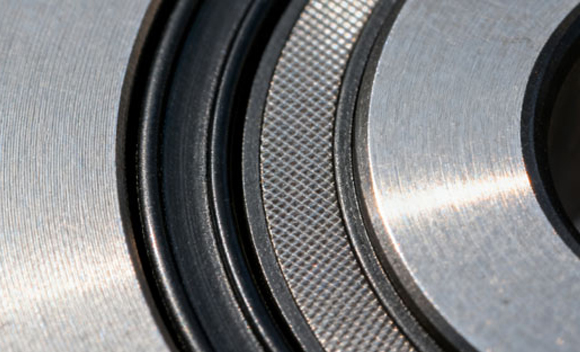
The flatness, roughness, and runout of the mechanical seal end face are key indicators, directly affecting liquid film formation and heat generation.
Good seals: Flatness can reach 1–3 bands. Low-end seals: 10 bands or more.
Invisible, but the effects are completely different:
The lower the band, the less likely the seal is to overheat, dry-grind, or burn out.
Poor-precision seals leak after a few hours.
Good-precision seals can operate stably for 6–18 months or even longer.
Some cheap seals use low-cost processing methods, lack precision grinding equipment, and do not provide flatness test reports, so their lifespan is naturally not guaranteed.
Does the structural design meet the operating conditions?
Many low-priced seals are simple ‘copycats.’ The structural shape is correct, but it is not optimized for real operating conditions.
For example:
A single-end face seal is used when a double-end face seal should be used.
An unbalanced type is used instead of a balanced type.
Flushing (Plan 11/32) should be included, but it is not.
An anti-clogging design is omitted.
The result is:
Uses on the machine → But has an extremely short lifespan.
No leakage → But heats up quickly.
Starts normally → But burns out immediately at high temperatures.
The more demanding the operating conditions, the more obvious the structural differences become. III. Differences in Quality Control
High-end seal manufacturers perform:
Flatness inspection
Pressure and leakage testing
Dynamic ring runout testing
Assembly tolerance inspection
Material spectral analysis
In contrast, cheaper seals typically:
Uninspected incoming materials
Improper machining
Uncontrolled assembly
No testing before shipment
Resulting in:
Poor batch stability
Sometimes usable, sometimes failing within hours
High complaint rate, significant hidden dangers
After-sales and Technical Support
Expensive seal manufacturers often sell solutions, not just products, such as:
Guidance on operating conditions
Providing installation advice
Checking pump alignment and vibration
Analyzing leakage causes
Providing material recommendations based on the medium
These services significantly reduce downtime losses, which are often more than ten times the cost of the seal itself.
Cheap seals lack technical support, offering only a ‘ask me for a quote’ approach, and are unable to diagnose problems.
The price difference in mechanical seals is never about ‘identical appearance but exorbitantly expensive,’ but rather a comprehensive reflection of materials, processes, design, quality control, and service systems. While inexpensive seals do offer a cost advantage, they are suitable for equipment operating under light conditions, low risk, and low requirements. However, in scenarios involving critical processes, continuous operation, corrosive media, high temperatures, high pressures, or high particle content, more expensive seals are not a premium, but rather an investment that truly reduces downtime, minimizes leaks, and improves safety for the company.
For the purchaser, the core of judging the value of a seal is not ‘looking the same,’ but asking three questions:
Are the materials genuine and compliant?
Does the processing precision meet standards?
Can the supplier provide professional selection and technical services?
If all three are clearly reliable, then a higher price for the seal is to avoid greater losses in the future. Mechanical seals are not merely accessories, but ‘core safety components’ of equipment. Choosing the right seal not only improves pump operating efficiency but also allows companies to save significant costs in unseen areas.