
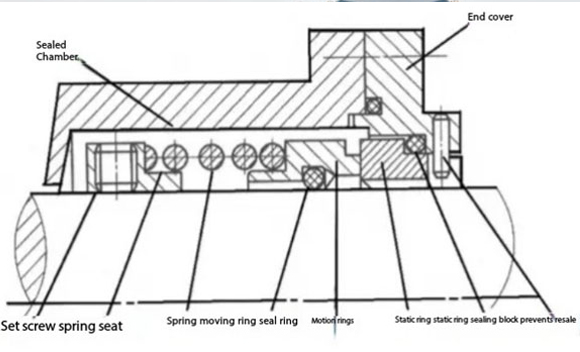
As a critical sealing device in rotating equipment, the performance of a mechanical seal directly affects the reliability and safety of equipment operation. Its sealing system consists of four precision sealing nodes. These nodes achieve dynamic balance through material complementarity and structural design, forming a complete sealing barrier from the media side to the atmosphere side.

Precision Control of End-Friction of Dynamic Seal
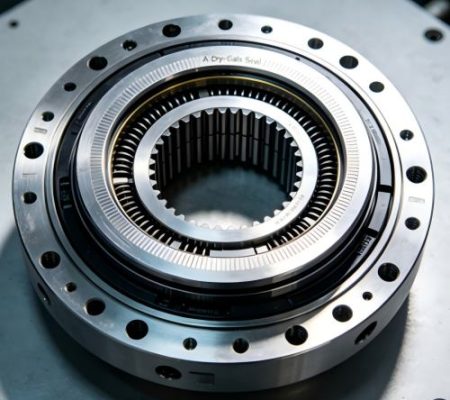
The end-face seal between the dynamic and stationary rings is the ‘heart’ of the mechanical seal and is a typical dynamic seal structure. Under the combined action of spring force and media pressure, the two ring end faces maintain a micron-level gap, achieving non-contact sealing through a liquid film or gas film. Modern high-end mechanical seals often use hard-on-hard pairings such as SiC/SiC and SiC/graphite. The high hardness and corrosion resistance of silicon carbide can withstand high-temperature conditions above 300℃, while the self-lubricating properties of graphite effectively reduce the coefficient of friction to 0.01-0.03. Under high-pressure conditions, the bellows-type dynamic ring compensates for end-face wear through elastic deformation, ensuring a constant sealing specific pressure. End-face groove designs, such as spiral grooves and T-grooves, can form a gas film through hydrodynamic pressure effects, reducing leakage rates to below 1 mL/h, which is particularly important in high-speed equipment such as centrifugal compressors.
Dual Protection of Axial Static Seal for Rotating Interface
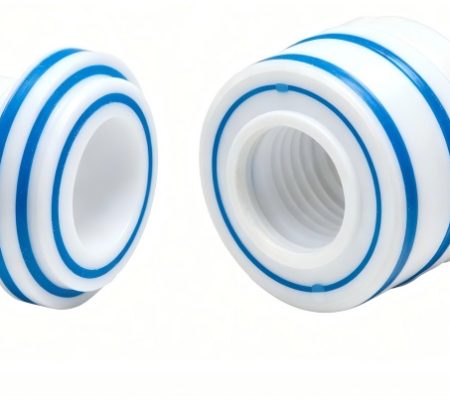
The seal between the rotating ring and the shaft/shaft sleeve uses O-rings, rectangular rings, or elastic bellows structures, which are relatively static seals. The O-ring material must match the operating temperature and media characteristics—nitrile rubber is suitable for mineral oil, fluororubber can withstand strong corrosive media below 200℃, and perfluoroether rubber can resist organic solvents at 300℃. This sealing node must withstand axial movement and radial runout; the O-ring compression ratio (typically 15%-30%) and wire diameter tolerance must be calculated during design. In high-speed shaft scenarios (linear velocity > 30 m/s), V-type combination seals achieve a balance between low friction and high wear resistance through multi-lip design. Failure modes mainly manifest as aging cracking and extrusion seizure, which need to be improved by adding anti-extrusion retaining rings or using PTFE-filled structures.
Sealing Method of Static Seal in Static Seating
The seal between the stationary ring and the stationary ring seat uses a gasket seal or an O-ring seal, which is a purely static seal. Non-metallic gaskets, such as expanded graphite spiral wound gaskets, can withstand temperatures up to 600℃, while metal spiral wound gaskets are suitable for high-pressure conditions. Special attention needs to be paid to the thermal expansion compensation of the stationary ring at this node—in high-temperature conditions, the stationary ring often adopts a floating design with corrugated compensation, absorbing thermal deformation through springs or bellows. In low-temperature conditions, PTFE gaskets are the preferred choice due to their ultra-low temperature adaptability down to -190℃. During installation, the bolt preload must be controlled to avoid excessive compression that could lead to gasket failure; typically, a torque wrench is used to tighten the bolts diagonally in stages.
The Last Line of Defense of the Interface of Static Sealing Equipment
The seal between the stationary ring seat (gland) and the equipment flange constitutes the outer boundary of the mechanical seal system, and is also a static seal. This node often uses a planar seal or a conical seal structure, with sealing elements including metal flat gaskets, elliptical gaskets, or flexible graphite gaskets. In high-pressure reactors and similar applications, octagonal gaskets achieve zero leakage through a wedge-shaped self-tightening effect; in vacuum equipment, fluororubber O-rings can maintain a vacuum level of 10⁻⁶ Pa. During installation, ensure flange parallelism ≤0.1mm, bolt spacing deviation ≤0.5mm, and apply an anti-seize lubricant to prevent thread adhesion.
The quadruple sealing system forms a synergistic sealing system through material matching and stress transfer. For example, in pump mechanical seals, the liquid film pressure on the dynamic ring end face is transmitted to the stationary ring seat, affecting the stress distribution of the boundary seal. Therefore, the overall design requires finite element stress analysis to verify the deformation compatibility of each node under thermo-mechanical coupled loads. Modern intelligent mechanical seals also integrate temperature sensors and vibration monitoring modules, enabling predictive maintenance through real-time monitoring of end face wear, transforming traditional ‘reactive maintenance’ into ‘pre-emptive warning.’
The quadruple sealing system of a mechanical seal is like a sophisticated symphony orchestra, where each part performs its function yet resonates harmoniously. From the hydrodynamic pressure effect of end face dynamic seals to the thermal deformation compensation of boundary static seals, every sealing node embodies a delicate balance of materials science, tribology, and mechanical design. With breakthroughs in new technologies such as silicon carbide coating technology and magnetohydrodynamic sealing, mechanical seals are evolving towards longer lifespan and greater intelligence, continuously safeguarding the ‘leak-free future’ of industrial equipment.