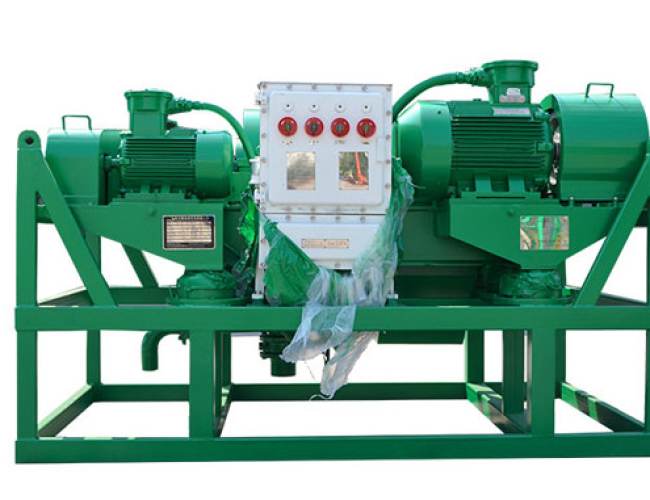
In the intricate landscape of the oil and natural gas industry, ranging from exploration and drilling operations to engineering sites such as horizontal directional drilling, micro-tunneling, and tunnel construction, as well as environmental protection tasks like drilling waste management and wastewater treatment, efficient separation technology is crucial for ensuring the smooth operation of various processes. The decarbonization centrifuge stands out with its outstanding performance in these diverse application scenarios, demonstrating excellent separation effects and becoming an indispensable piece of equipment in the industry.
Assisting Drilling Operations for Cost Reduction and Efficiency Improvement
During oil and natural gas drilling, due to complex geological conditions, the drilling fluid is prone to being mixed with a large amount of solid particles and impurities. The decarbonization centrifuge efficiently separates harmful particles, improves the performance of the drilling fluid, enhances drilling efficiency, reduces accidents and equipment wear, lowers drilling costs, and ensures the stable progress of drilling operations.
Enabling Mud Reuse in Tunnel Engineering
In horizontal directional drilling and tunnel construction, the recycling of mud is of great importance. The decarbonization centrifuge finely treats used mud, removing impurities such as drill cuttings and restoring the mud’s performance, allowing it to be reused multiple times. This reduces mud waste and procurement costs, prevents environmental pollution caused by discarded mud, and contributes to green engineering construction.
Promoting Green Development through Waste Treatment
In the process of drilling waste management and wastewater treatment, the decarbonization centrifuge plays a significant role. It can deeply separate solid waste from liquids, facilitating the harmless treatment or resource recovery of solid waste. The treated liquid, if meeting relevant standards, can be reused or safely discharged. This improves the efficiency and effectiveness of waste treatment and promotes the green and sustainable development of the industry.
Technical parameters:
| Model | LW223 | LW223-VFD | LW363 | LW363-VFD | LW452 | LW453 |
| Bowl Inner Diameter (mm) | 220 | 220 | 360 | 360 | 450 | 450 |
| Bowl Length (mm) | 670 | 670 | 1271 | 1271 | 1105 | 1540 |
| Maximum Treatment Capacity (m³/h) | 2 | 2 | 45 | 45 | 57 | 80 |
| Effective Treatment Capacity (m³/h) | 0.5-2 | 0.5-2 | 30 | 30 | 40 | 60 |
| Maximum Bowl Speed (RPM) | 4800 | 4800 | 3900 | 3900 | 1800 | 3200 |
| Bowl Speed Range (RPM) | 4800 | 0-4800 | 3200 | 0-3200 | 1800 | 1800 |
| Separation Factor (G) | 2840 | 2840 | 3063 | 3063 | 815 | 1974 |
| Separable Particle Diameter (μm) | 2-5 | 2-5 | 2-5 | 2-5 | 5-7 | 5-7 |
| Differential Speed Ratio | 95:01:00 | 57:01:00 | 57:01:00 | 57:01:00 | 57:01:00 | 57:01:00 |
| Differential Motor Torque (N.M) | 1400 | 1400 | 3500 | 3500 | 3500 | 4000 |
| Main Motor Power (kW) | 7.5 | 7.5 | 37 | 37 | 45 | 37 |
| Auxiliary Motor Power (kW) | 3 | 3 | 11 | 11 | N/A | 11 |
| Four-Screw Pump Power (kW) | 1 | 1 | 7.5 | 7.5 | 11 | 7.5 |
| Explosion-Proof Type | ExIIB t4 / IECEx / A – TEX | ExIIB t4 / IECEx / A – TEX | ||||
| Weight (kg) | 750 | 750 | 3300 | 3300 | 2634 | 2900 |
| Overall Dimensions (mm) | 2130x790x1115 | 2130x790x1115 | 3414x1516x1430 | 3414x1516x1430 | 3274x1090x1653 | 3789x1090x1685 |