In oil and gas well and geothermal well operations, fishing operations are a crucial step in ensuring downhole safety and restoring production. As well types increasingly evolve towards deviated and extended-reach wells, the wellbore trajectory becomes more complex, and friction increases. Traditional fishing tools are prone to problems such as difficulty in centering and uneven stress distribution during use. External conical taps, with their unique structural characteristics, demonstrate significant advantages in deviated well fishing operations and have become one of the commonly used fishing tools in complex well conditions.
Technical Challenges of Deviated Well Fishing Operations
Deviated well sections typically have a large inclination angle, making it easier for fishing tools to come into contact with the wellbore during lowering, leading to instability. Fish often fall into the well in an eccentric or tilted state, increasing the difficulty of centering and engagement. Simultaneously, the combined axial and lateral loads in the deviated well environment make the stress on the fishing tool more complex, placing higher demands on the tool’s structure and strength.
Under these conditions, ordinary straight-tube fishing tools are prone to jamming or slippage when entering the inner hole of the fallen fish, affecting the success rate of retrieval.
Structural Characteristics of Externally Tapered Taps
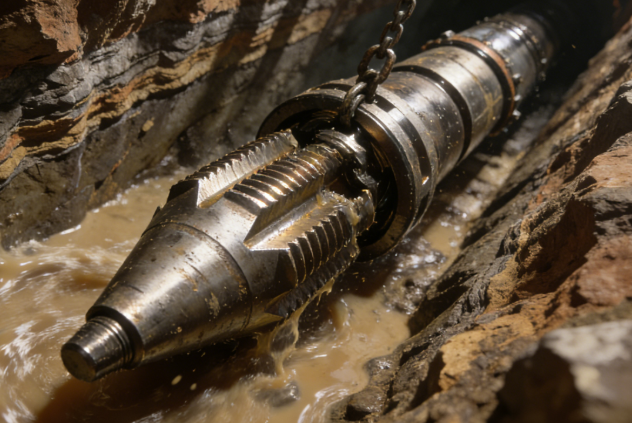
Externally tapered taps employ a tapered outer contour that gradually increases in size, providing natural guidance when entering the inner hole of the fallen fish. The tapered structure allows for gradual contact with the inner hole, achieving a smooth transition and effectively reducing the difficulty of initial engagement.
Their threads are typically specially designed to balance cutting ability and load-bearing capacity, ensuring reliable engagement during retrieval while avoiding excessive damage to the fallen fish.
Advantages of Externally Tapered Taps in Inclined Wells
Compared to vertical well environments, inclined wells place greater demands on the guidance and stability of fishing tools. External tapered taps offer several advantages in deviated well operations, primarily in the following aspects:
The tapered structure facilitates automatic centering, reducing ineffective contact with the well wall.
The engagement process progresses from shallow to deep, reducing the impact load in the initial stages of retrieval.
The force distribution is more uniform, improving overall load-bearing capacity.
These characteristics make it easier for external tapered taps to form stable connections in deviated wells, improving retrieval efficiency.
Practical Performance in Improving Retrieval Success Rate
In deviated well retrieval operations, the success rate often depends on whether the tool can quickly and stably enter the fish and form a reliable engagement. External tapered taps, through a step-by-step engagement method, create a larger contact area between the thread and the inner hole of the fish, thereby improving tensile and torsional resistance. Simultaneously, due to its strong adaptability to well inclination, it can maintain good working condition even when the well section has a certain degree of curvature or eccentricity, reducing repeated attempts and ineffective lowering.
Positive Impacts on Downhole Operation Safety
The application of external tapered taps in deviated well fishing not only improves operational efficiency but also helps reduce operational risks. A stable engagement state can prevent sudden disengagement or secondary fish falling during fishing, thereby reducing the probability of complex downhole accidents.
Key Considerations in Application and Selection
Although external tapered taps have significant advantages, reasonable selection based on specific well conditions is still necessary in practical applications. Factors such as the size of the fish, the well inclination angle, and wellbore conditions should be comprehensively considered to ensure that the tap specifications match the working conditions.
Conducting thorough working condition analysis and scheme design before operation helps to maximize the effectiveness of external tapered taps in deviated well fishing.
Conclusion
With the increasing number of deviated and complex well types, the demand for highly adaptable fishing tools is becoming increasingly prominent. External tapered taps, with their good guiding properties, stable force characteristics, and high fishing success rate, demonstrate significant advantages in deviated well fishing operations. The proper application of this tool can not only improve salvage efficiency, but also provide a reliable guarantee for the safety and continuity of downhole operations.