In oil and gas drilling operations, drilling efficiency and wellbore quality are critical to the success of a project. During drilling, the drill string can experience well deviation, borehole enlargement, or abnormal drill bit wear due to complex formation conditions. To improve controllability and safety, drill stabilizers are essential components of the bottom hole assembly (BHA). They provide structural support and downhole mechanical control, ensuring drill string centralization and wellbore trajectory stability.
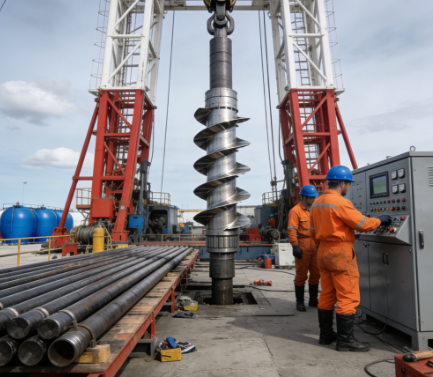
Primary Functions of Drill Stabilizers
The core functions of drill stabilizers involve supporting the drill string, controlling drill bit trajectory, and reducing vibrations, which collectively enhance drilling efficiency and wellbore quality. Specifically, the functions include:
- Well Deviation Control: Stabilizers keep the drill string centered in the wellbore, minimizing deviation during drilling.
- Vibration and Shock Reduction: Stabilizers support the drill string in alternating hard and soft formations, reducing vibration amplitude and impact forces, thereby protecting the drill tools.
- Improved Drill Bit Load Distribution: By adjusting the stiffness distribution of the drill string, stabilizers ensure more uniform bit loading and higher drilling efficiency.
- Protection of Drill String and Wellbore: Stabilizer blades make controlled contact with the wellbore, reducing abnormal friction between the drill string and the formation and lowering wear risks.
These functions work together to maintain operational safety, continuous drilling, and prolonged service life of drilling equipment.
Structural Components of Drill Stabilizers
A typical drill stabilizer consists of:
- Body: Provides the main structural strength, resisting axial and lateral loads on the drill string.
- Blades or Spiral Ribs: Contact the wellbore to support and centralize the drill string.
- Wear-Resistant Layer: Enhances the stabilizer’s lifespan in abrasive downhole environments, ensuring long-term stable operation.
Different stabilizer designs accommodate varying wellbore diameters, formation conditions, and drilling objectives.
Working Principles of Drill Stabilizers
The stabilizer operates on the principle of mechanical support and force balance. As the drill string rotates, the stabilizer blades make multiple points of contact with the wellbore, aligning the drill string along the centerline. This reduces lateral forces on the drill bit, stabilizes the drilling direction, and suppresses well deviation.
In directional drilling, the number and placement of stabilizers can adjust the stiffness distribution along the drill string, passively guiding the wellbore trajectory. This structural control method achieves stability without the need for complex electronic systems.
Types of Drill Stabilizers and Their Applications
Drill stabilizers can be classified according to design and function:
- Straight Blade Stabilizers: Simple structure, suitable for conventional vertical wells, cost-effective.
- Spiral Blade Stabilizers: Enhanced cuttings removal, suitable for formations with alternating soft and hard layers.
- Replaceable Sleeve Stabilizers: Easy to maintain and replace, reducing long-term operational costs.
Choosing the appropriate stabilizer type ensures optimal performance under different well conditions.
Importance of Stabilizer Placement
The position of stabilizers along the drill string directly impacts their effectiveness. Stabilizers near the drill bit primarily control bit direction and limit deviation, while stabilizers placed higher on the string enhance overall drill string stability. A properly designed BHA ensures ideal wellbore trajectory control across varying formation sections.
Operational Considerations
Effective stabilizer use requires consideration of wellbore diameter, formation hardness, and drilling parameters. Overuse may increase friction, whereas insufficient placement may fail to achieve desired stability. Proper control of weight on bit, rotary speed, and real-time monitoring of torque and downhole parameters helps extend stabilizer life and maintain safe operations.
Drill stabilizers play a critical role in controlling well deviation, stabilizing the drill string, and improving wellbore quality in oil and gas drilling. Through careful structural design, selection of the appropriate type, and optimized placement, stabilizers can provide reliable support in various formation conditions. As drilling technology advances, the value of stabilizers in complex wells and high-difficulty drilling operations will continue to grow, making them essential tools for ensuring drilling efficiency and safety.