In oil drilling operations, wire ropes, as the core component connecting the drilling rig and drill strings, directly impact operational safety and economic efficiency due to their fatigue life. Statistics show that drilling accidents caused by wire rope breakage account for over 30%, and predicting their fatigue life in advance can reduce unplanned downtime risks by more than 70%. With advancements in materials science and computational technology, fatigue life prediction models based on multiphysics coupling have become a research hotspot in the industry, providing a more scientific basis for drilling engineering decisions.
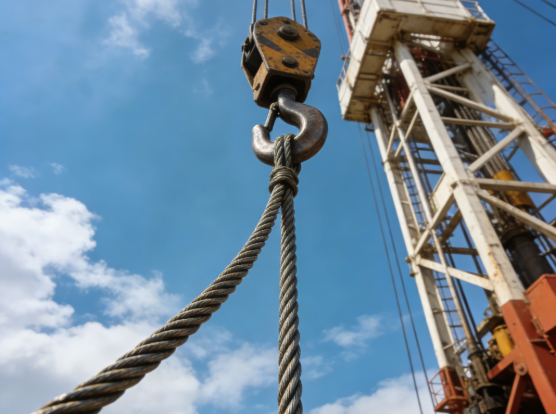
Fatigue damage in wire ropes stems from cyclic loading under complex operating conditions. In deep well drilling, wire ropes must withstand multi-directional stresses, including the drill string’s own weight, drill bit impact force, and wellbore friction. The internal steel wires, within their helical structure, experience complex stress distributions. Studies show that side wires, simultaneously subjected to tensile and shear stresses, have a fatigue life approximately 40% shorter than the core wire, and fatigue cracks often originate in the contact area between the side and core wires. Furthermore, environmental factors also significantly impact fatigue life: in corrosive well fluids containing hydrogen sulfide, the fatigue limit of wire ropes decreases by more than 50%; while high-temperature environments (above 120°C) lead to material grain coarsening and accelerated crack propagation. These multi-factor coupling effects make traditional empirical formulas difficult to accurately predict actual lifespan, necessitating the development of more refined models.
Currently, hybrid prediction models based on finite element analysis (FEA) and machine learning demonstrate significant advantages. By constructing a three-dimensional solid model, the stress-strain distribution of wire ropes under dynamic loads can be accurately simulated, and an initial prediction framework can be established using the S-N curve (stress-life curve). Further introduction of deep learning algorithms allows for feature extraction from massive amounts of experimental data, identifying key parameters affecting fatigue life, such as stress amplitude, loading frequency, and environmental corrosion rate. Field data from an oilfield shows that the error between the wire rope life predicted by this model and the actual fracture time is controlled within 8%, an improvement of more than 60% compared to traditional methods. It is worth noting that the model must also consider the impact of manufacturing processes—a pitch deviation exceeding 5% can lead to contact stress concentration, shortening local fatigue life by 30%; while improper heat treatment processes causing grain boundary weakening can become the source of crack initiation.
To extend the service life of wire ropes, targeted measures must be taken in engineering practice. During the selection phase, a suitable structure should be chosen based on well depth, load spectrum, and environmental conditions. For example, anti-rotation wire ropes are recommended for deep wells to reduce torsional damage. During maintenance, surface corrosion and wire breakage should be regularly inspected, and wire ropes with corrosion rates exceeding 0.1 mm/year should be replaced promptly. Simultaneously, an intelligent monitoring system should be used to collect vibration, tension, and other data in real time, and dynamic assessment of fatigue status should be achieved through edge computing. An application case of an offshore drilling platform shows that combining predictive models with preventative maintenance strategies can extend the average service life of wire ropes to 18 months and reduce maintenance costs by 45%.
With the maturity of digital twin technology, wire rope fatigue life prediction is moving towards a new intelligent stage. By constructing a real-time mapping between physical entities and virtual models, the damage evolution process under different working conditions can be simulated, enabling proactive maintenance through “prevention before damage occurs.” In the future, with breakthroughs in quantum computing and new materials science, the predictive model will further integrate microstructure evolution and multi-scale damage mechanisms, providing drilling engineering with more accurate and reliable life management solutions. Driven by both safety and efficiency, wire rope fatigue life prediction technology will undoubtedly become a core engine for promoting high-quality development in the drilling industry.