In oil and gas field development, choke manifolds, as core equipment for controlling well kicks and implementing pressure management, are crucial for the safety and efficiency of drilling operations. However, in the harsh winter environment, the fluid inside the manifold is prone to freezing due to low temperatures, leading to valve jamming, pipeline rupture, and other malfunctions, thus triggering well control risks. Therefore, scientifically formulating winter antifreeze measures for choke manifolds has become an important issue for ensuring the continuity of oil and gas production.
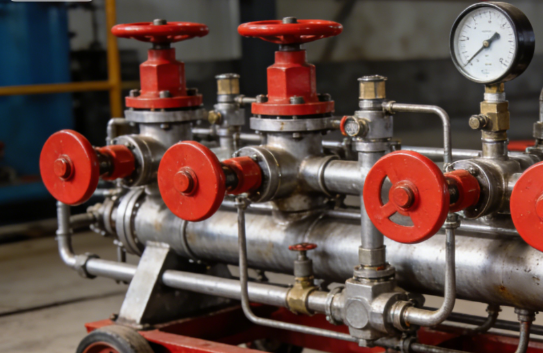
Antifreeze protection for choke manifolds requires a coordinated approach from three aspects: equipment design, material selection, and operating procedures. During the design phase, antifreeze structures should be prioritized, such as burying pipelines below the frost line to utilize the constant temperature characteristics of the formation to insulate against external low temperatures. For exposed pipelines, double-layer insulation sleeves should be installed, with the inner layer filled with high-efficiency thermal insulation materials such as polyurethane foam and the outer layer covered with waterproof galvanized steel plates. This prevents cold air penetration and avoids snowmelt seeping into the pipe wall. In terms of material selection, key components such as throttle valves and gate valves must be made of corrosion-resistant alloys with a titanium and nickel content exceeding 50%. These alloys must maintain their toughness under extreme temperature differences ranging from -30℃ to 121℃, preventing seal failure due to thermal expansion and contraction. Simultaneously, low-temperature resistant sealing rings should be used at pipeline connections. These rings should have silicone oil added to their rubber formulation, maintaining elasticity at -40℃ and preventing fluid leakage leading to freezing.
Operational antifreeze measures must be implemented throughout the entire drilling operation cycle. During routine maintenance, the antifreeze performance of manifold pressure gauges, sensors, and other electronic components should be checked regularly. For exposed instruments, electric heating tape can be installed, and an intelligent temperature control system can maintain their operating temperature above 5℃. During low-temperature warnings, residual fluid in the manifold must be emptied in advance: after shutting off the blowout preventer, first open the throttle valve bypass channel, use a mud pump to circulate the drilling fluid in the pipe to the separator, and then inject antifreeze (such as a 1:2 mixture of ethylene glycol and water) through the kill line to ensure that the freezing point of the medium in the pipe is lower than the local minimum temperature. For frozen pipelines, direct heating with open flame or hammering is strictly prohibited. A staged thawing method should be used: first, wrap the frozen area with a hot towel, then slowly pour 30°C warm water along the pipeline. After the ice softens, start the mud pump to circulate antifreeze at a low flow rate, gradually restoring the manifold diameter.
Antifreezing measures under special operating conditions need to be dynamically adjusted according to well control requirements. In soft shut-in operations, when a blowout occurs, first open one side of the choke valve, then close the blowout preventer, and finally close the gate valve. During this process, the casing pressure gauge readings must be continuously monitored to prevent water hammer from causing the manifold to freeze. If a hard shut-in method is used, the electric heating system must be started immediately after closing the blowout preventer to avoid localized stress concentration through uniform heating. For high-pressure well operations, temperature sensors can be installed at key manifold nodes. When the pipeline temperature is detected to be below 0°C, an alarm is automatically triggered and the heating device is activated, forming a closed-loop management system of “monitoring-early warning-response”. In addition, a comprehensive pressure test of the manifold is required before winter operations to simulate its pressure-bearing capacity under low-temperature conditions, ensuring stable operation of the equipment even under extreme conditions.
Winter antifreeze is not only a technical issue but also a systematic project of safety management. From antifreeze design in the design phase to stringent standards for material selection and meticulous management of operating procedures, every link must be strictly controlled with the goal of “zero freezing and blockage.” By constructing a full-chain antifreeze system of “prevention-monitoring-response,” the throttling manifold can build an indestructible safety barrier in the severe cold, safeguarding winter production in oil and gas fields.