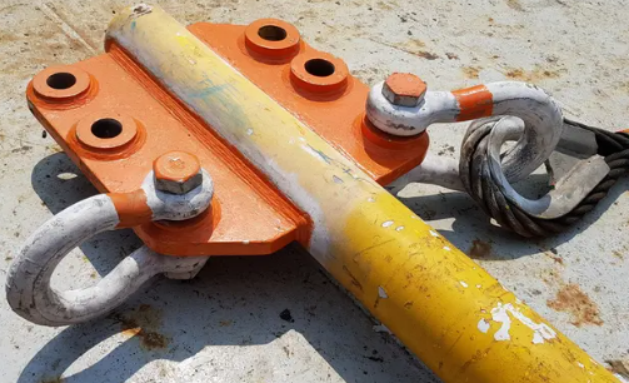
Elevator links are a critical component of wellhead tools used in oil and gas operations. They connect the elevator to the lifting system and bear the full weight of drill strings or casing during hoisting operations. Their reliability directly affects operational safety and overall well control.
High-quality elevator links are typically manufactured from high-strength alloy steel, forged, heat-treated, and strictly inspected to ensure sufficient load capacity and fatigue resistance. However, under long-term exposure to heavy loads, cyclic stress, and harsh field environments, elevator links inevitably experience wear, fatigue, and potential cracking. Therefore, scientific service life evaluation and effective life extension methods are essential for safe wellhead operations.
What Is Elevator Link Service Life Evaluation?
Service life evaluation refers to the systematic assessment of an elevator link’s remaining safe usable life (Remaining Useful Life, RUL) by analyzing its operating condition, load history, and material fatigue status. Unlike simple time-based replacement, proper evaluation is based on actual working conditions and measurable technical data.
Typical evaluation includes:
Visual inspection: Checking for cracks, deformation, corrosion, and surface damage
Dimensional inspection: Measuring critical dimensions to confirm compliance with original tolerances
Mechanical performance checks: Assessing strength degradation through load testing
Non-destructive testing (NDT): Magnetic particle testing, dye penetrant testing, and ultrasonic testing to detect surface and internal defects
Load history and operating condition analysis: Reviewing cyclic loading frequency and peak load events
Only through a comprehensive evaluation can the remaining service life be accurately determined.
Key Factors Affecting Elevator Link Service Life
1. Material and Manufacturing Process
Elevator links produced from forged high-strength alloy steel and properly heat-treated exhibit superior load-bearing capacity and fatigue resistance. Forging significantly reduces internal defects and improves structural integrity, making it essential for heavy-duty wellhead tools.
2. Load Type and Frequency
Elevator links are subjected not only to static loads but also to repeated cyclic loads, impact loads, and lateral forces, all of which accelerate fatigue damage and reduce service life.
3. Corrosive Operating Environment
Exposure to drilling fluids, salt spray, well fluids, and corrosive gases can lead to surface corrosion and micro-crack initiation, significantly accelerating fatigue failure.
4. Maintenance and Inspection Practices
Insufficient inspection and maintenance greatly increase the risk of premature failure. Regular monitoring allows early detection of defects and timely corrective action.
How to Scientifically Evaluate Elevator Link Service Life
1. Regular Non-Destructive Testing
Using magnetic particle testing (MT), penetrant testing (PT), and ultrasonic testing (UT) helps identify early-stage surface and subsurface defects before they develop into critical failures.
2. Load History Tracking and Analysis
Recording actual lifting loads and operating cycles enables engineers to assess whether the elevator link has experienced overloads or excessive fatigue cycles beyond its design limits.
3. Fatigue-Based Life Assessment
For critical lifting components, fatigue analysis combined with operating condition simulations can be used to estimate remaining service life and determine optimal replacement intervals.
Effective Methods to Extend Elevator Link Service Life
1. Select High-Standard Materials and Manufacturing Quality
Choose elevator links that comply with recognized industry standards (such as API specifications) and are manufactured with certified forging and heat treatment processes.
2. Implement Effective Corrosion Protection
Applying anti-corrosion coatings, rust inhibitors, or protective surface treatments can significantly slow down material degradation, especially in corrosive environments.
3. Control Load and Avoid Impact Overloading
Strictly operating within the rated load limits and minimizing sudden shock loads can greatly reduce fatigue crack initiation and propagation.
4. Establish Preventive Maintenance and Replacement Plans
Combining inspection results with planned maintenance schedules ensures that elevator links approaching the end of their service life are replaced before safety is compromised.
Conclusion
As a key lifting component in wellhead tool systems, the service life of elevator links is not defined by a fixed time period but by a combination of material quality, loading conditions, environmental exposure, and maintenance practices. Through systematic life evaluation and proper maintenance strategies, operators can accurately predict remaining service life, prevent accidents, and maximize equipment utilization.
By integrating non-destructive testing, load analysis, and disciplined operating procedures, elevator link safety and reliability can be significantly improved while reducing maintenance costs and operational risks.