In the oil drilling industry, the precision of cost control directly determines a company’s market competitiveness. With the continued growth in global energy demand, how to reduce costs and increase efficiency while ensuring safety and quality has become a core issue for the industry. The breakthrough application of automated drilling rig technology is bringing revolutionary cost optimization solutions to the industry by systematically restructuring drilling operations.

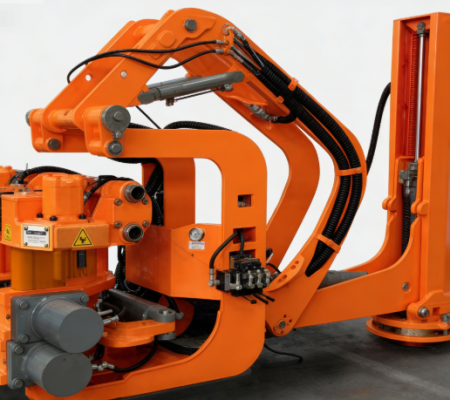
In traditional drilling operations, the dual bottlenecks of reliance on manpower and equipment efficiency have long constrained cost optimization. Taking the Shunbei Block in the heart of the Taklamakan Desert as an example, during conventional drilling operations, three operators are required for the drilling rig and the second-level platform. Operations such as hydraulic tongs, column coupling, and hoisting are all done manually. This model is not only labor-intensive and inefficient, but also carries a high risk of mechanical injury due to human factors. The fully automated 9000-meter drilling rig introduced by the Northwest Oilfield, through the integration of intelligent equipment such as drilling rig robotic arms, second-level platform robotic arms, and powered catwalks, has achieved a “robotic arm replacing manual labor” operation mode. Operators only need to remotely control the robotic arm via a wireless joystick, and it can complete a single-column erection within 3 minutes and 20 seconds, improving efficiency by 12.5% compared to manual operation. This leap in efficiency directly translates into cost savings. Data shows that automated drilling rigs shorten single-well cycles by 15%, reduce the time spent on complex faults by 30%, and lower overall costs by 15%.
This qualitative leap in equipment efficiency is the core driving force behind the cost reduction of automated drilling rigs. Traditional drilling rigs are limited by the precision of manual operation, resulting in lags in adjustments to parameters such as drill pressure and rotational speed, leading to frequent problems such as accelerated drill bit wear and wellbore trajectory deviation. Automated systems, by collecting over 200 parameters such as drill pressure, torque, and drilling speed in real time, and combining them with AI algorithms to build dynamic optimization models, achieve millisecond-level adjustments to drilling parameters. The DrillOps system, jointly developed by Schlumberger and NOV, in its application in the Permian Basin, has reduced control loop time from 20 minutes to real-time response through an autonomous downhole control system, improving wellbore trajectory accuracy by 40% and extending drill bit life by 30%. This precise control not only reduces non-productive time but also creates a continuous cost-reduction effect by lowering the consumption of consumables such as drill bits and drilling tools.
The leapfrog improvement in safety management further solidifies the foundation for cost optimization. In drilling operations, losses from accidents such as blowouts and stuck pipe often account for more than 20% of the cost of a single well. Automated drilling rigs, through their “unmanned red zone” design, have robotic arms complete all operations in high-risk areas such as the second-level platform and drilling platform, forming multiple safety barriers in conjunction with intelligent blowout preventer assemblies and real-time pressure monitoring systems. Data from a certain oilfield shows that after the application of automated drilling rigs, the accident rate decreased by 65%, and downtime losses due to accidents decreased by 80%. This improvement in safety efficiency essentially replaces post-accident repair costs with preventative investment, forming a more sustainable cost-reduction path.
At a deeper level, the operational model transformation driven by automated drilling rigs is reshaping the industry’s cost structure. In traditional drilling operations, labor costs, equipment maintenance costs, and accident handling costs constitute the three major expenditure segments, accounting for 25%, 30%, and 15%, respectively. The application of automation technology systematically reduces these three costs by decreasing on-site personnel, extending equipment’s trouble-free operating cycle, and lowering the accident rate. Taking an international energy company as an example, its automated drilling rig operation data shows that single-well labor costs have decreased by 40%, equipment utilization has increased to 92%, and accident-related costs have decreased by 70%, ultimately achieving a breakthrough result of a 30% reduction in overall single-well costs.
Currently, the global energy industry is accelerating its transformation towards intelligent and green practices. Automated drilling rigs, as a key carrier in this process, not only achieve direct cost reduction through technological iteration but also build a virtuous cycle of “efficiency-safety-cost” for the industry through data-driven operational model innovation. With the deep integration of technologies such as 5G communication, digital twins, and edge computing, future drilling operations will achieve fully autonomous decision-making and zero-contact operation, continuously expanding the space for cost optimization. In this industry transformation led by technological revolution, automated drilling rigs are redefining the cost boundaries and value standards of oil drilling with an irreversible trend.