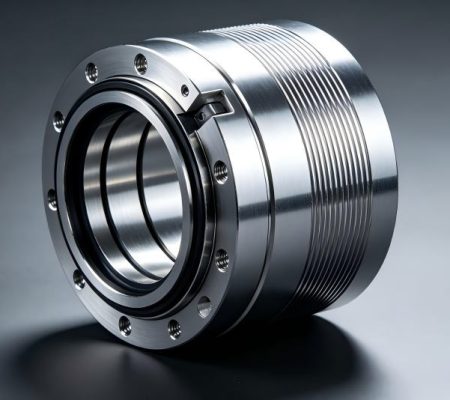
In modern industrial equipment, sealing systems not only affect the stable operation of equipment but also directly impact energy efficiency and production safety. Traditional contact mechanical seals rely on physical contact between the sealing faces to achieve gas or liquid isolation. However, this contact method is prone to wear, frictional heat accumulation, and fatigue failure, especially in high-temperature, high-speed, high-pressure, or corrosive media environments, where long-term stable sealing performance is difficult to maintain. Non-contact sealing technology has emerged to address this issue. By optimizing the end-face structure, utilizing fluid dynamics, and minimizing gaps, it achieves a sealing effect without direct contact. This sealing method not only reduces wear and energy loss but also significantly extends seal life and maintains stable sealing performance under extreme operating conditions. Non-contact seals are widely used in high-end industrial equipment such as refrigeration compressors, gas compressors, vacuum equipment, and chemical pumps, becoming an important development direction for modern industrial sealing technology.
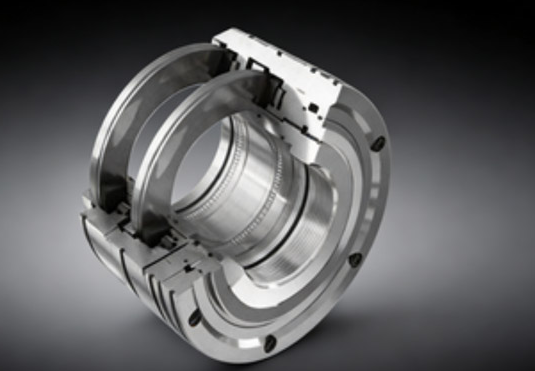
Basic Principles of Non-contact Seals
The core of non-contact sealing lies in forming an extremely small gap between the end faces, achieving sealing isolation through fluid dynamics. Its working principle mainly includes the following aspects:
Micro-gap isolation
A micron-level gap is maintained between the sealing end faces to avoid direct physical contact. The gap size is precisely calculated to prevent large-scale leakage of the medium and maintain hydrodynamic balance during rotation or axial movement.
Hydrodynamic sealing effect
Utilizing the hydrodynamic force generated by rotation or movement, a high-pressure fluid film is formed between the sealing end faces. This film can withstand pressure differences, forming an effective barrier layer, thereby achieving a sealing effect in a non-contact state.
Optimized end face geometry
The sealing end faces typically adopt grooved, spiral, or micro-textured designs. By changing the gap distribution and fluid flow path, the hydrodynamic effect is enhanced, further improving the sealing performance and ensuring effective isolation even under high-speed rotation or pressure fluctuations.
Design characteristics of non-contact seals
Non-contact seals have significant structural and material advantages in design:
Dual-end face series design
Many non-contact seals use a main and auxiliary dual-end face series design. The main end face is responsible for the main sealing, while the auxiliary end face provides safe isolation when the main seal fails, ensuring only a very small amount of leakage of the process medium.
Polymer and Metal Composite Materials
The sealing ring material is typically made of high-temperature, pressure-resistant, and corrosion-resistant polymer or metal composite materials. This not only ensures stability under extreme operating conditions but also reduces friction and heat buildup.
Rotating Ring Encasing Structure
Under high-speed rotation or instantaneous pressure impact, the outer circumferential encasing design of the rotating ring protects the sealing end face, preventing secondary damage while maintaining the integrity of the auxiliary seal.
Integral Modular Design
The integrated design facilitates installation, adjustment, and disassembly, reducing the risk of leakage due to installation errors and improving on-site maintenance efficiency.
Application Advantages of Non-Contact Seals
Compared to traditional contact seals, non-contact seals offer multiple advantages in industrial applications:
Long Lifespan and Low Maintenance
Because there is no direct contact between the end faces, friction and wear are minimal, significantly extending the seal lifespan and reducing maintenance cycles.
Adaptability to Extreme Conditions
It can withstand high-temperature, low-temperature, high-speed, high-pressure, and corrosive media environments, ensuring stable operation of equipment under complex conditions.
Reduced Energy Consumption
Reduces end-face friction loss, making equipment operation more efficient while reducing bearing load and energy consumption.
Safety and Environmental Protection
Even in the event of main seal failure, the auxiliary seal can still control leakage, enabling media recovery or reducing environmental impact, meeting energy conservation, emission reduction, and safe production requirements.
Work Environment and Industry Value
Non-contact seals are suitable for various high-end industrial equipment and critical operating conditions:
High-speed rotating equipment
such as refrigeration compressors and gas compressors, maintaining a seal under high speeds below 180 m/s.
High-pressure and high-temperature systems
Can withstand pressures of 0~25 MPa and temperatures from -160℃ to 260℃, meeting the demands of harsh operating conditions.
Low-temperature and vacuum conditions
In low-temperature or vacuum equipment, the tiny fluid film between the sealing end faces can maintain long-term isolation, effectively preventing leakage.
Through this highly adaptable design, non-contact seals not only improve equipment operational reliability but also reduce maintenance costs and environmental risks, becoming one of the key technologies for modern high-end industrial equipment.
Non-contact seals achieve highly efficient sealing without contact through micro-gap design, hydrodynamic effects, optimized end-face geometry, and material selection. The series design of main and auxiliary end faces, the rotating ring encapsulation structure, and the application of polymer or metal composite materials ensure long-term stable sealing performance in high-speed, high-pressure, high-temperature, or low-temperature environments. Compared to traditional contact seals, non-contact seals not only significantly extend service life and reduce energy consumption, but also control leakage through auxiliary seals in the event of main seal failure, enabling media recovery and environmental protection. This technology has wide application value in high-end industrial equipment such as refrigeration compressors, gas compressors, vacuum equipment, and chemical pumps.