During oil and gas drilling operations, the quality of casing connections directly affects wellbore stability and subsequent production safety, with torque control being a critical link in casing connections. If the torque is too high, it can easily cause thread damage and equipment wear; insufficient torque may lead to loose connections or even leakage. As an important device for making up and breaking out casing connections, the casing tong needs to deliver stable and precise torque output under high-load conditions. Modern equipment places greater emphasis on clamping stability, hydraulic control precision, and automated operation capabilities, enabling more accurate torque management under complex working conditions, thereby improving construction quality and operational efficiency.
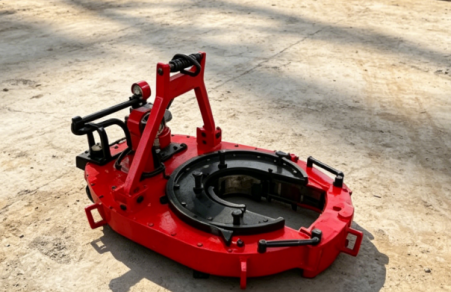
Stable Clamping Structure Improves Torque Transmission Accuracy
Precise torque control requires a stable clamping foundation.
- The casing tong uses a high-strength clamping structure to firmly secure the casing, reducing slippage and misalignment.
- An evenly distributed force design allows torque to be transferred more stably to the casing connection point.
- Stable clamping also reduces thread wear, improving connection reliability.
This clamping capability provides a foundation for precise torque control.
Hydraulic System Enables Stable Output
The hydraulic system plays an important role in torque control. The casing tong uses hydraulic drive to provide continuous and stable power output, allowing the equipment to maintain balanced torque during make-up and break-out operations, reducing fluctuations and impact issues. At the same time, hydraulic parameters can be adjusted according to different casing specifications and construction requirements, thereby improving torque control accuracy and avoiding connection damage caused by instantaneous uneven force. This stable output method not only improves connection quality but also enhances the continuity and stability of on-site operations.
Precise Parameter Adjustment Reduces Connection Errors
Different construction environments have varying torque requirements.
- The casing tong can set corresponding torque parameters according to construction standards, improving connection consistency.
- Precise adjustment avoids rework issues caused by excessive or insufficient torque.
- Standardized parameter control also improves casing sealing performance and wellhead safety.
This parameter management approach helps enhance overall construction quality.
Improved Automation Level Optimizes Construction Efficiency
Modern drilling operations have increasingly high requirements for equipment intelligence.
- An automated control system monitors torque changes in real time, improving operational accuracy.
- Reducing manual adjustments effectively improves on-site construction efficiency.
- Intelligent operation also reduces human error, enhancing the stability of continuous operations.
This automation capability makes torque control more efficient and reliable.
In modern drilling engineering, the casing tong is not just a connection tool but a key piece of equipment for ensuring casing connection quality. From clamping stability to hydraulic output, and further to parameter adjustment and automated control, its role is evident throughout the entire casing connection process. Through proper use and standardized operation, torque control accuracy and construction efficiency can be effectively improved, providing more stable and reliable support for drilling engineering.