
In modern industrial equipment, mechanical seals are crucial components, especially in rotating equipment such as pumps, compressors, and mixers, where they play a vital role in preventing liquid or gas leakage. Compared to traditional packing seals, mechanical seals offer advantages such as reliable sealing, low wear, and low maintenance costs, making them widely used in industries like petrochemicals, pharmaceuticals, and food processing.
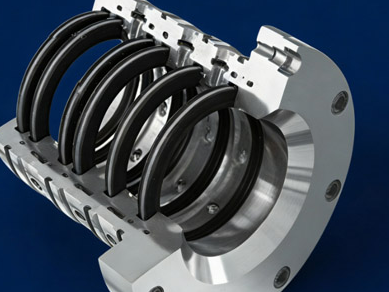
Core Components of a Mechanical Seal
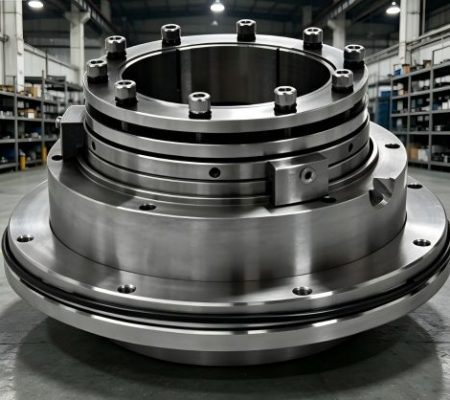
The most critical parts of a mechanical seal are the rotating ring and the stationary ring.
Rotating Ring: Typically mounted on the rotating shaft and rotating with it. Its main function is to form a sealing surface with the stationary ring, preventing media leakage along the shaft. The rotating ring is generally made of high-hardness materials, such as silicon carbide, tungsten carbide, or ceramics, to ensure wear resistance and high-temperature resistance. The rotating ring structure sometimes incorporates a spring or balance ring to maintain stable contact pressure at the sealing surface.
Stationary Ring: Fixed to the machine body or pump body and not rotating with the shaft. It forms the sealing interface together with the smooth contact surface of the rotating ring. The stationary ring material is typically graphite, ceramic, or a metal composite material, requiring both wear resistance and corrosion resistance. The stationary ring has various structural forms, and can be designed as an internal, external, or end-face type depending on the equipment space and operating conditions.
The contact surfaces of the rotating and stationary rings are usually precision-machined to ensure high flatness and low roughness, thereby reducing leakage and friction. Their structural design directly determines the durability and sealing effect of the seal.
Auxiliary Components
In addition to the rotating and stationary rings, mechanical seals rely on a series of auxiliary components to maintain sealing performance:
Springs: Springs provide a stable clamping force to the rotating ring, ensuring good contact between the sealing surfaces even under shaft vibration or media pressure fluctuations. Springs come in various forms, including helical springs, wave springs, or spring assembly designs; the specific choice depends on the seal structure and operating environment.
Packing or O-rings: These components are usually mounted on the back of the rotating or stationary rings to assist in sealing, absorb vibration, and compensate for installation clearances. Common materials include fluororubber and silicone rubber, requiring temperature resistance, corrosion resistance, and good elasticity.
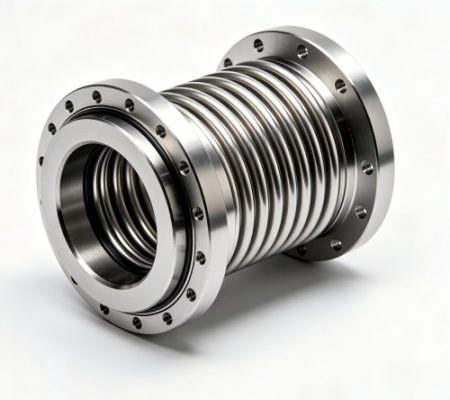
Auxiliary sealing components: Such as end cap seals and metal bellows, used to enhance sealing reliability or adapt to special operating conditions. For example, under high pressure, high temperature, or highly corrosive media, auxiliary seals can provide additional protection and extend the life of the mechanical seal.
Installation Structure
The installation structure of a mechanical seal is also a crucial factor affecting its sealing performance. Common types include:
Single-end face seal:The most common type, with only one sealing surface between the dynamic and static rings, suitable for most conventional operating conditions.
Double-end face seal:With a sealing surface at each end of the dynamic ring, it can withstand higher pressures or prevent media leakage to both ends, commonly used in high-pressure pumps or critical operating conditions.
Balanced and unbalanced structures:Balanced seals distribute pressure evenly through a special structure, making the sealing surface stress uniform, suitable for high-pressure conditions; unbalanced structures are simple and low-cost, suitable for low-pressure conditions.
Multi-spring and single-spring structures:Multi-spring structures can evenly distribute pressure, adapting to shafts with eccentricity or significant vibration; single-spring structures are compact and easy to install, commonly used in small pumps.
The choice of different installation structure types depends on the equipment operating conditions, media properties, and maintenance requirements. A well-designed installation structure can significantly improve the seal’s lifespan and reliability.
Mechanical seals mainly consist of a rotating ring, a stationary ring, a spring, packing, and auxiliary sealing components, which work together to form a reliable sealing system. The rotating and stationary rings are the core of the seal, controlling leakage through precise contact surfaces; the spring and auxiliary sealing components ensure uniform pressure on the sealing surface, absorb vibration, and adapt to gaps; the installation structure determines whether the seal can adapt to different pressure, temperature, and operating conditions.