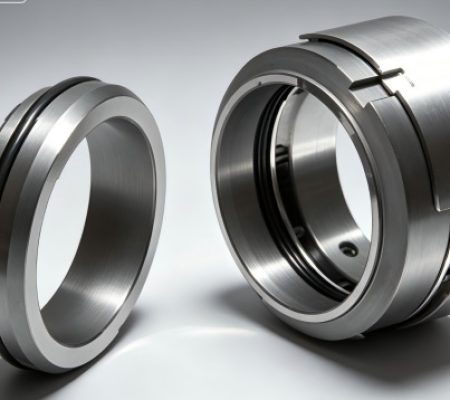
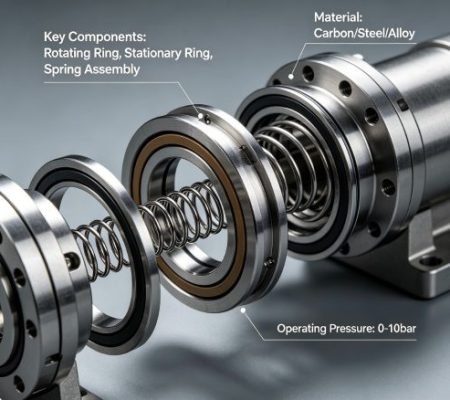
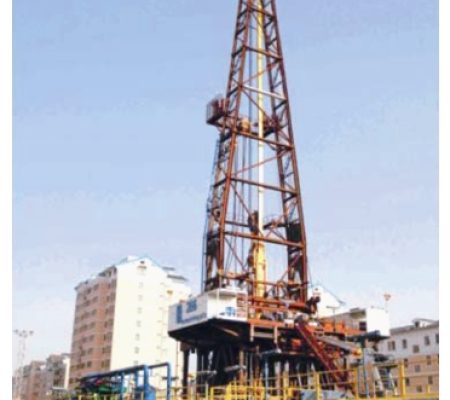
Mechanical seals are critical components for achieving axial dynamic sealing in pump equipment, consisting of a rotating ring, stationary ring, elastic compensation mechanism, sealing ring, and auxiliary structures. During long-term operation, factors such as friction, temperature, medium corrosion, and mechanical vibration can gradually cause wear, leakage, or performance degradation in mechanical seals. When problems arise, there are typically two options on site: directly replace the mechanical seal or perform an overhaul-level intervention on the equipment. The essential difference between the two lies in the scope of treatment—replacement is a “point repair,” involving only the seal assembly; whereas an overhaul is a “system repair,” addressing not only the seal but also the shaft, sleeve, sealing chamber, alignment, and even restoring overall pump accuracy. Focusing only on the outcome (leakage) may lead to repeated seal replacements without success; focusing on the root cause (system issues) requires entering an overhaul-level inspection and repair process.
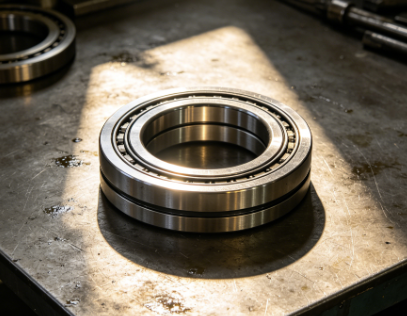
Decision-making process for replacement or major overhaul
Determining whether a mechanical seal requires replacement or a full overhaul should not rely solely on experience. It requires a stepwise process of “inspection—analysis—confirmation—treatment”; otherwise, repeated failures are likely.
Initial On-Site Inspection
First, inspect the type of leakage and the condition of the seal. If there is only end-face wear, aging of the sealing ring, or spring fatigue, and the shaft, sleeve, and sealing chamber show no obvious abnormalities, this usually indicates the mechanical seal has reached the end of its service life and can be replaced directly. However, if there is abnormal end-face cracking, severe uneven wear, or thermal damage, further assessment is required to determine whether a system-level issue exists.
Equipment Operation Analysis
If the equipment exhibits excessive shaft vibration, misalignment, excessive runout, or an unstable flushing system, even a new seal may fail quickly. Such situations go beyond a “single component issue” and generally warrant an overhaul rather than simple replacement.
Clearance and Shaft System Inspection
By measuring shaft diameter wear, sleeve clearance, and sealing chamber dimensions, if fitting precision has declined or shaft surfaces show grooving, a new mechanical seal alone cannot ensure normal operation. In this case, machining or overall repair is necessary to restore precision, which falls within the scope of an overhaul.
Final Decision
If the problem is confined to the seal itself, replacement is appropriate; if it involves the shaft system, pump body, or operating conditions, an overhaul is necessary. The key criterion is whether replacement can “eliminate the root cause.” If not, the process must escalate to an overhaul.
How to Determine Whether to Replace or Overhaul a Mechanical Seal?
The core distinction between replacement and overhaul is not operational difficulty, but whether the “failure root cause has been addressed.” If the root cause is unresolved, replacement merely postpones recurring failure.
When Is Replacement Sufficient?
End-face damage can be categorized as normal wear, thermal cracking, dry-wear burn, or uneven wear. If it is only uniform wear or minor aging, the system is essentially operating normally, and replacement alone is sufficient. However, if obvious one-sided wear or local burn occurs, this indicates shaft eccentricity or lubrication failure, and replacement alone cannot solve the problem, necessitating an overhaul.
When Is an Overhaul Necessary?
The shaft and sleeve are the fundamental support structures for mechanical seal operation. If the shaft surface has grooves, corrosion pits, or dimensional wear, even a new seal cannot maintain a stable lubrication film, making leakage likely to recur. Additionally, excessive shaft runout can cause periodic disengagement of the seal end face, leading to intermittent dry friction. Therefore, any structural damage to the shaft system requires repair or replacement, which is a typical overhaul scenario.
Hidden Sources of Failure
Repeated seal failures are often not caused by the seal itself, but by misalignment between the pump and motor. Significant coaxial deviation can subject the seal to uneven load, causing local pressure concentration and abnormal temperature rise. Such issues cannot be solved by seal replacement alone and require overall alignment adjustment or pump inspection to restore system precision.
Systemic Root Causes
If the flushing system is blocked, flow is insufficient, or the design is flawed, replacing the seal will still result in dry-wear or overheating. For example, high-temperature media without cooling flush or particulate-laden media without filtration can quickly destroy a new seal. In such cases, the system must be modified or maintained, which falls under overhaul-level treatment.
Common Questions
Q: Can a faulty mechanical seal simply be replaced?
If the wear is normal or the seal has reached its service life, direct replacement is possible. But if there is shaft vibration, misalignment, or flushing anomalies, replacing the seal alone often leads to repeated failures.
Q: How do I know if an overhaul is necessary?
If the same equipment experiences repeated leakage after multiple seal replacements in a short time, it usually indicates a system issue requiring an overhaul inspection.
Q: Is an overhaul always much more expensive than replacement?
In the short term, yes. However, if repeated replacements continue to fail, long-term costs are higher. Overhaul usually resolves the problem once and for all.
Ultimately, whether to “replace with a new seal” or “perform an overhaul” depends not on the seal itself, but on whether the problem exists solely at the seal. If it is normal wear—such as naturally flattened seal faces due to long-term use—replacement is sufficient. But if a new seal fails quickly or repeated replacements do not solve the issue, the problem lies with the equipment itself, such as shaft misalignment, excessive vibration, inadequate flushing, or worn mating parts. Continuing to replace the seal in such cases is merely “treating the symptom,” and a full overhaul is required to restore system integrity.