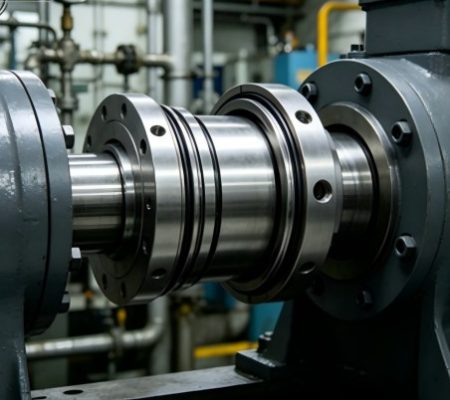
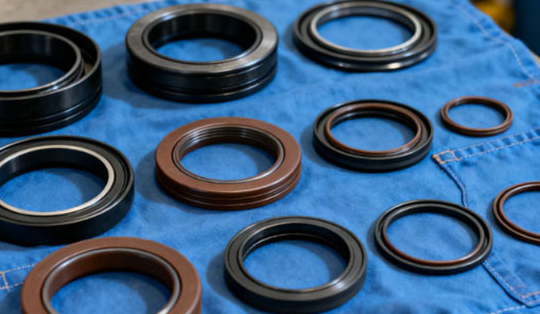
Mechanical seals are key components in industrial equipment to prevent liquid or gas leakage. Auxiliary sealing rings, as an important part of these seals, act like a protective film on the machine’s ‘joints,’ needing to be both tight and leak-proof, as well as flexible and durable. Although it’s a small part, the choice of material and its requirements directly affect the lifespan and reliability of the entire seal.
Corrosion Resistance of Auxiliary Sealing Rings
The reason auxiliary sealing rings must be able to withstand corrosion is that in industrial environments, equipment may contain not just water, but also ‘powerful’ substances like acids, alkalis, oils, and solvents. If the material itself is not corrosion-resistant, for example, ordinary rubber will quickly be corroded by strong acids, leading to leaks. Therefore, the material must be durable. For example, fluororubber can withstand most chemicals, and polytetrafluoroethylene (PTFE) is virtually incompatible with any medium. This ensures that no matter what is inside the equipment, the sealing ring will remain secure and undamaged.
Elasticity of Auxiliary Seals
The reason why the material of auxiliary seals needs to be ‘elastic’ is that the working environment of auxiliary seals is not very flat. During equipment operation, there will be vibration, pressure fluctuations, and even slight shaft misalignment. In this situation, the seal must act like a spring, able to be compressed and quickly ‘spring back,’ always maintaining a tight seal without gaps. If the material is too hard, it won’t spring back after compression, leading to leakage; if it’s too soft, it’s easily squeezed into the gaps in the sealing surface, causing faster wear. Therefore, a material with ‘moderate hardness’ is needed, such as silicone rubber with good elasticity, or nitrile rubber which is oil-resistant and resilient. This way, no matter how much the machine shakes, the seal can ‘keep up with the pace.’
Heat Resistance of Auxiliary Seals
The reason why the material of auxiliary seals needs to be ‘heat-resistant’ is that temperatures in industrial equipment can range from freezing temperatures of tens of degrees below zero to heating environments of hundreds of degrees. If the material hardens and cracks when cold, or softens and deforms when hot, the sealing effect will definitely fail. For example, in high-temperature steam pipes, ordinary rubber might age and become brittle within minutes; while in low-temperature liquid nitrogen storage tanks, the material must maintain flexibility, preventing cracking and breakage. Therefore, materials that are both cold- and heat-resistant must be chosen. For instance, fluorosilicone rubber can withstand temperature changes from -40℃ to 200℃, ensuring the sealing ring remains stable regardless of temperature.
The Wear Resistance and Aging Resistance of Auxiliary Sealing Rings
The reason auxiliary sealing ring materials must also be both wear-resistant and aging-resistant is that friction occurs between the sealing ring and the shaft during equipment operation. Over time, the material will be worn thinner and thinner, even crumbling. If the material has poor wear resistance, it will need to be replaced frequently, increasing downtime and costs. Simultaneously, the material must withstand the test of time, not easily aged by oxygen and ultraviolet radiation in the air; otherwise, it will harden and crack after only one or two years, also affecting its lifespan. For example, polytetrafluoroethylene (PTFE) has excellent wear resistance, while ethylene propylene diene monomer (EPDM) rubber has outstanding aging resistance; these are good choices for longevity.
In addition to the aforementioned characteristics of auxiliary sealing rings, the materials must also adapt to the factory’s operational rhythm. Industrial production emphasizes efficiency, so the sealing rings must be easily molded into various shapes, such as O-rings, V-rings, and U-rings, to fit different sealing grooves. Simultaneously, installation must be smooth; they cannot be too stiff to be inserted, nor too soft to deform under pressure. Furthermore, the materials must be ‘environmentally friendly and harmless,’ free of toxic substances, and recyclable after disposal, meeting increasingly stringent environmental requirements.
The requirements for auxiliary sealing ring materials in mechanical seals are akin to choosing an all-around ‘bodyguard’: they must withstand corrosion and high temperatures, be elastic, wear-resistant, and age-resistant, as well as be easy to process and environmentally friendly. Only by selecting the right material can the sealing ring ‘fulfill its duty,’ ensuring the machine is leak-proof and airtight, providing both safety and peace of mind.