In the oil and gas extraction field, wellhead equipment, as the core equipment controlling the production, reinjection, and safe operation of oil and gas wells, directly affects operational safety and production efficiency. With the large-scale development of deep wells, ultra-deep wells, and high-pressure gas wells, wellhead equipment faces challenges from extreme operating conditions such as ultra-high pressure, high sulfur content, and high gas production. Traditional hydraulic testing methods, due to their low efficiency and poor accuracy, are gradually becoming insufficient to meet these demands. Against this backdrop, pneumatic pressure testing technology, with its advantages of high efficiency, accuracy, and safety, has become an “invisible guardian” of wellhead equipment performance and has been successfully applied in numerous major projects both domestically and internationally.
Technical Principle: Precise Pressure Control Driven by Pneumatics
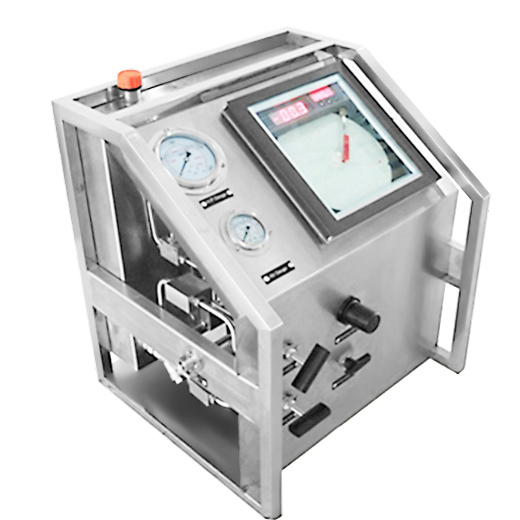
Pneumatic pressure testing of wellhead equipment uses compressed air or nitrogen as a power source. A pneumatic booster pump converts low-pressure gas into high-pressure fluid, simulating the pressure environment under extreme downhole conditions. Its core principle lies in utilizing the conversion relationship between air pressure and hydraulic pressure, and achieving multi-stage precise control of the output pressure by precisely adjusting the driving air pressure of the pneumatic pump. For example, a certain type of pneumatic pressure testing device adopts a two-stage pressurization structure, with a primary pump ratio of 1:60 and a secondary pump ratio of 1:200. It can output a maximum hydraulic pressure of 140MPa under a driving air pressure of 0.3-0.8MPa, with a pressure control accuracy of ±0.5%FS, meeting the requirements of international standards such as API 6A and API 16A.
This technology achieves fully automated control through a PLC controller and computer collaboration, supporting functions such as preset test programs, automatic pressure increase, pressure holding time, and stepped pressure increase. During testing, the system collects parameters such as pressure and temperature in real time, generates standardized reports, and is equipped with a three-level safety mechanism: a mechanical safety valve automatically releases pressure in case of overpressure, the electrical system triggers an audible and visual alarm, and an emergency stop button instantly cuts off the power source, ensuring a safe and controllable testing process.
Application Scenarios: Covering Everything from Conventional Conditions to Extreme Challenges
In conventional oil and gas well testing, pneumatic pressure testing technology has been widely applied to test the pressure resistance and sealing performance of wellhead equipment such as blowout preventer (BOP) assemblies, choke manifolds, and production (gas) trees. For example, an oilfield used a pneumatic pressure testing device to conduct a 70MPa high-pressure test on a BOP assembly, discovering and repairing a sealing defect at the flange connection, thus avoiding potential blowout risks. In the field of ultra-deep wells, this technology is even more crucial. In 2025, during the production and pressure recovery well testing operation of the Pengyang 102 well, the Southwest Oil and Gas Field Company successfully verified the sealing performance of the wellhead equipment under extreme conditions of 111.37 MPa using its independently developed 140MPa ultra-high-pressure pneumatic testing system, setting a new domestic record for wireline well testing pressure.
For high-sulfur gas wells, pneumatic testing technology, by employing hydrogen sulfide-resistant materials and special sealing structures, solves the reliability problem of traditional tools in highly corrosive environments. For example, a certain type of gas-tightness test bench, constructed of 316 stainless steel and featuring a weld-free piping design, supports pressure ratings up to 210MPa and is equipped with various gas source options, including nitrogen cylinders and nitrogen generators, to meet diverse operating conditions. In high-pressure, high-yield gas wells, this technology, through segmented well control and real-time pressure monitoring, effectively manages the vibration risk of wellhead equipment under high-speed gas flow, ensuring the accuracy of test data.
Technical Advantages: Comprehensive Upgrades in Efficiency, Accuracy, and Safety
Compared to traditional manual pressure testing pumps, pneumatic pressure testing technology achieves three major breakthroughs: First, improved efficiency, with dual-loop synchronous testing reducing multi-component testing time by more than 50%; second, optimized accuracy, with 0.4-level precision sensors and a PID closed-loop control system controlling pressure fluctuations within ±0.25%FS; and third, enhanced safety, with a three-level safety mechanism and remote monitoring significantly reducing the risks of high-pressure operations. For instance, after applying pneumatic testing technology, a certain oilfield saw its wellhead equipment test pass rate increase from 85% to 98%, reducing unplanned downtime by over 200 hours annually and generating direct economic benefits exceeding ten million yuan.
Future Outlook: Intelligentization and Integration Lead Technological Innovation
As oil and gas extraction extends into deeper and more complex formations, pneumatic pressure testing technology for wellhead equipment is evolving towards intelligentization and integration. On the one hand, by integrating IoT and big data technologies, real-time transmission and intelligent analysis of test data are achieved, providing predictive support for equipment maintenance. On the other hand, the development of modular testing platforms supports rapid replacement and joint testing of various types of wellhead equipment, further improving operational efficiency. It is foreseeable that pneumatic pressure testing technology will continue to safeguard the safety of oil and gas extraction, becoming a core force driving the industry’s high-quality development.