In the oil and gas exploration and development field, SCDS is the core equipment for maintaining drilling fluid performance and ensuring the continuity of drilling operations. It uses equipment such as vibrating screens, desanders, and centrifuges to work together to separate harmful solid particles from the drilling fluid, ensuring its recycling. However, due to the differences between marine and terrestrial environments, there are significant differences in design concepts, equipment configurations, and technical requirements between SCDS for offshore drilling platforms and those for onshore drilling.
Environmental Adaptability
Offshore drilling platforms are exposed to extreme environments such as salt spray, waves, and tides for extended periods, placing stringent demands on the corrosion resistance, vibration resistance, and stability of SCDS. For example, during a deep-water drilling operation in the South China Sea, salt spray corrosion caused perforation of the SCDS equipment casing, leading to a drilling fluid leak, highlighting the challenges that the marine environment poses to equipment reliability. To address these issues, marine solids control systems must possess the following characteristics:
Corrosion-resistant design:The equipment casing is constructed of high-strength alloy steel or composite materials, coated with marine-grade anti-corrosion paint. Key components (such as centrifuge drums and vibrating screens) utilize titanium alloy or ceramic coatings. For example, the tank of a certain offshore platform’s solids control system employs a double-layer structure design: an inner layer of stainless steel and an outer layer of carbon steel coated with anti-corrosion paint, effectively extending equipment lifespan.
Vibration-resistant stabilization technology:The impact of platform vibration on the equipment is reduced through designs such as vibration-damping bases and elastic connectors. For example, the solids control system of a certain semi-submersible platform uses hydraulic dampers to control vibration amplitude within ±5mm, ensuring stable operation of the equipment in sea state 6.
Heave compensation function:On drilling vessels or semi-submersible platforms, the drilling rig and wellhead require heave compensation devices to offset platform undulations. For example, the solids control system of a certain deep-water drilling vessel integrates a hydraulic heave compensation module, which can maintain stable drilling fluid circulation pressure at a wave height of 3 meters.
In contrast, onshore drilling only needs to cope with conventional weather conditions, and equipment design focuses more on balancing cost and efficiency. For example, the tanks of onshore solids control systems mostly use single-layer carbon steel structures, and corrosion protection only requires ordinary painting, without considering heave compensation.
Equipment Integration
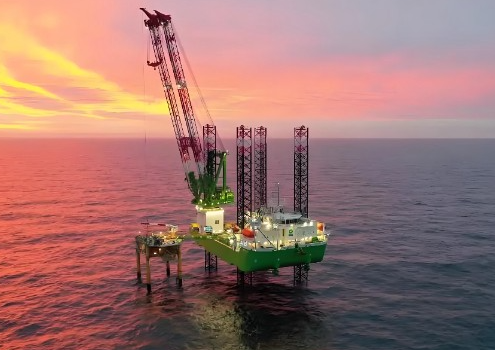
Offshore drilling platforms have limited deck space. Taking a jack-up platform as an example, its operating area is typically less than 2,000 square meters, which needs to accommodate drilling equipment, living facilities, and the solids control system. Therefore, offshore solids control systems need to achieve high integration through the following methods:
Skid-mounted layout: Integrating equipment such as vibrating screens, desanders, desilters, and centrifuges into a single skid reduces the footprint. For example, a certain offshore platform solids control system uses a four-stage purification skid, which improves the structural compactness by 40% compared to onshore equipment and supports overall hoisting and relocation.
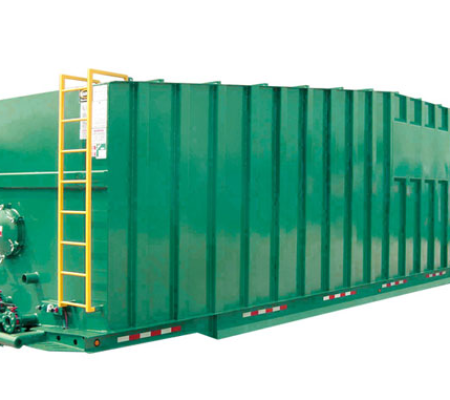
Multi-stage cascade process: Connecting various devices through a pipeline network to form a purification process of ‘vibrating screen → desander → desilter → centrifuge’. For example, the solids control system of a deepwater drilling platform adopts a composite tank design, with built-in manifolds simplifying the piping layout, while a conical tank bottom prevents solids precipitation.
Functional Combinations: Some equipment needs to perform multiple functions. For example, the vacuum degasser on an offshore platform, in addition to separating gases, needs to have pressure regulation capabilities to adapt to the drilling fluid density requirements under different well depth conditions.
Land drilling sites are open, and solids control systems can adopt a decentralized layout with larger equipment spacing, facilitating maintenance and expansion. For example, the solids control system of an ultra-deep well drilling rig adopts a modular mud tank design, with independently set up weighting, mud mixing, and circulation compartments, clearly defining functional zones, but occupying more than three times the area of an offshore platform.
Safety Redundancy
Once an accident occurs in offshore drilling, the rescue difficulty is far greater than on land. For example, in 1979, a drilling vessel capsized due to a blowout, causing significant casualties, highlighting the high risk of offshore operations. Therefore, marine solids control systems need to enhance safety redundancy through the following measures:
Equipment Redundancy Configuration:Key equipment (such as centrifuges and vibrating screens) should be designed in parallel to ensure the system continues to operate even if a single piece of equipment fails. For example, the solids control system of a certain ultra-deep well drilling platform connects multiple centrifuges and high-mesh vibrating screens in parallel to ensure drilling rig uptime.
Automated Monitoring System:Integrating sensors and a PLC control system to monitor drilling fluid performance parameters (such as solids content, viscosity, and density) in real time and automatically adjust equipment operating parameters. For example, a certain intelligent solids control system can automatically adjust the vibrating screen frequency based on the drill cuttings particle size distribution, reducing the risk of manual intervention.
Emergency Discharge System:Dedicated discharge pipelines and storage tanks should be installed for the rapid discharge of contaminated drilling fluid in emergencies. For example, the solids control system of a certain semi-submersible platform is equipped with an emergency desliming device, which can quickly separate gas and solid particles in the drilling fluid during a well kick to prevent blowouts.
While land drilling also emphasizes safety, its redundancy design strength is relatively low. For example, onshore solids control systems often employ a combination of manual detection and periodic inspections, resulting in a 20%-30% lower level of automation compared to offshore systems.
Operation and Maintenance Models
Offshore drilling platforms are located far from onshore bases, requiring a balance between efficiency and cost in equipment maintenance. For instance, each maintenance operation of a drilling platform in the North Sea oilfield requires 3-5 days of downtime, resulting in direct losses exceeding one million US dollars. Therefore, offshore solids control systems need to optimize operation and maintenance through the following methods:
Modular Design: Equipment adopts standardized interfaces and quick-release structures for easy replacement of faulty components. For example, the centrifuge drum on a certain offshore platform supports online replacement, reducing maintenance time by 50% compared to onshore equipment.
Remote Diagnostic Technology: Data on equipment operation is transmitted to the onshore control center via satellite communication, allowing an expert team to remotely analyze the causes of failures and provide solutions. For example, a certain intelligent solids control system can monitor the equipment status of offshore drilling platforms globally in real time, reducing fault response time to within 2 hours.
Local Spare Parts Inventory: Commonly used spare parts (such as screens and seals) are stored on the platform to reduce waiting time for resupply. For example, a deep-water drilling platform’s solids control system spare parts inventory can meet 30 days of autonomous operation and maintenance needs.
Land-based drilling operations and maintenance rely more on on-site technical personnel, resulting in longer equipment maintenance cycles but lower costs. For instance, routine maintenance of land-based solids control systems is typically performed quarterly, while offshore platforms require monthly inspections.
The differences between offshore and land-based drilling solids control systems are essentially the result of a trade-off between environmental constraints and engineering requirements. The high-risk and high-cost characteristics of the marine environment force solids control systems to develop towards integration, intelligence, and high redundancy; while the flexibility requirements of land-based drilling make it more focused on cost optimization and efficiency improvement.