In drilling engineering for oil and gas exploration and development, drilling fluid is known as the ‘blood of drilling,’ its performance directly affecting drilling efficiency, safety, and cost. However, during circulation, drilling fluid carries a large amount of rock cuttings, sand particles, and colloidal substances. If these harmful solid phases are not removed in time, they will lead to serious consequences such as decreased drilling speed, equipment wear, wellbore instability, and even blowouts. Drilling solids control systems are a technological system developed to solve this problem. Through the coordinated operation of multiple equipment stages, it achieves the purification and performance regulation of drilling fluid, making it a true ‘invisible guardian’ of drilling engineering.
The Core Mission of Solids Control Systems
The primary task of drilling solids control systems is to remove harmful solid phases from drilling fluid while retaining useful solid phases. During drilling, rock cuttings are the most significant harmful solid phase. Their presence increases drilling fluid density by 5%-10% and viscosity by 20%-30%, leading to increased drill bit torque, decreased drilling speed by 30%-40%, and even accidents such as stuck pipe and lost circulation. For example, in ultra-deep well operations in the Tarim Basin, the solids control system, through real-time monitoring and purification, kept the solids content in the drilling fluid within a reasonable range, increasing drilling speed by 15% and shortening the single-well cycle by 20 days.
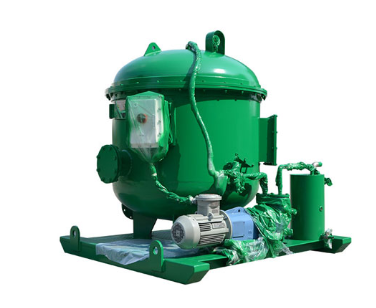
The solids control system also plays a crucial role in balancing formation pressure and preventing blowouts. When encountering high-pressure gas layers, if the gas content in the drilling fluid exceeds 5%, it may trigger a well kick or even a blowout. The vacuum degasser, using the principle of vacuum suction, can increase the gas separation rate in the drilling fluid to 98% within 30 seconds, ensuring stable bottomhole pressure. Similar equipment successfully prevented a secondary explosion and averted an escalation of the disaster during a deepwater drilling accident in the Gulf of Mexico.
Five-Stage Purification System
The solids control system employs a five-stage purification process: ‘vibrating screen – desander – desilter – centrifuge – degasser,’ forming a solids separation network from coarse to fine: Vibrating screen: As the first line of defense, it uses high-frequency vibration to screen and discharge coarse rock cuttings with a particle size greater than 74μm, with a processing capacity of 150 m³/h. In Sichuan shale gas wells, double-layer vibrating screens reduce the content of large particles in drilling fluid by 90%, lightening the burden on subsequent equipment.
Desander: Utilizing the principle of centrifugal sedimentation, it separates solid particles with a diameter of 44-74μm, with a processing capacity of 30-60 m³/h. In drilling in the Taklamakan Desert, the desander reduces the sand content in the drilling fluid from 8% to 1.5%, significantly reducing equipment wear.
Desilter: For fine particles of 15-44μm, it achieves separation through hydrocyclones, with a processing accuracy of 95%. In deep-water drilling in the South China Sea, the desilter reduces the viscosity fluctuation range of the drilling fluid to ±5%, ensuring wellbore stability.
Centrifuge: As the ultimate purification device, it can separate ultrafine particles of 2-15μm. The TRLW450×1000N horizontal screw centrifuge generates a separation factor of 1210 times through high-speed rotation at 2200 r/min, with a single-unit processing capacity of 50 m³/h, achieving a drilling fluid reuse rate of over 90% in Xinjiang shale gas wells.
Degasser: Employing vacuum suction technology, it increases the gas separation rate in drilling fluid to 98%, preventing well control risks caused by gas intrusion. In drilling on the East China Sea platform, the degasser controls drilling fluid density fluctuations within ±0.02 g/cm³.
Technological Upgrades
As drilling projects expand into deep-sea, deep-seated, and unconventional areas, solids control systems are undergoing intelligent transformation. Intelligent vibrating screens can automatically adjust vibration frequency and amplitude to adapt to different formation cuttings characteristics; variable frequency centrifuges achieve stepless speed adjustment through PLC programming, achieving a separation accuracy of 2-5 μm; the integrated solids control platform integrates over 200 monitoring points, providing real-time feedback on solid content, viscosity, density, and other parameters, with an early warning accuracy rate of 95%. In ultra-deep wells in the Tarim Basin, intelligent solids control systems have reduced drilling fluid performance regulation time from 2 hours to 15 minutes.
Environmental requirements are driving the green transformation of solids control systems. Through process optimization, drilling fluid reuse rates have increased from 65% to 92%, and waste disposal costs have decreased by 55%. Barite recovery technology has saved over 100,000 yuan per well. The application of nanoscale separation materials has increased the removal rate of harmful salts in drilling fluids to 99%, reducing groundwater pollution. In drilling in the Ordos Basin, solids control systems have reduced wastewater discharge by 80%, meeting the national Class I discharge standard.
From land to sea, from shallow to deep formations, drilling solids control systems have always been the core support for drilling engineering. They not only affect drilling efficiency and cost but also bear the dual mission of safety and environmental protection. With the deep integration of intelligent technologies, solids control systems are shifting from passive maintenance to proactive prevention, achieving precise regulation of drilling fluid performance through real-time data-driven decision-making.