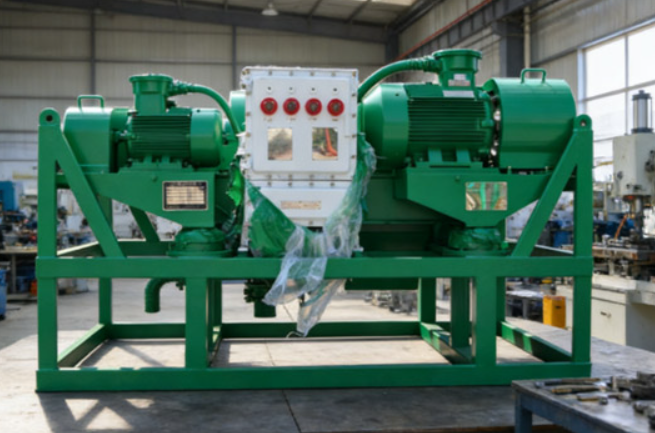
In many industrial sites, especially those dealing with mud, wastewater, and drill cuttings, “separation” is always a crucial issue. Liquids containing solids, oil-water mixtures, and fine particles that are difficult to settle—if these problems are not handled properly, they not only affect construction efficiency but also increase costs and even pose environmental risks. It is against this backdrop that decarbonization centrifuges have gradually come into the view of more people. A decarbonization centrifuge is a device that uses high-speed rotation to efficiently separate fine solid particles from liquids. Compared to traditional sedimentation and filtration methods, it is faster, more stable, and requires less space, making it particularly suitable for processing materials that are “dirty, mixed, and difficult to separate.” For this reason, it is becoming increasingly common in fields such as oil and gas, tunnel construction, directional drilling, and wastewater treatment. Many people may only have heard of decarbonization centrifuges in the drilling industry, but in reality, its applications are far broader than imagined. It can be found in almost any scenario involving mud circulation, solid-liquid separation, and environmental treatment.
Oil and Gas Drilling
In oil and gas drilling, drilling mud is present almost throughout the entire process. The mud not only carries drill cuttings and cools the drill bit, but also stabilizes the wellbore. If the solid content in the mud is too high, it will affect drilling efficiency and even pose safety hazards. The role of a decarbonization centrifuge here is to separate fine drill cuttings and useless solids from the mud, maintaining its appropriate properties. On the one hand, the separated mud can be recycled, reducing material waste; on the other hand, it also reduces equipment wear and the burden of subsequent processing. It can be said that in modern oil and gas drilling sites, decarbonization centrifuges have become an indispensable part of the mud treatment system.
Horizontal Directional Drilling
Horizontal directional drilling is widely used in complex environments such as pipelines crossing rivers, highways, and buildings, requiring very high mud performance. The mud must have sufficient fluidity but not too many impurities, otherwise it can easily cause problems such as borehole instability and difficulty in pullback. The value of decarbonization centrifuges in this field is mainly reflected in fine separation. It can effectively remove ultrafine solid particles from drilling mud, helping construction workers better control mud quality. This not only makes the drilling process smoother but also reduces the risk of rework and malfunctions, greatly benefiting the overall construction progress.
Micro-tunnel Construction
Micro-tunnel construction involves limited space, but the requirements for equipment reliability and efficiency are no less stringent. The large amounts of mud and excavated soil generated during construction, if not handled promptly, will affect the tunneling rhythm. Decarbonization centrifuges, despite their relatively compact size, can achieve continuous and efficient solid-liquid separation, making them ideal for such site-constrained engineering environments. By rapidly separating fine particles, they not only maintain the circulating mud in good condition but also reduce the pressure on downstream processing, making the entire construction process smoother.
Tunnel Construction Engineering
In the construction of large and medium-sized tunnels, especially shield tunneling or pipe jacking, the mud treatment system directly affects the smoothness of construction. Poor control of solid particles in the mud will increase the burden on equipment and raise maintenance costs. In tunnel construction, decarbonization centrifuges mainly undertake the task of fine separation, helping to remove those difficult-to-settle fine particles. This makes the mud circulation system more stable and improves construction efficiency, which is especially important for long-term continuous operations.
Drilling Waste Management
With increasingly stringent environmental protection requirements, the treatment of drilling waste is receiving more and more attention. Directly stockpiling or discharging drill cuttings and waste mud not only takes up space but can also impact the environment. Decarbonization centrifuges can effectively separate liquids and solids in the waste treatment process, reducing waste volume and facilitating subsequent transportation and disposal. This efficient and controllable treatment method is particularly important for projects that need to comply with environmental regulations.
Wastewater Treatment
Besides engineering and energy sectors, decarbonization centrifuges also have applications in wastewater treatment. Many industrial wastewaters contain a large amount of fine suspended solids, and natural sedimentation is often ineffective. Through high-speed centrifugal separation, decarbonization centrifuges can quickly remove solid impurities from water, reducing the burden on subsequent treatment processes. Whether it’s temporary wastewater from construction sites or wastewater from some industrial production processes, this method can improve treatment efficiency.
The core reason why decarbonization centrifuges are used in so many fields is their ability to “separate quickly, finely, and adaptably.” From oil and gas drilling to horizontal directional drilling, microtunneling, and large tunnel construction, and to drilling waste management and wastewater treatment, it plays a stable and reliable role wherever complex solid-liquid mixtures are involved. For construction companies, decarbonization centrifuges not only improve work efficiency but also reduce material waste and equipment maintenance costs; and in today’s increasingly environmentally conscious world, they also provide a practical and feasible technical means for standardized and regulated processing.