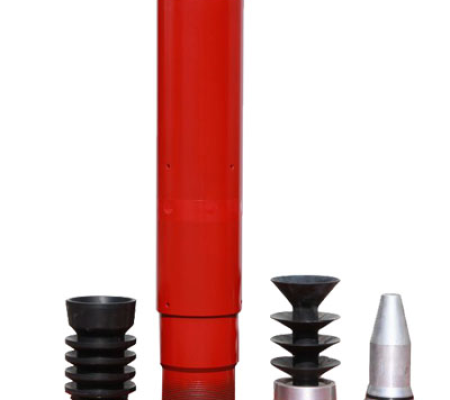

In well cementing operations, cement plugs play an extremely crucial role. They are not only important tools for controlling the flow of cement slurry and ensuring cementing quality, but also a core node in the entire wellbore sealing process. Cement plugs are generally divided into bottom plugs and top plugs, which respectively perform the functions of separating, sealing, cleaning, and propelling cement slurry. Their smooth operation directly affects the cementing strength, annular sealing effect, and the safety of subsequent wellbore operations. Therefore, understanding the key role of cement plugs in well cementing is of great significance for ensuring the quality of oil and gas well construction.

First, the most crucial function of cement plugs is to separate different fluids. During the cementing process, drilling mud is injected into the casing first, followed by cement slurry. The function of the bottom plug is to completely separate the drilling mud and cement slurry, preventing them from mixing. If the drilling mud and cement slurry mix, it will lead to reduced cement strength and unstable density, ultimately causing cementing failure. When the bottom plug is propelled by the drilling fluid, it cleans the inner wall of the casing and automatically breaks upon encountering a float collar or float shoe, allowing the cement slurry to flow smoothly. This process ensures the cement slurry remains pure and uniform, avoiding cementing hazards such as “thin cement” or “mixed slurry sections.”
Secondly, the top plug is responsible for accurately pushing the cement slurry into the annulus during cementing, filling it to the designated position and forming an effective sealing layer. After the cement slurry is injected, the top plug moves downwards with the displacement fluid, pushing out any remaining cement slurry from the casing, preventing residual cement from remaining inside and causing difficulties in subsequent operations. Once the top plug is seated, it signifies complete isolation between the displacement fluid and the cement slurry, and also indicates that the cement slurry has completely entered the annulus. The sealing structure of the top plug ensures that the displacement fluid does not continue to flow downwards into the annulus, ensuring the cement slurry maintains a stable position within the annulus, thus forming a uniform and continuous cement ring.
Another important function of the cement plug is to provide pressure indication. Cementing operations require precise judgment of whether the cement slurry has been completely replaced and whether the top plug has seated. The moment the cement plug seats, a noticeable surge in pump pressure can be felt on the surface; this “pressure peak” is a crucial indicator for operators to determine whether the cementing phase is complete. Without cement plugs, the various fluids involved in the cementing process cannot be clearly separated, and pump pressure cannot generate a clear indicator signal. This significantly increases operational uncertainty and the risk of cementing failure.
Furthermore, cement plugs clean the casing inner wall. As the bottom plug descends, it acts like a piston, pushing away mud residue and wall deposits within the casing, allowing the cement slurry to flow in a cleaner environment and improving the cementing bonding effect. The cleaner the casing inner wall, the stronger the bond between the cement slurry and the casing wall, resulting in a denser cement ring that effectively isolates formation pressure and prevents wellbore safety issues such as gas leakage and spillage.
Cement plugs also play a protective role in the overall cementing system. They prevent excessive dilution of the cement slurry, avoid wellhead overflow, and reduce the erosion of the cement slurry by the replacement fluid, making the cementing process more controllable and efficient. In deep wells, high-temperature wells, and complex wells, the role of cement plugs is even more prominent because cementing conditions are harsh, and the stability and flow control of the cement slurry are extremely important; cement plugs can significantly reduce operational risks.
Cement plugs play an irreplaceable role in cementing operations. They not only ensure fluid separation and prevent slurry mixing, but also perform multiple tasks such as pushing, sealing, cleaning, and pressure indication, directly and profoundly impacting cementing quality and wellbore integrity. Their reliability often determines the success of cementing and affects the safety and profitability of oil and gas wells throughout their entire lifecycle. Understanding and correctly using cement plugs is an indispensable and crucial step in any cementing operation.