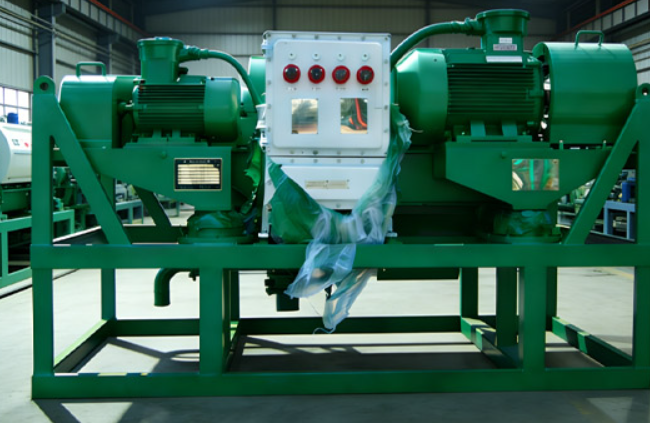
In oil and gas extraction, microtunneling, horizontal directional drilling, and drilling waste treatment, large quantities of mud and suspensions with varying solid contents are generated. These muds not only affect construction efficiency but also cause equipment wear and tear, and improper handling can lead to environmental pollution. Therefore, selecting a suitable decarbonization centrifuge is crucial for treating mud and suspensions. Decarbonization centrifuges effectively separate solid particles from liquid through high-speed rotation, thereby recovering reusable mud liquid, reducing waste, and improving construction efficiency. Depending on the equipment parameters, each model of decarbonization centrifuge varies in processing capacity, separation accuracy, and applicable mud types.

Processing Capacity and Applicable Slurry Concentration
The processing capacities of different decarbonization centrifuges vary significantly: The small models LW223 and LW223-VFD have a maximum processing capacity of 2 cubic meters per hour, with an effective processing capacity of 0.5-2 cubic meters per hour; the medium models LW363 and LW363-VFD have an effective processing capacity of 30 cubic meters per hour; and the large models LW452 and LW453 have effective processing capacities of 40 cubic meters per hour and 60 cubic meters per hour, respectively. Small centrifuges are suitable for processing low-flow, low-solids-content slurries or for laboratory and field testing applications; medium and large centrifuges are suitable for high-solids-content slurries and high-flow-rate suspensions in industrial construction sites. Therefore, when the slurry concentration is high or the construction flow rate is large, models LW363 and above should be prioritized to ensure continuous operation and efficient separation.
Separation Accuracy and Particle Size
Equipment parameters show that the LW223 to LW363 series can separate particles with diameters of 2-5 micrometers, while the LW452 and LW453 are suitable for particles of 5-7 micrometers. Therefore, small and medium-sized centrifuges are suitable for processing fine-particle mud, such as drilling fluid containing clay and fine sediments; large centrifuges are more suitable for processing mud with coarser particles and higher sand content. The separation factor (G-value) shows that the LW223 is approximately 2840G, the medium-sized LW363 is approximately 3063G, and the large LW452 and LW453 are 815G and 1974G respectively. This indicates that high-speed, small-sized equipment is more suitable for high-precision separation, while low-speed, large-sized equipment is suitable for processing heavier, coarser mud with high flow rates.
Rotation Speed Matching with Mud Characteristics
The maximum bowl rotation speed and its range determine the centrifugal force: LW223 and LW223-VFD can reach 4800 RPM, making them suitable for separating low-density, fine-particle mud; the LW363 series has a maximum speed of 3900 RPM, suitable for medium-density mud; LW452 and LW453 have maximum speeds of 1800 RPM and 3200 RPM respectively, making them more suitable for high-density mud with high sand content. For drilling fluids containing oil or chemical additives, high rotation speeds allow for faster solid settling while maintaining liquid stability, while low rotation speeds are used to process coarse-particle or high-concentration mud, avoiding rotor overload or clogging.
Viscosity and Fluid Type Adaptability
Decarbonization centrifuges can operate stably even with high-viscosity mud, but model matching is crucial: LW223 is suitable for low-viscosity mud (light drilling fluids, mud wastewater); LW363 and LW363-VFD are suitable for medium-viscosity mud (ordinary oilfield mud); LW452 and LW453 are suitable for high-viscosity or high-particulate-content mud (sandstone drilling mud or tunnel construction mud). Furthermore, explosion-proof models (ExII B t4/IECEx/A-TEX) can handle mud containing flammable solvents, ensuring safety.
Operating Environment and Application Scenarios
Decarbonization centrifuges can be widely used in drilling wastewater, mining mud, microtunnel mud, and tunnel construction mud management. Small units are suitable for experiments, research and development, or small-scale drilling operations; medium-sized units are suitable for medium-scale construction sites; and large units are suitable for oilfields, long-distance tunnels, or high-volume construction sites. Weight and overall dimensions also indicate ease of installation and relocation; smaller units are easy to move and deploy quickly, while larger units are suitable for fixed installation.
Decarbonization centrifuges are highly adaptable to mud or suspension treatment, with different models suitable for different mud types and construction scenarios. Small, high-speed units (LW223, LW223-VFD) are suitable for low-flow, fine-particle, low-concentration mud; medium-sized units (LW363, LW363-VFD) are suitable for medium-flow and solids-content mud; and large units (LW452, LW453) are suitable for high-flow, high-solids-content, and coarse-particle mud. When selecting appropriate equipment, processing capacity, separation accuracy, particle size, rotation speed, and viscosity matching should be comprehensively considered, along with the construction environment and safety requirements. Correctly matching the mud type and centrifuge model ensures efficient mud separation, extends equipment lifespan, reduces maintenance costs, and improves construction efficiency and safety.