In coal mining, geological exploration, and various engineering construction fields, trailer-mounted drilling rigs, with their excellent mobility and convenient relocation capabilities, have become key equipment for improving operational efficiency. As construction scenarios place increasingly stringent demands on timeliness and flexibility, achieving rapid and safe movement of trailer-mounted drilling rigs has become a crucial focus of technological innovation in the industry. From vast desert oilfields to bustling urban construction sites, from complex and ever-changing geological environments to short-distance relocation needs, trailer-mounted drilling rig mobility solutions are continuously breaking through traditional limitations through modular design, power system optimization, and transportation technology innovation, bringing more efficient solutions to the industry.
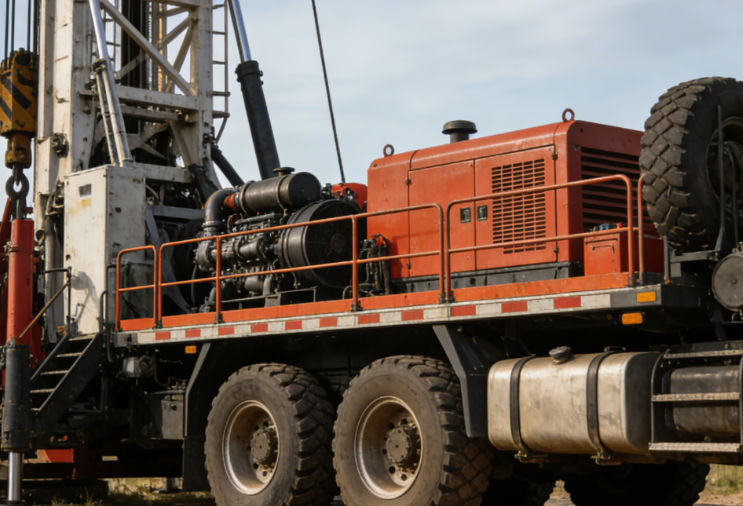
Modular design is the cornerstone of improving the mobility efficiency of trailer-mounted drilling rigs. Taking a rapid-movement drilling rig used in desert areas as an example, its base and derrick adopt a dual-modular structure. Wheeled axles are equipped at the four corners of the base, allowing for overall relocation with the help of two tractors; a transport trolley is installed at the rear of the derrick, requiring only one tractor to complete the simultaneous relocation of the derrick and supporting equipment. This design simplifies the cumbersome process of disassembling, transporting, and assembling traditional drilling rigs into modular, integrated transport, significantly reducing inter-well relocation time. In actual desert oilfield operations, the relocation cycle for this drilling rig within a 100-kilometer radius has been reduced to less than 3 days, improving relocation efficiency by over 60% compared to traditional methods, making it particularly suitable for large-scale, high-frequency operations.
Optimized power systems provide the core power for the rapid movement of trailer-mounted drilling rigs. One type of trailer-mounted water well drilling rig uses an independent diesel engine to drive the mechanical winch and rotary table, and is equipped with four hydraulic outriggers that can be operated independently or in conjunction. Two of the rear outriggers can extend horizontally, enhancing stability by increasing the support span and effectively avoiding the risk of overturning due to center of gravity shift during movement. Furthermore, hydraulic turret-raising technology allows the turret to fold and shorten during transport and quickly unfold upon arrival at the work site, reducing the need for auxiliary equipment. This integrated “power-support-turret-raising” design enables the drilling rig to maintain efficient mobility in complex terrains, such as mountainous areas or muddy roads, with significantly better adaptability and safety than traditional models.
Breakthroughs in trailer-mounted transportation technology have further unlocked the potential of trailer-mounted drilling rigs. One model of a fully trailer-mounted drilling rig features a main trailer that, through structural improvements, optimizes the vertical load at the towing pin and adopts a lightweight axle design, reducing unsprung mass by 13% while meeting strength and rigidity requirements. Its trailer wheel assembly has steering capabilities, allowing for base movement while the derrick is upright without disassembling the top drive unit, significantly reducing the risks of high-altitude operations. Another type of trailer-mounted drilling rig uses a chassis made of high-strength steel plates and is equipped with hydraulically and mechanically locked outriggers, ensuring even tire stress when traveling on uneven surfaces and preventing equipment damage due to single-point overload, providing reliable protection for long-distance, high-load transportation.
For short-distance movement scenarios, the industry has also explored some low-cost solutions. For example, installing a self-made winding device on the drill rod allows the drill rig’s own power to drive a wire rope for traction; or using a hand-operated hoist in conjunction with anchor bolts to achieve short-distance displacement. While these methods have limitations in terms of control precision and safety, they offer an economical and feasible alternative for small engineering teams, particularly suitable for scenarios with limited budgets or low operating frequency.
Trailer-mounted drilling rig rapid relocation technology is making great strides towards modularization, integration, and intelligence. From deserts to urban construction sites, from large oil fields to complex geological environments, through structural optimization, power upgrades, and transportation technology innovation, drilling rig relocation has transformed from a time-consuming and labor-intensive project into a standardized process that is highly efficient and safe. With the deep integration of IoT technology and automated control, trailer-mounted drilling rigs are expected to achieve remote monitoring, autonomous navigation, and intelligent scheduling in the future, further driving the industry’s transformation towards efficiency, low carbon emissions, and safety. For construction companies, choosing a rapid relocation solution suitable for their specific scenarios is not only key to enhancing competitiveness but also an inevitable choice for practicing green development principles, injecting continuous momentum into the industry’s sustainable development.