In geological exploration, oil extraction, and engineering drilling, drill pipes are core tools whose performance directly determines operational efficiency and safety. However, many companies often overlook the potential impact of storage environments on drill pipes, leading to premature corrosion, deformation, and even breakage, resulting in significant economic losses. In fact, the storage environment for drill pipes must meet multiple technical standards, from temperature and humidity control to corrosion prevention measures; each aspect affects its service life and performance.
Drill pipes are extremely sensitive to the temperature and humidity of their storage environment. According to industry standards, drill pipes should be stored in a dry, well-ventilated environment with a temperature range of -15℃ to 35℃ and a relative humidity not exceeding 80%. Prolonged exposure to high temperatures can cause internal stress in the metal material due to thermal expansion and contraction, leading to pipe bending or loosening of threads; while a humid environment accelerates oxidation, forming a rust corrosion layer. For example, an oilfield once stored drill pipes in an open area, and after only three months, large-scale pitting corrosion was found on the pipe surface, with a corrosion depth of 0.5 mm, directly rendering the entire batch of drill pipes unusable. Furthermore, direct sunlight can cause a rapid rise in the surface temperature of the drill rods, leading to localized thermal fatigue and further weakening the structural strength.
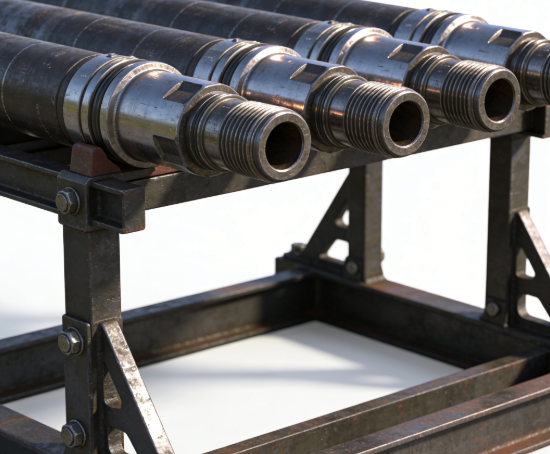
The layout and support methods of the storage space are equally crucial. Drill rods must be placed on dedicated pipe racks, with the first layer of pipes at least 30 cm above the ground to isolate them from ground moisture and soil erosion. The pipe rack foundation must be solid, and the piers should be on the same horizontal plane to prevent the drill rods from bending due to foundation settlement. At least three isolation wooden blocks must be laid between each layer of drill rods, and these blocks must be perpendicular to the drill rods and directly above the lower layer to prevent the joints from bearing the weight of the pipes. One construction team failed to use these blocks, resulting in permanent bending of the drill rods due to their own weight during storage, ultimately leading to breakage during drilling. In addition, the length difference between each layer of drill rods should be controlled within the joint or coupling length range, and both ends must be secured with plugs to prevent sliding and collisions.
Corrosion prevention is a core aspect of storage management. The drill pipe’s water holes and threaded areas must be thoroughly cleaned with clean water to remove drilling fluid residue. Afterward, apply a special anti-rust oil and attach a protective thread to prevent direct contact between the metal and air. For drill pipes stored long-term, a comprehensive inspection should be conducted annually, focusing on thread wear, damage to the sealing shoulder, and end-face deformation. If signs of corrosion are found, immediate sandblasting to Sa3 grade (white standard) should be performed, followed by application of an internal coating conforming to SY/T 0544-2016. This coating can withstand temperatures up to 107℃ and pressures up to 35MPa, extending its service life by 2 to 3 times compared to ordinary drill pipes. One drilling company, by introducing internal coating technology, increased the average service life of its drill pipes from 3 years to 8 years, reducing single-well costs by 40%.
Storage in special environments requires specific measures. In acidic or alkaline areas or coastal regions, the drill pipe surface should be pre-treated with nickel or zinc plating to form a physical protective layer. If stored in a salt spray environment, steel particles in the drilling fluid should be periodically removed using a magnetic device to prevent sharp-edged materials from embedding in the pipe and causing fatigue cracks. Furthermore, drill pipes must not be stored with chemicals, nor used as platforms to support heavy objects, to prevent deformation due to external pressure. A chemical company once nearly caused a major safety accident by storing drill pipes together with hydrochloric acid tanks, resulting in penetrating corrosion holes on the pipe surface.
A scientifically sound and standardized storage environment is the cornerstone of ensuring drill pipe performance and extending its service life. From temperature and humidity control to corrosion prevention, from spatial layout to regular inspections, every requirement embodies industry experience and technical expertise. Only by strictly adhering to storage standards can companies avoid equipment damage caused by management negligence and gain a competitive edge in the fierce market. In the future, with the continuous advancement of materials science and corrosion prevention technology, drill pipe storage management will become more refined, providing more reliable equipment support for geological exploration and energy development.