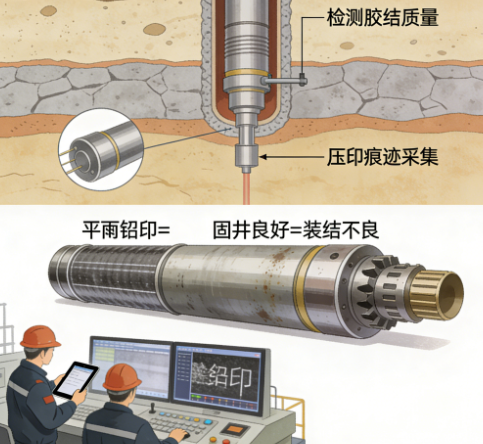
In oil and gas well engineering, cementing quality directly affects wellbore integrity and the safety of subsequent production. To accurately evaluate the bonding condition between the cement sheath, casing, and formation, several inspection methods are commonly used in the field. Among them, lead impression modules are valued for their ability to provide intuitive contact information. By following a standardized inspection process, cementing performance can be assessed more clearly, providing reliable support for evaluation and decision-making.
Preparation Before Inspection
Before carrying out lead impression module inspection, thorough preparation is essential to ensure reliable results. Well parameters such as depth, casing size, and the target cemented interval must be confirmed in advance to ensure the module specifications match downhole conditions. The inspection tool should then be checked for integrity, with particular attention paid to the condition of the lead surface and the firmness of the fixing structure to prevent damage or detachment during running in hole. Wellbore cleanliness is also important, and cleaning operations may be required to minimize interference from residual debris.
Running the Lead Impression Module and Depth Positioning
After preparation, the lead impression module is slowly lowered to the target interval using a logging tool or work string. During the run-in process, the descent speed should be carefully controlled to avoid deformation of the lead surface caused by impact. Once the designed depth is reached, positioning devices are used to confirm that the module is located within the cemented section to be evaluated, ensuring sufficient contact between the lead impression module and the casing or wellbore. Accurate depth control is a key prerequisite for effective cementing evaluation.
Applying Pressure to Obtain Contact Impressions
When the lead impression module is properly positioned, pressure is applied according to predetermined parameters to create contact between the lead material and the surrounding structures. During this stage, the lead surface records the shape characteristics of the casing, formation, or cement sheath. Both pressure magnitude and holding time should be adjusted based on well conditions to ensure clear impressions without excessive deformation. After pressure application, the module remains in place briefly to allow complete formation of the impressions.
Retrieving the Tool and Analyzing the Lead Impressions
Once the pressure application is completed, the lead impression module is carefully retrieved to the surface. The retrieval speed must be controlled to prevent secondary damage to the impressions. At the surface, the lead surface is cleaned and protected before analysis begins. By examining impression continuity, depth variations, and contact patterns, operators can make an initial assessment of whether voids, channels, or poor bonding exist within the cemented interval.
Key aspects commonly evaluated include:
Continuity and completeness of the impressions
Uniformity of impression depth
Presence of discontinuities or abnormal patterns
These characteristics provide direct evidence for evaluating cementing quality.
Integrating Data to Form Cementing Evaluation Conclusions
Lead impression results primarily reflect localized contact conditions. To improve evaluation accuracy, inspection results are typically compared with other logging data and cementing operation parameters. By integrating information from multiple sources, a more comprehensive understanding of cementing quality can be achieved, reducing the risk of misinterpretation based on a single dataset. The final conclusions serve as an important basis for deciding whether remedial operations or adjustments to subsequent construction plans are required.
Conclusion
The process of evaluating cementing quality using lead impression modules includes preparation, running and positioning, pressure application, retrieval, and result analysis. Each step directly affects the reliability of the final evaluation. Through standardized operations and careful interpretation, lead impression modules provide intuitive insight into cemented interval contact conditions, supporting accurate cementing quality assessment and contributing to long-term wellbore safety.