
Rotating components are ubiquitous in various mechanical equipment. Effectively preventing media leakage during rotation is a crucial problem that must be solved in mechanical design and equipment operation. Rotary seals are a key component developed to meet this need, widely used in pumps, compressors, agitators, speed reducers, fans, and various transmission devices. Whether the medium is liquid, gas, or contains particles or corrosive components, as long as shaft rotation is involved and the isolation between internal and external media needs to be controlled, rotary seal technology is indispensable. With increasingly complex industrial conditions, the types of rotary seals have continuously evolved, from early simple seals relying on material deformation to today’s sophisticated technologies that balance sealing and lifespan. Different types of rotary seals differ significantly in their working principles, applicable conditions, and performance focuses.
Packing Seals
Packing seals are the earliest type of seal applied to rotating equipment, typically consisting of packing, a stuffing box, and a gland. The packing creates a certain contact pressure on the shaft surface, thereby preventing media leakage. This type of sealing structure is simple and low-cost, with relatively relaxed installation precision requirements, making it suitable for low-speed, low-pressure, or non-critical leakage control conditions. However, packing seals rely on direct contact between the shaft and the packing, resulting in significant frictional losses and rapid wear, requiring regular adjustment and replacement. In modern high-efficiency equipment, it is gradually being replaced by other sealing methods.
Lip Seals
Lip seals are typically made of rubber or elastomer materials, relying on the elastic contact between the lip and the shaft surface to form a seal. They are compact, easy to install, and commonly used for lubricating oil sealing or dust and water protection. Lip seals are suitable for low-to-medium speed, low-pressure conditions, but require high shaft surface quality. During long-term operation, the lip is prone to failure due to frictional heat and aging, thus limiting its application in high-temperature, high-speed, or high-pressure environments.
Mechanical Seals
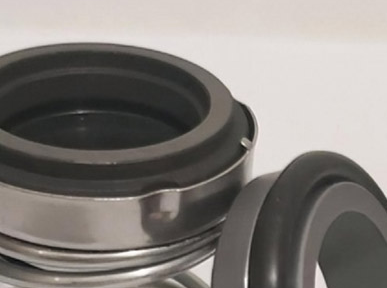
Mechanical seals are one of the most common and widely used sealing methods in modern rotating equipment. They form a stable sealing interface through the contact between the end faces of the rotating and stationary rings, under the action of elastic elements and media pressure. Mechanical seals have low frictional losses and controllable leakage, making them suitable for high-speed, high-pressure, and various complex media conditions. Mechanical seals, based on their structure and function, can be categorized into single-end-face, double-end-face, balanced, and unbalanced types, among others, to meet the needs of various equipment and processes.
Labyrinth Seals
Labyrinth seals increase the resistance to media flow through multiple tortuous channels, thereby reducing leakage. This type of seal typically does not rely on direct contact and is considered a non-contact seal. Labyrinth seals have extremely low frictional losses, making them suitable for high-speed rotation and gaseous media conditions. However, their sealing effect is limited; they typically cannot achieve a complete seal and are mostly used to reduce leakage rather than completely block it.
Dry Gas Seals
Dry gas seals are a type of non-contact seal that operates based on gas dynamics effects and are commonly used in high-end equipment such as high-speed compressors. They achieve sealing and lubrication by forming a stable gas film on the sealing end face. This type of seal has extremely low frictional losses and a long lifespan, but it requires extremely high equipment precision, gas source quality, and operational stability, resulting in relatively high costs and a relatively limited range of applications.
Magnetohydrodynamic Seals and Other Special Rotary Seals
Magnetohydrodynamic seals utilize a magnetic field to fix a magnetic fluid in the gap between the shaft and the housing, forming a sealing barrier. They are commonly used in vacuum or clean environments. In addition, there are special rotary seal types such as brush seals, water seals, and gas seals. These are designed for specific operating conditions and have distinct application characteristics and limitations.
Comprehensive Classification by Contact Form and Function
Rotary seals can also be classified as:
Contact seals: such as packing seals, lip seals, and mechanical seals;
Non-contact seals: such as labyrinth seals and dry gas seals;
Combination seals: combining various forms to balance sealing performance and lifespan.
Rotary seals are diverse, ranging from simple packing seals to high-precision mechanical seals and dry gas seals. Each type has its own value and applicable boundaries. Different types of rotary seals differ significantly in their working principles, sealing performance, friction loss, maintenance requirements, and applicable operating conditions, and cannot be simply generalized as superior or inferior. In practical engineering applications, the key to selecting the appropriate rotary seal type lies in fully understanding the equipment operating conditions, media characteristics, and requirements for leakage and lifespan. For low-speed, low-requirement operating conditions, simple sealing methods are still practical; however, for high-speed, high-pressure, or high-safety and environmental protection requirements, sealing solutions with more stable performance and greater controllability are needed. The development trend of rotary seals is towards low friction, long life and high reliability.