As industrial equipment develops towards higher temperatures, higher pressures, and higher reliability, mechanical seals play an increasingly important role in equipment operation. This is especially true in fields such as petrochemicals, power generation, metallurgy, and high-end manufacturing, where equipment often operates continuously in high-temperature environments. Thermal expansion is a common phenomenon in rotating equipment; shafts, pump housings, and sealing components undergo varying degrees of thermal deformation under temperature changes. If the mechanical seal cannot adapt to this thermal expansion, it may lead to end-face cracking, leakage, or even structural damage. Metal bellows seals, with their unique metal bellows structure and high elasticity compensation capability, exhibit significant advantages in coping with end-face displacement and pressure changes caused by thermal expansion. Compared to traditional spring seals, they can maintain uniform contact and stable stress on the sealing end face under temperature fluctuations, ensuring continuous sealing performance.
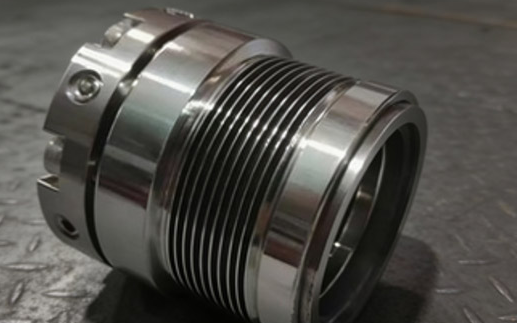
The Impact of Thermal Expansion on the Mechanical Seal End Face
Thermal expansion causes changes in the dimensions of the shaft and pump housing, resulting in axial or radial displacement or uneven stress on the sealing end face. In traditional mechanical seals, springs or non-metallic auxiliary seals often fail to fully compensate for thermal deformation, leading to the following problems:
Uneven end-face contact: Axial expansion may cause partial separation between the rotating and stationary rings, reducing sealing effectiveness.
Local overload: Excessive stress in certain areas can accelerate wear or cause thermal cracks.
Increased risk of seal leakage: Tiny gaps at the end faces can lead to media leakage and even safety hazards.
Therefore, the stability of mechanical seals under high-temperature conditions directly depends on their ability to effectively compensate for thermal expansion.
Axial Compensation Principle of Metal Bellows
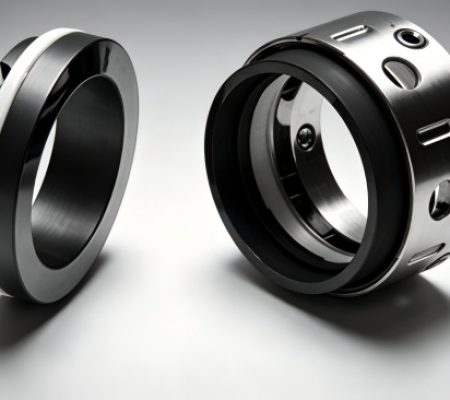
The core advantage of metal bellows seals lies in the fact that the metal bellows can simultaneously perform elastic compensation and force transmission functions. When the shaft or pump casing expands due to temperature rise, the bellows absorbs axial displacement through elastic deformation, maintaining the contact pressure between the rotating and stationary rings within a reasonable range. The axial elasticity of the bellows is closely related to the design thickness, the number of bellows, and the material stiffness. Its uniform stress distribution, independent of rubber or auxiliary springs, prevents nonlinear deformation or aging failure during temperature fluctuations. This adaptive compensation characteristic ensures continuous contact pressure on the sealing face during thermal expansion, preventing cracking or leakage.
Stress Uniformity and Face Stability
Metal bellows seals transmit elastic force through the metal bellows, achieving uniform stress distribution on the face. Unlike traditional springs that concentrate force, the bellows is a continuous elastic body along the axial direction, smoothly adjusting face pressure. This uniform stress distribution is significant under thermal expansion conditions:
Reduced Local Stress Concentration: The bellows disperses local pressure changes caused by shaft and pump housing expansion, reducing face wear.
Maintained Face Parallelism: Even with large axial displacement at high temperatures, the rotating ring maintains parallelism with the stationary ring under the action of the bellows, improving sealing performance stability.
Enhanced Face Life: Uniform stress reduces thermal stress concentration and fatigue damage, thus extending the service life of the sealing face.
Therefore, metal bellows seals not only maintain sealing performance under thermal expansion conditions but also effectively extend their overall lifespan.
Dynamic Adaptability and Operational Reliability
Thermal expansion is often accompanied by cyclical temperature fluctuations or rapid heating and cooling during equipment start-up and shutdown. The elastic structure of the metal bellows seal can quickly respond to changes in axial displacement under dynamic conditions, maintaining a constant end-face pressure.
The advantages of this dynamic adaptability include:
Reduced leakage fluctuations: The end-face contact pressure automatically adjusts with thermal expansion, ensuring continuous seal stability.
Reduced maintenance frequency: The sealing end face is less prone to gaps due to thermal deformation, eliminating the need for frequent adjustments.
Adaptability to complex operating conditions: Suitable for harsh conditions such as high temperature, high pressure, and media containing solid particles or corrosive substances.
Therefore, metal bellows seals exhibit excellent operational reliability under dynamic thermal expansion environments.
The excellent sealing stability of metal bellows seals under thermal expansion conditions is mainly due to the elastic compensation capability and uniform stress characteristics of its bellows structure. When the shaft and pump casing undergo thermal expansion due to temperature changes, the bellows effectively absorbs axial displacement, maintaining appropriate contact pressure between the rotating and stationary rings and preventing risks of localized overload, thermal cracking, and leakage at the end faces. Simultaneously, uniform stress and end face parallelism ensure even wear of the end faces, extending seal life. Compared to traditional spring-type or rubber-assisted seals, metal bellows seals offer greater adaptability and reliability under high temperature, pressure fluctuations, and dynamic operating conditions. This not only improves the overall safety of the equipment but also reduces unplanned downtime and maintenance costs caused by thermal expansion. Therefore, in high-temperature or significantly thermally expanding conditions, metal bellows seals are a crucial choice for ensuring the long-term stable operation of mechanical seals.