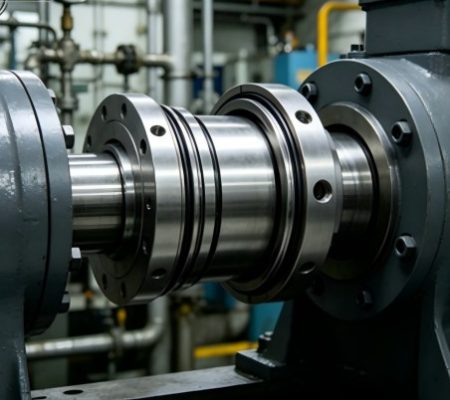
In pumps and rotating machinery, mechanical seals are a crucial sealing method, with the two most essential components being the rotating ring and the stationary ring. Through precise fitting, they achieve media sealing under extremely thin liquid film conditions.
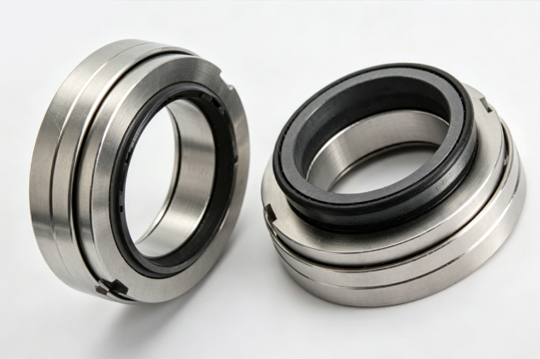
The Essential Functions of Rotating and Stationary Rings
Definition and Function of the Rotating Ring
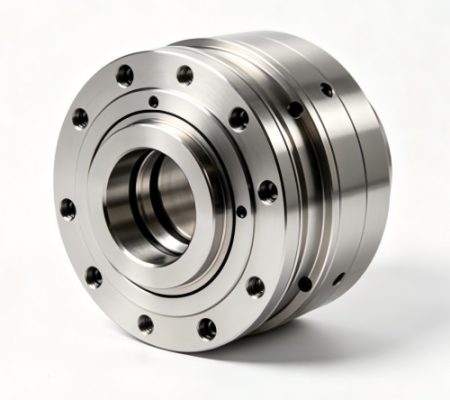
The rotating ring is the sealing element in a mechanical seal that rotates with the shaft, typically fixedly connected to the pump shaft or bushing. Its core function is to maintain a rotating state during equipment operation and continuously adhere to the end face of the stationary ring, thus forming a dynamic sealing interface. Functionally, the rotating ring is not merely a “rotating sealing surface,” but more importantly, it bears the responsibility of pressure transmission and displacement compensation. When the equipment experiences slight axial movement or vibration, the rotating ring can maintain its contact state through elastic structures (such as springs or bellows), preventing seal failure.
Definition and Function of the Stationary Ring
The stationary ring is a sealing element installed within the sealing cavity and remaining fixed and non-rotating. It is usually embedded in the sealing gland and achieves static sealing through O-rings or gaskets. The core function of the stationary ring is to provide a stable and wear-resistant sealing end face reference. It does not participate in rotation, therefore, higher hardness or more wear-resistant materials can be used to maintain its flatness over a long period, thus forming a stable friction pair with the rotating ring.
The Synergistic Relationship Between the Two
The rotating and stationary rings do not work independently, but rather constitute an “end face sealing pair.” Within an extremely small gap (micrometer level), lubrication is maintained through a liquid film, achieving a sealing state that is “neither completely in contact nor completely separated.” This state is key to the high efficiency and long lifespan of mechanical seals.
How Mechanical Seals Work?
Installation and Initial Fitting Stage:
When the equipment is stationary, the rotating and stationary rings are tightly fitted under spring force or medium pressure. At this time, there is almost no gap between them, forming the initial sealing surface. During installation, the end face cleanliness must be ensured; otherwise, even tiny particles can cause early leakage.
Start-up and Operation Stage:
After the equipment starts, the shaft drives the rotating ring to rotate at high speed. Due to centrifugal force and the presence of the lubricating medium, an extremely thin liquid film forms between the rotating and stationary rings. This liquid film is crucial for sealing; it reduces friction and prevents direct leakage of the medium.
Stable Operation Phase:
Under stable operation, the rotating and stationary rings are in a “dynamic equilibrium”:
· Spring force pushes the end faces together
· Liquid film pressure pushes the end faces into slight separation
· The two forces reach equilibrium
Ultimately, a stable micron-level gap is formed, achieving a long-term reliable seal.
Shutdown Phase:
When shutting down, the liquid film gradually disappears, and the rotating ring, under the action of the spring, re-adheres to the stationary ring, restoring the initial sealing state and preventing medium backflow or leakage.
Design Process and Material Quality
· Rotating Ring Material Selection and Performance Requirements
The rotating ring material must simultaneously meet the requirements of wear resistance, heat resistance, and a certain degree of elasticity. Common materials include carbon graphite and SiC (silicon carbide). Carbon graphite has good self-lubricating properties, which can reduce the risk of dry friction during startup; while silicon carbide is suitable for high-pressure and highly corrosive conditions. The core principle of material selection is a “hard-on-hard” or “hard-on-soft” matching relationship to reduce wear while ensuring seal stability. Improper material selection can lead to rapid ablation or crack propagation at the end face, causing leaks or even equipment shutdown.
· Stationary Ring Structural Stability Design
Although the stationary ring does not rotate, its structural stability directly determines the seal’s lifespan. The stationary ring must ensure high flatness and low roughness, generally requiring an end face roughness of Ra 0.2~0.4μm. Simultaneously, the stationary ring’s embedded structure needs good vibration resistance to prevent uneven wear caused by pump body vibration. Furthermore, the selection of the stationary ring seal is crucial, requiring a balance between temperature resistance, corrosion resistance, and elastic recovery; otherwise, stationary ring loosening or leakage channels may occur.
· Liquid Film Formation and Control Technology
The long-term stable operation of a mechanical seal depends on the stable existence of the liquid film. An excessively thick liquid film will lead to leakage, while an excessively thin film will cause dry friction damage. Therefore, it is necessary to control the liquid film thickness by optimizing the spring specific pressure, end face width, and medium pressure. Typically, the liquid film thickness is maintained between 0.1 and 1 micrometer. In high-speed equipment, the impact of thermal deformation on the liquid film must also be considered; otherwise, localized overheating can lead to liquid film rupture and seal failure.
· Control of Alignment Precision of Dynamic and Static Rings
The dynamic and stationary rings must be highly coaxial; otherwise, uneven wear will occur. During installation, shaft runout is typically required to be controlled within 0.05mm, and end-face perpendicularity error must also be strictly controlled. Poor alignment, even with high-quality materials, can cause localized high-pressure contact, leading to localized end-face burnout. Therefore, specialized tooling is required for alignment during assembly, and a no-load test run must be performed.
Frequently Asked Questions
Q: What happens when the dynamic and stationary rings are damaged?
When the dynamic or stationary rings show wear, cracks, or deformation, the most obvious symptom is increased sealing leakage, which can lead to continuous dripping or even jetting leakage in severe cases. In addition, it may be accompanied by increased equipment vibration, abnormal temperature rise, and increased operating noise. If left untreated for a long time, it can also lead to increased pump shaft wear and even affect the lifespan of the entire bearing system. Therefore, the end-face condition should be checked promptly upon initial detection of leakage.
To understand the dynamic and stationary rings more simply, a mechanical seal can be imagined as “two very smooth glass plates.” The dynamic ring is the one that rotates, while the stationary ring is the one that remains stationary. When the machine is running, these two plates are not completely pressed together; instead, an almost invisible “water film” supports them. This water film is crucial; it acts like lubricant to reduce friction and also acts as a barrier to prevent liquid leakage. Without the precise fit between the dynamic and stationary rings, this water film cannot exist stably, leading to leaks, overheating, or even damage to the equipment. It is precisely because of this structure that mechanical seals can operate stably for extended periods in high-pressure, high-speed, and complex media environments. As long as the dynamic and stationary rings maintain a good fit, the equipment can achieve low leakage, low wear, and high efficiency operation, which is a major reason why mechanical seals are widely used in modern industrial pump systems.