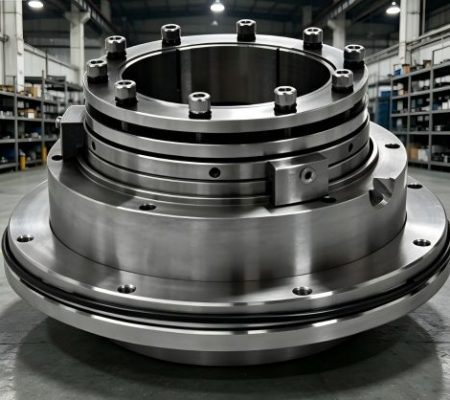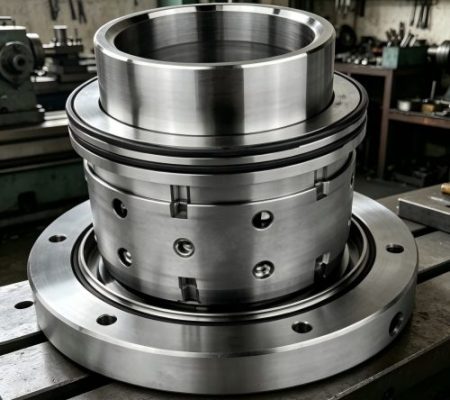
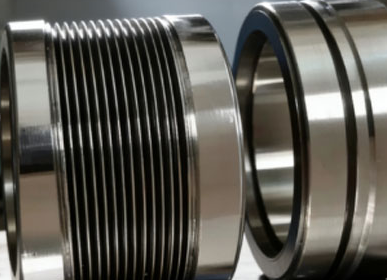
In modern fluid equipment, sealing technology has evolved from traditional packing and ordinary mechanical seals towards higher stability, longer lifespan, and lower maintenance costs. Single-ended bellows mechanical seals, as a widely used type of structure, exhibit significant advantages in many operating conditions due to their characteristics such as ‘no spring corrosion,’ ‘automatic wear compensation,’ ‘good axial flexibility,’ and ‘more uniform stress on the end face.’

Compared to conventional spring-type seals, the value of single-ended bellows seals lies not in their greater ‘complexity,’ but in their ability to maintain reliable sealing in harsh environments, unaffected by factors such as spring blockage, corrosion, and jamming. As the complexity of media increases, equipment speed accelerates, and sealing cavity pressure rises, the limitations of traditional structures become apparent. Single-ended bellows seals, with their compact structure, precise compensation, and superior temperature and corrosion resistance, are gradually becoming the preferred solution in many applications.
Whether in chemical production, power generation, solvent pumps, high-temperature hot oil pumps, or various corrosive media conveying equipment, single-end bellows seals are indispensable in any operating environment that demands high reliability, sealing performance, and long-term stable operation. They are not only widely applicable, but more importantly, they effectively improve the overall stability of equipment and reduce unexpected downtime, offering significant value to the purchaser.
Suitable for Corrosive Media
The single-end bellows seal integrates the spring function into the metal bellows, eliminating the exposed spring structure. Therefore, it is ideal for:
Strong acids and alkalis
Corrosive solvents
Media with high salt and chloride ion content. Without an exposed spring, there is no risk of corrosion, jamming, or failure, significantly reducing the risk of leakage.
Suitable for High-Temperature Conditions
Belled pipe materials are typically made of stainless steel, Hastelloy, Inconel, etc., possessing excellent temperature resistance and suitable for:
Hot oil systems
High-temperature steam
High-temperature solvents
High-temperature hot water
Conditions with a significant tendency to coke
At high temperatures, springs lose elasticity or become stuck due to impurities, while the bellows structure maintains stable compensation force, ensuring reliable end-face contact.
Particulate or clog-prone environment
The single-end bellows-sealed compensation structure is entirely sealed, preventing external particles from entering the spring cavity. Therefore, it is particularly suitable for:
Media containing small solid particles
Media prone to crystallization and polymerization
Cleaning agents, slurry-like media
The bellows structure reduces the problem of compensation failure caused by jamming and clogging, helping to stabilize end-face pressure.
Vacuum or low pressure system
In low-pressure or even negative-pressure systems, traditional spring seals may suffer from insufficient pressure, leading to inadequate sealing force. Bellows, with their low stiffness and stable compensation force, are more suitable for:
Vacuum pumps
Vacuum distillation systems
Distillation column bottom circulation pumps
Solvent transfer pumps under low-pressure conditions.
They maintain good sealing force, reducing end-face vibration and gas leakage.
Axially bouncing equipment
Single-end bellows inherently possess axial flexibility, automatically compensating for a certain range of:
Axial movement
Axial thermal expansion
Partial installation deviations. For systems with low machine precision or significant axial thermal expansion, bellows seals can reduce the impact of deviations on the end face.
Devices with limited installation space
The bellows structure integrates compensation devices and has a shorter overall length than the spring structure, making it suitable for:
Compact equipment
Retrofit projects (no need to lengthen the cavity)
Small pumps, horizontal pumps, vertical pumps
In many projects requiring ‘short axial distance’ or where ‘cavity structure cannot be modified,’ the single-end bellows seal is the most convenient alternative.
Lower maintenance costs
The long-term value of the single-end bellows seal lies in:
Simple structure, fewer maintenance points
Less prone to jamming, not dependent on high filtration accuracy
More stable lifespan, adaptable to fluctuating operating conditions
For users seeking long-term operation, it significantly reduces maintenance frequency and spare parts costs.
The widespread adoption of the single-end bellows seal is not because it is ‘more advanced,’ but because it is more reliable than traditional sealing structures in many critical operating conditions. It maintains stable end-face contact force in corrosive, particulate, high-temperature, vacuum, easily clogged, and high-compensation-requirement conditions, unaffected by spring corrosion, jamming, thermal decay, etc. For the purchaser, this translates to lower downtime risk, higher system stability, and more controllable operating costs.
Single-end bellows seals are often used in applications with common characteristics: complex media, harsh environments, and equipment requiring long-term operation. Leakage can result in significant economic or safety consequences. Therefore, these seals act as ‘reliability insurance,’ playing a crucial role in mitigating risk in engineering projects. Whether used in chemical pumps, vacuum systems, hot oil pumps, solvent pumps, or high-temperature equipment, single-end bellows seals provide a suitable, stable, and long-term reliable solution whenever higher safety and sealing reliability are required.