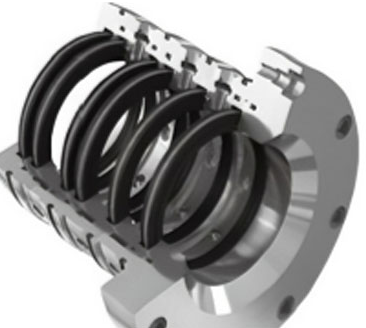
Among all industrial equipment, aero-engines are among the systems with the highest and most demanding sealing requirements. Their core components operate in environments with high temperatures, high speeds, high pressure differentials, high vibrations, and high cleanliness requirements. Even the smallest leak can affect thrust, efficiency, and even flight safety. While traditional mechanical seals, bellows seals, or lip seals perform excellently in industrial pumps and compressors, they struggle to simultaneously meet the requirements for temperature resistance, lifespan, friction, weight, and reliability under the extreme conditions of aero-engines.

Therefore, the most commonly used seals in aero-engine shaft sealing systems are not the common mechanical seals, but rather Carbon Seal/Carbon Ring Seal, Labyrinth Seal, and, in some cases, Brush Seal. Carbon ring seals, in particular, have long been the preferred choice for aero-engine manufacturers due to their lightweight, high-temperature resistance, low coefficient of friction, excellent self-lubricating properties, and ability to maintain a stable seal at high speeds.Carbon ring seals are not simply “cheaper” or “simpler,” but rather the optimal compromise for aero-engines under extreme operating conditions. It maintains controllable wear and stable sealing even under high temperature and high speed conditions, a feat difficult to achieve with any traditional mechanical seal. Therefore, understanding the advantages of carbon ring seals can help the mechanical seal industry absorb more advanced ideas.
Suitable for High-Temperature Environments
The core area of an aero-engine can exceed 1000°C, and even the area around the shaft seal often exceeds several hundred degrees Celsius.
Carbon ring seals, due to their material properties, possess:
High-Temperature Stability
No thermal cracking or deformation of the sealing face as seen in traditional seals
Controllable thermal expansion due to temperature rise
Mechanical seals face problems such as end-face burnout, spring annealing, and material creep in such high-temperature environments, while carbon graphite can withstand these extreme conditions.
Allows for Self-Lubricating Wear
The oil passages inside aero-engines are thin, and oil supply fluctuates frequently, sometimes even experiencing momentary oil shortages.
The graphite material in carbon ring seals possesses: natural self-lubricating properties; resistance to ablation even with a thin or instantaneous liquid film; and operation through controlled wear.
Mechanical seals, on the other hand, rely on a stable liquid film, which quickly burns out upon film breakage. Carbon ring seals minimize this risk through self-lubrication.
Meeting the Requirements of High-Speed Rotors
Aero-engines often operate at speeds of 10,000–30,000 rpm or even higher, demanding extremely high stability from the sealing face.
Carbon ring seals can withstand high speeds due to:
light weight and low centrifugal force; uniform stress on the face and stable fit; and low frictional heat, reducing the risk of thermal damage. In contrast, mechanical seals may experience face vibration, liquid film disruption, and excessive centrifugal force at high speeds.
Simple and Reliable Structure
For aero-engines, a simpler structure and less reliance on external systems result in higher reliability.
Carbon ring seals offer the following advantages:
No exposed springs
No complex compensation mechanisms
Controllable wear and predictable lifespan
Lightweight structure
This simplified structure is designed to adapt to the high-vibration, high-acceleration aerospace environment, with minimizing potential failure points as the core principle.
Suitable for High Pressure Differential Environments
Aero-engine shaft seals exhibit significant pressure differentials, such as:
High-pressure oil chambers
Pressure gradients between the air compression section and the combustion zone. Carbon ring seals possess excellent end-face adaptability and internal pressure compensation capabilities, maintaining stable contact under pressure differential fluctuations. Traditional mechanical seals, under high pressure differentials, suffer from uneven end-face stress, leading to rapid wear or leakage.
Commonly Used in Combination with Labyrinth Seals and Brush Seals
Aero-engine shaft seal systems do not use a “single seal”; they typically employ multi-stage combinations:
Labyrinth seals: Used for primary gas throttling;
Carbon ring seals: Used at critical locations for oil-gas separation;
Brush seals: Used to further reduce leakage and improve sealing efficiency.
Carbon ring seals are often the “last reliable seal,” ensuring more stable and controllable oil-gas isolation.
Aero engines don’t operate without mechanical seals; rather, their required sealing performance exceeds the physical limits of traditional mechanical seals. High speeds, ultra-high temperatures, enormous pressure differentials, vibration, lightweight requirements, controllable wear, and self-lubricating properties—these stringent conditions collectively dictate that carbon ring seals are the most reasonable solution. Carbon ring seals not only withstand harsh operating conditions but also maintain predictable wear, simplify maintenance logic, and improve overall life-cycle reliability—precisely the most important indicators for aerospace equipment.
As aircraft continue to demand higher fuel efficiency, thrust, and safety, the combination of labyrinth seals, carbon ring seals, and brush seals will remain the core sealing architecture for mainstream aero engines. Carbon ring seals are not a “simple structure” but rather a systematic achievement resulting from the combined efforts of materials science, thermal management, fluid mechanics, and reliability engineering.