In industrial equipment operation and management, ‘zero leakage’ is almost the ideal expectation of all users for mechanical seals. Whether it’s hazardous media in chemical plants or critical process fluids in energy and environmental protection fields, leakage means increased safety risks, environmental pressure, and maintenance costs. Therefore, mechanical seals are often given an almost absolute goal—to completely seal off the medium and achieve completely leak-free operation. However, in actual engineering, many devices, even those using high-grade mechanical seals, still experience invisible leaks, minor releases during initial operation, or brief leaks under fluctuating operating conditions. This phenomenon often raises the question: Do mechanical seals truly possess the capability of ‘zero leakage’? Is the so-called zero leakage a technological limit or a misconception?
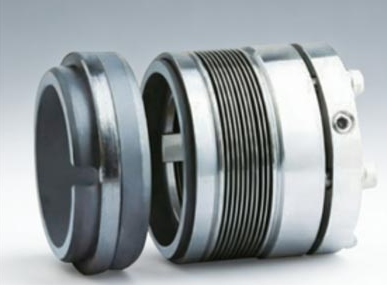
Mechanical seals are not completely ‘static seals’
The core of a mechanical seal lies in the fit between the dynamic and static ring end faces, achieving a balance between sealing and lubrication through an extremely thin liquid or gas film. This structure is essentially a ‘dynamic seal,’ rather than a static seal that relies entirely on material deformation to achieve blockage. Under normal operating conditions, a lubricating film at the nanometer or even micrometer scale typically exists between the end faces. This lubricating film is crucial for reducing friction, controlling temperature rise, and extending lifespan, but it also means that the medium is not completely isolated in a physical sense. Therefore, in principle, mechanical seals aim for ‘controlled leakage’ rather than absolute leak-free operation. An end face state with no medium passing through can actually lead to dry friction, rapid wear, or even instantaneous failure.
Leakage is an objectively existing continuous process
Even with extremely high end face machining precision, roughness peaks and valleys still exist at the microscopic level. When the dynamic and static rings come into contact under pressure and elastic elements, the medium will migrate along these microscopic channels on a very small scale. This migration is typically: extremely small in magnitude, invisible to the naked eye; fluctuates with changes in operating conditions; and is considered acceptable in engineering. Therefore, the so-called ‘zero leakage’ is more of a macroscopic perception or management goal than a strictly physical state.
‘Zero leakage’ is not an absolute concept
In engineering practice, ‘zero leakage’ often has clear technical boundaries. It typically refers to: no visible liquid dripping externally; no obvious odor or environmental pollution; and leakage below the allowable value specified in the code or standard. In other words, ‘zero leakage’ is more of an engineering definition than a mathematically absolute zero value. As long as leakage is controlled within safe, environmentally friendly, and process-permissible ranges, it can be considered an achieved goal.
Operating Condition Fluctuations Make Leakage Inevitable
The operating environment of mechanical seals is often not constant. Start-up, shutdown, sudden pressure changes, temperature fluctuations, and changes in the phase of the medium all affect the end face condition. During these non-steady-state phases, the end face may temporarily deviate from the optimal fit, leading to a slight increase in leakage. This phenomenon does not necessarily indicate seal failure, but is a natural result of changes in operating conditions. Therefore, requiring mechanical seals to remain absolutely leak-free at all stages and under all operating conditions is inherently unrealistic in engineering.
Sealing Effectiveness Depends on Overall Conditions
Mechanical seals are not independent components; their performance is highly dependent on: the stability of the equipment shaft system; installation accuracy and cleanliness; the reliability of flushing, cooling, or isolation systems; and the level of operation and maintenance. Under ideal system conditions, mechanical seals can maintain near-zero leakage operation for extended periods; however, under unfavorable system conditions, even with a intact seal, achieving the desired effect is difficult.
Controllability is More Important than ‘Absolute’
With increasingly stringent safety and environmental requirements, engineering focus has shifted from ‘whether leakage exists’ to ‘whether leakage is controllable.’ Through double-end sealing, isolation fluid systems, and online monitoring, leakage risks can be controlled to extremely low levels, achieving ‘zero external discharge’ in an engineering sense. This approach is more realistic and reliable than pursuing theoretically absolute zero leakage.
Mechanical seals are difficult to achieve absolutely zero leakage in a strictly physical sense because their working mechanism relies on the presence of a microscopic lubricating film. However, this does not mean that mechanical seals cannot meet the engineering goal of ‘zero leakage.’ As long as leakage is controlled within a range that is invisible, imperceptible, and does not pose a safety or environmental risk, a successful seal in an engineering sense has been achieved. What truly matters is not the existence of trace media migration, but whether the leakage is stable, predictable, and manageable. With proper selection, standardized installation, stable operation, and improved auxiliary systems, mechanical seals can maintain extremely low leakage levels for extended periods. Therefore, instead of focusing on whether a mechanical seal can achieve absolute zero leakage, it’s more effective to concentrate on system optimization and risk control. In real-world industrial environments, stable, controllable, and sustainable sealing performance is the true measure of a mechanical seal’s value.