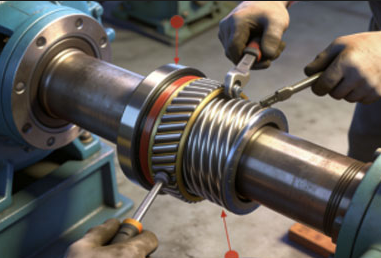
Bellows are a highly valuable structural component in the design of many chemical, pressure pipelines, high-temperature steam, vacuum systems, and mechanical seal cavities. They possess advantages such as displacement compensation, high-temperature and corrosion resistance, and a frictionless structure, playing a crucial sealing role in demanding operating conditions. However, the bellows itself is not an independent sealing device; its real challenge lies in the ‘connection points’—the sealing interfaces between the bellows and end faces, flanges, shells, welds, and moving/stationary components. Improper design, manufacturing, or installation of these connection interfaces often lead to leaks more easily than the bellows itself.bellows undergo axial compensation, thermal expansion and contraction, pressure pulsation, mechanical vibration, and cyclic loads during operation. This means that the connection points must not only be sealed but also possess sufficient structural flexibility and fatigue life. In practical engineering, users often encounter problems such as weld leaks, flange deformation, insufficient compensation leading to scoring, and excessive assembly stress causing microcracks.
Choosing the Right Structural Form
Different connection methods correspond to different risk points; therefore, structural selection must be based on operating conditions:
Welded Connection: Suitable for high-temperature, high-pressure, and vacuum systems, offering the most stable sealing performance, but requiring extremely high welding quality.
Flanged Connection: Easy to assemble and disassemble, but requires higher standards for flange flatness, gasket material, and preload control.
Mechanical Clamping Connection: Commonly used in low-pressure and low-temperature systems, relying on gaskets and clamping structures for sealing.
Selection must consider the corrosiveness of the medium, pressure, temperature, displacement compensation requirements, and on-site maintenance capabilities to avoid inherent leakage risks caused by ‘structure mismatch with operating conditions.’
Weld Quality Control
The welds between bellows and end fittings are high-risk areas for leakage and a key focus of quality control:
Low-heat-input processes such as argon arc welding and plasma welding must be used to reduce heat-affected zone embrittlement.
Ensure full weld bead coverage, free of porosity, undercut, and incomplete fusion.
Post-weld testing requires hydrostatic pressure, airtightness, penetration testing, or helium mass spectrometry to ensure no micro-leakage.
For chemical or high-pressure systems, post-weld heat treatment (PWHT) is often necessary to improve metal toughness and resistance to stress corrosion.
Selection of Sealing Auxiliary Materials
In flanges or clamping structures, the choice of auxiliary materials directly affects sealing performance:
High-temperature steam systems: Spiral wound metal gaskets and flexible graphite gaskets are more reliable.
Corrosive media: PTFE gaskets or modified PTFE gaskets offer better chemical resistance.
Vacuum systems: Choose metal or graphite gaskets with low gas release.
Auxiliary materials must not only be resistant to the media but also ensure they do not fail, cold flow, or fatigue under pressure cycling.
Pre-tightening Force Management
The sealing performance of bellows connections highly depends on the uniformity and controllability of the tightening force:
Insufficient pre-tightening force → Gaskets cannot form an effective sealing surface, resulting in micro-leakage.
Excessive pre-tightening force → Gaskets are crushed, flanges deform, and bellows are damaged.
In engineering practice, it is essential to:
Use a diagonal, step-by-step, uniform tightening method.
Record and maintain consistent torque.
Avoid uneven stress caused by on-site misoperation.
In some cases, a torque wrench or hydraulic tensioner is required to ensure reliable pre-tightening force.
Compensation Capability
The compensation capacity of bellows is limited. Excessive installation deviation will cause the bellows to operate in an undesigned position:
Excessive axial tension: Fatigue in thin-walled metals, weld cracking.
Lateral offset: Uneven stress on the corrugations, drastically reduced lifespan.
Torque effect: Local deformation of the bellows, leading to micro-leakage.
Before installation, ensure proper alignment, adequate pre-compensation, and a reasonable support structure to avoid subjecting the bellows to undue external forces.
Media Impact Assessment
Bellpipe materials (304/316L, Inconel, Monel, Hastelloy, etc.) are all sensitive to the media: Corrosive media can cause pitting or stress corrosion cracking in bellpipes; high temperatures can reduce the fatigue life and yield strength of the metal.
Therefore, it is essential to select appropriate materials based on the media and temperature profiles, including alloy materials, thickened corrugations, anti-corrosion linings, and control of stress concentration points, to ensure long-term stability of the sealing interface.
The sealing performance of bellpipe connections cannot be guaranteed by a single design point. It is the result of the combined effects of various engineering factors, including structural matching, weld quality, auxiliary material selection, preload control, displacement management, and media compatibility. Essentially, the reason bellpipes can maintain sealing performance under harsh operating conditions is because their thin-walled metal structure provides flexibility, and all sealing points, weld points, and connection surfaces must maintain reliable static sealing performance under this flexibility.